Two days ago, I flew home from a week-long business trip to Belgium. Today, it’s 2:00 AM, and I’m wide awake listening to a thunderstorm pass by and eating a piece of chocolate I purchased while on the other side of the Atlantic. Jet Lag sucks!
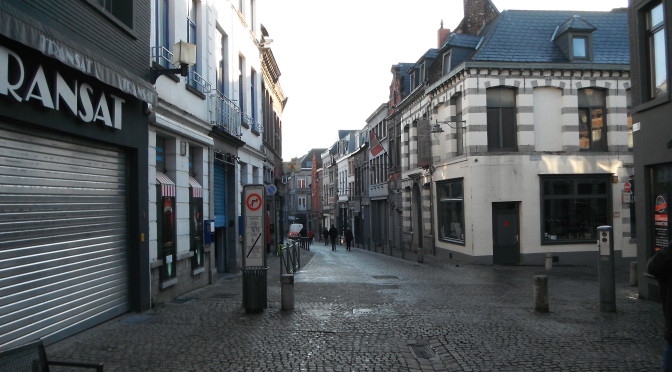
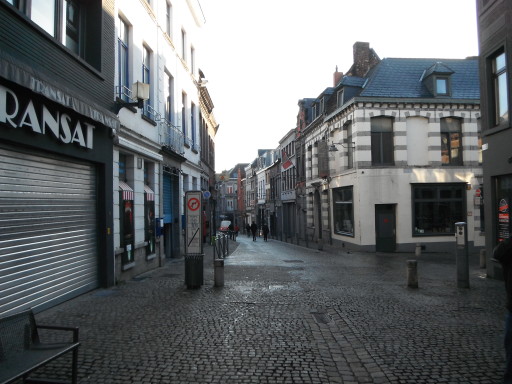
While I was in Belgium to work, we did have a few opportunities to see the sights, including on the 30 minute drive from where we were staying out in the country to where the meetings were being held . The Belgian countryside is beautiful. Even though it was February and below freezing most of the time, the grass was thick and green — unlike here where the grass all dies and turns brown at the first frost. The towns we drove through all were charming little hamlets with cobblestone streets, narrow roads, and plenty of of personality.
The streets of Mons, Belgium about 10:00 Friday Morning
Dining was a challenge on this trip. Just about every place that served food closed between 2:00 and 6:30 or so, only seated a handful of people, and expected/required that you essentially spend the whole evening there since it would take at least an hour to get your food, and they wouldn’t come by with the check until you had digested your food for another hour. Over-all, I was under-impressed with the much renowned fine dining. It might have been better if it had been less expensive and I had spoken French. Since most of the waiters didn’t speak any more English than I did French, we ended up playing menu roulette. A few of the results were quite disappointing.
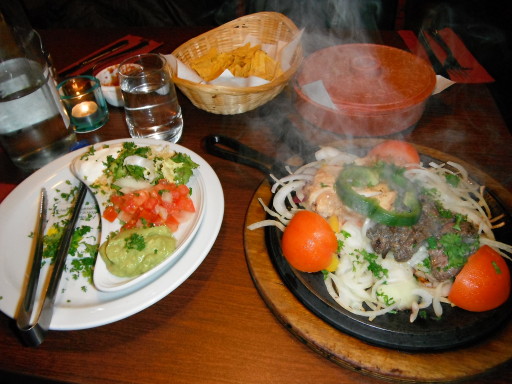
Among the stranger things we did was stop at a “Tex-Mex” restaurant that was on the road to Mons (the nearest “town” of any sort). I will admit it was more out of morbid curiosity than any real desire to eat the food. These low expectations proved to be a good thing. Had I gone there expecting good food or Texas-style service, I would have been sadly disappointed. In appearances, the food nominally looked at least something like it should, but that is where the semblance ended. The chips were stale, salsa more like ketchup than anything you’d find here in Texas, the guacamole probably had more food coloring than avocado, the cheese wasn’t even close to the right kind, the meat was from the wrong cut, there was only a small pile fancy curly greens instead of lettuce, there were about a million onions with just one or two slices of bell pepper (completely raw), British-style fried tomatoes for “garnish”, and to top it all off, whatever they used to season it, it wasn’t even close to anything you’d find near the US-Mexico border. The sour cream was about the only part of the meal that tasted like what I get here at home.
“Fajitas” at a Belgian Tex-Mex restaurant. My travelling companion and I decided we would have to host the next round of meetings to teach them what real Tex-Mex tastes like.
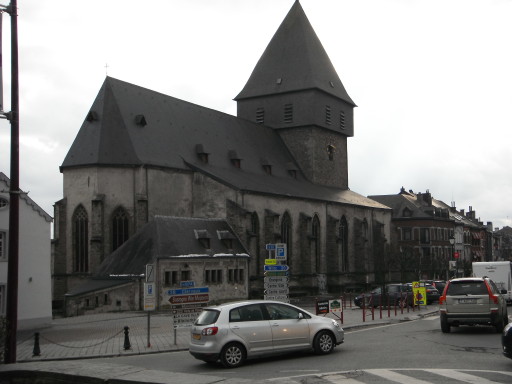
Other than the scenery along the commute, we didn’t have much time programmed in for sight-seeing, but fortunately, we were able to wrap up the meetings a day early and spend Friday sight-seeing. My traveling companion and I decided we’d spend it looking at downtown Mons and driving down through the Ardennes to Bastogne. After hitting a few museums and wandering the market district, we came to the conclusion that we’d need a few more days to see what there was in that town. It was rather neat, and my favorite part of the whole trip.
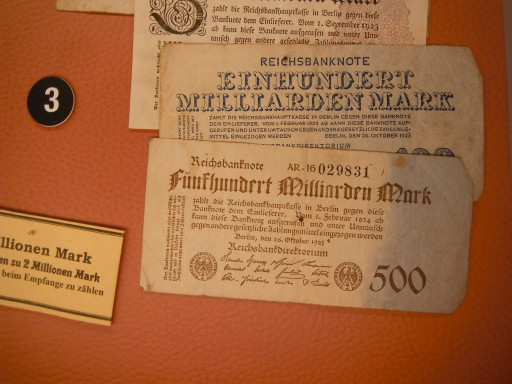
The cathedral at Bastogne. The national museum for the Battle of Bastogne (part of the Battle of the Bulge) is across the street behind where I was standing to take this picture.One of my favorite displays from the museum. For those who don’t speak German, the banknotes visible are DM 100,000,000,000.00, and DM 500,000,000,000.00. How’s that for inflation…
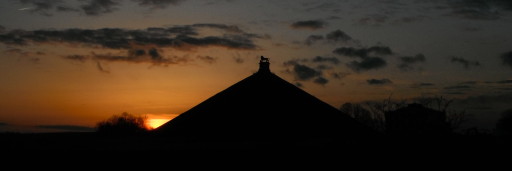
The last thing we did before heading back to Brussels for the flight home the next morning was to drive by Waterloo. By the time we got there, the museums were closing so all we could do was look at the “Lion’s Mound” built by the Belgians to commemorate the battle that took place there. I’d like to go back and spend more time there at some point.
The Lion’s Mound at sunset. The mound was built by hand using earth dug up from the revetments and other earthworks. The figure atop the mound is a huge bronze-cast lion.
As with any of my stories based in reality, it is true and accurate only to the extent that my memory is correct. This is an account of things as I remember them.
Vica Nationals
When I was in High School, I had a rather patient, kind, and understanding electronics teacher named Ralph Dammann who went out of his way to give me opportunities to explore that subject and “color outside the lines” that conventional educational programs draw. He allowed me to skip other classes to work on projects, supported me as I cooked up various new things, and was generally an excellent mentor and facilitator. Under his watchful eye, I worked on a wide variety of projects that ranged from assembling kits that made lights sequence or goofy buzzing noises to designing and building custom circuit boards and electronic “toys” that did fun things like jam television signals, shock unsuspecting victims, trigger an alarm if a sink flooded, and other things like that.
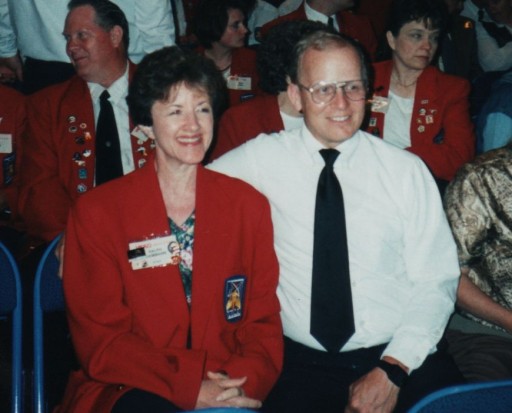
Mr Dammann and his beautiful bride at the VICA Nationals closing ceremonies. I owe that man more than he can ever know.
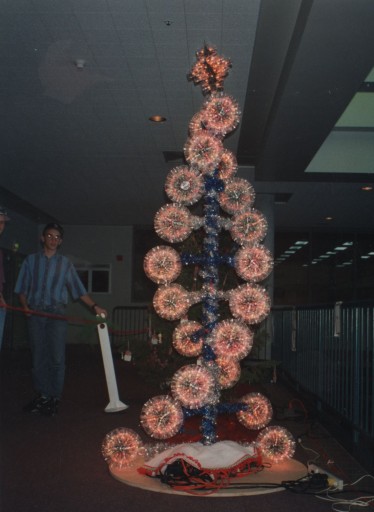
As an example of the kind of things I ended up dong, my school had an annual Christmas tree decorating contest. The wood-shop and electronics teachers decided they were tired of letting the home-economics classes have all the glory and recruited a few of us to “decorate” a tree that would stand out in a crowd. We decided to build a “tree” out of a helical spiraling tower of lights and set them up on a sequencer to run in various patterns. The wood-shop built the frame, a bunch of us built the light balls (Christmas lights stuck through the back of small plastic cups, and the cups glued together to form balls), and I designed and built the sequencer.
Me standing next to the first “Christmas Tree” the shop-classes built. I built the sequencer that would flash the light-balls in a variety of patterns.
We won the voting hands-down. In fact, after two years of wiping out the competition, the rules were changed to require a real tree. As a result, my brother and his cohorts were forced to integrate a small Charley Brown style tree into the display they built. In the end, modified rules only made people more creative and the shop classes still won…
As a result of Mr Dammann’s efforts, I became rather adept at working with electronics and was invited to participate in an annual state-wide electronics competition sponsored by the Vocational Industrial Clubs of America (VICA) my Junior year in High School. With no idea what I was doing, I entered the competition and won the state championship. I was off to the national competition in Kansas City. I was pretty sure I wouldn’t win, but the prospect of flying on a plane for the first time and having the opportunity to experience a bunch of other new things made the trip quite a pleasure.
While I didn’t place the first year, I won State the next and returned to Kansas City the summer after I graduated. Our class also decided to enter a display competition with something as unconventional as our flashing Christmas tree, so a team of us got together to see what we could do. We decided to put a custom-built clock up on a pedestal over a table that would act as the display surface. We hung a pendulum with a magnet in the base of it under the clock, embedded magnets in the display surface to make the pendulum swing in a rather random motion, and I built a custom “exciter” that would put out a strong magnetic pulse when the pendulum swung over the center of the display to keep it going.
The graphics shop printed the logos and other display materials, we recruited someone to sew the skirts together, the wood-shop built the clock cabinet and the display structure, and I took the lead developing the electronics to make it all work. For the clock, Mr Dammann and I decided to build something unconventional by essentially integrating three light sequencers with a disciplined clock… one for the seconds, one for minutes, and one for hours. The graphics shop printed a pattern on the surface of a sheet of plastic and I drilled out the holes, inserted the LEDs, and wired it all together with the custom circuit board that ran the thing. Just for effect, we put a red light bulb in the clock cabinet just to add that special touch.
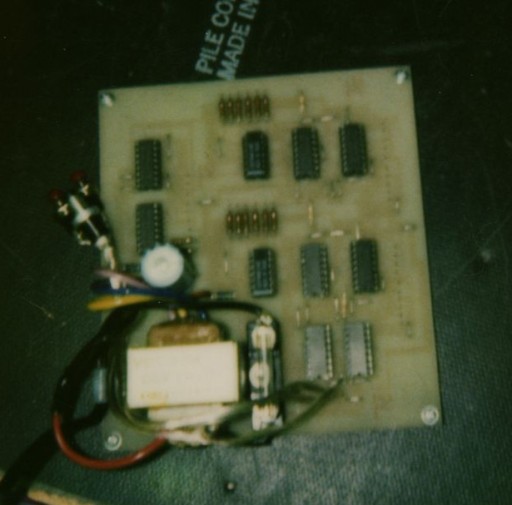
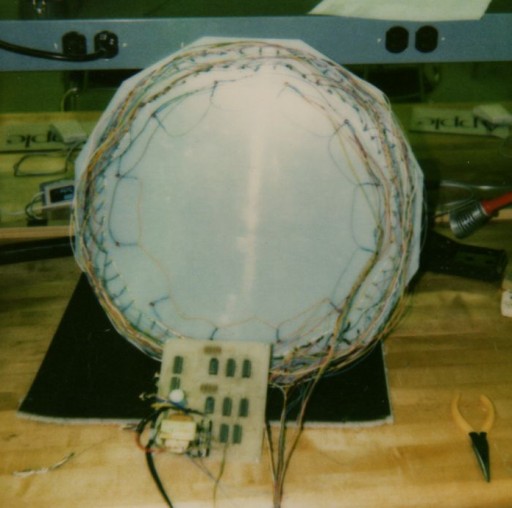
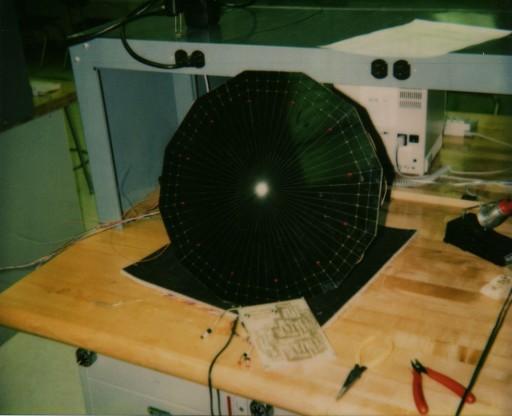
The control board for the clock. It consists of a clock-generation section and three multiplexed counters that would recycle after twelve or sixty counts.The Completed electronics for the clock. The whole thing was designed from the ground up using basic cad tools to draw out both the schematic and the circuit board.There are 132 lights set into the face of the clock. The inner ring shows the hour, middle ring the minute, and outer ring ticks off the seconds.
One of the funnier aspects of the clock was the reaction I got when we tried to pack it up and take it on the plane with us. We were concerned it might get broken if we checked it in baggage or shipped it with the rest of the display, so we opted to bring it as a piece of carry-on luggage. You should have seen the face of the security screener when he saw a box full of wires and circuit boards go through the x-ray machine. They made me take the back off of it and show them there were no explosives inside it and show them how it worked before they would let me through. That was before 9/11 when you could still bring pocket knives on a plane. I doubt they’d let me take that thing on a plane today.
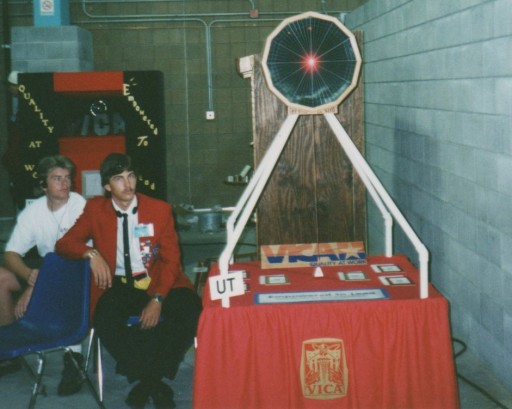
Jason and Tyler (who’s last names I forget) watching over the display in the Kansas City convention center. I built the electronics, others built everything else.
While we didn’t win anything for the display, the clock design was the coolest and most complex thing I’d done in the shop. Years later, I reached out to Mr Dammann to see how he was doing and let him know how much I appreciated what he had done for me, only to find out that several years after he retired he had hunted down that clock and acquired it from the school. He has it hanging in his house to this day.
In addition to the display team and me, we had another team from our school that had won the state competition. This team happened to include a bunch of girls, most of which I had dated at one point or another. Being stupid teenage boys, a few of us thought it would be fun to harass them in an unconventional way. One of the more popular projects to build in the electronics shop was what we call the “annoyatron” – a little box that was easily hidden and would emit a high-pitched scream periodically. We decided it would be fun to modify one with a light-sensor so that it would only turn on when the lights went out and hide it in the girl’s hotel room. I honestly don’t remember how we managed, but we were successful at placing it. About two thirty the next morning, Mr Dammann knocked on our door to tell us he didn’t care who did it (I’m sure he knew) but that we needed to go get it and turn it off so the girls could get some sleep. The girls got even the next day by filling our room with silly string and stuff like that. They took our prank in the right spirit, and everyone had a good time in the end.
I had more luck with my competition. I felt I had done pretty well, but didn’t expect to place in the top three. However, when they announced the winners, I came out second place. I was ecstatic. Aside from the accolades, I was awarded with a range of stuff donated by various companies that included a Snap-On tool kit, Kenwood oscilloscope, and a digital multimeter that would ultimately pay my way through college while I used them to fix televisions, radios, computers, monitors, and anything else that would pay. I still have and regularly use those three items over 20 years after the fact.
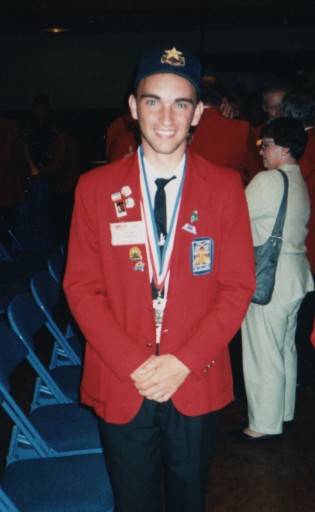
Me, the night of the awards ceremony. I think I smiled almost continuously until after the plane landed that brought me home.
Middle of nowhere, not a soul is in sight,
I'm alone far from help in a terrible fright,
Marooned yesterday and all through the night.
Weakened and failing, dealt a heavy hard blow,
Then a thumping and rumbling rattling low,
Creeps through the quiet and steadily grows.

Now the feet of a giant appear overhead,
With a deafening roar beating down latent dread,
Tells me help is at hand, and safety ahead.
The jolly green giant called out to assist,
Searching the morn' that frost's icy lips kissed,
Pararescueman watching ensures nothing's missed.

He sees me and motions to show me he knows,
Then out of the doorway he rapidly goes,
Down a cable to meet me while rotor-wash blows.
A rapid assessment - thinks I'm stable and then,
He straps me in harness and upwards I spin,
While twisting in air I am pulled safely in.

Just a minute, no more, and my rescuer's back,
From a hover we drop to a zig-zagging track,
Dodging through treetops to avoid an attack.
Back to safety and comfort and a happier time,
Relieved and or'whelmed I wipe tears from my eye,
So grateful for giants that fly through the sky.
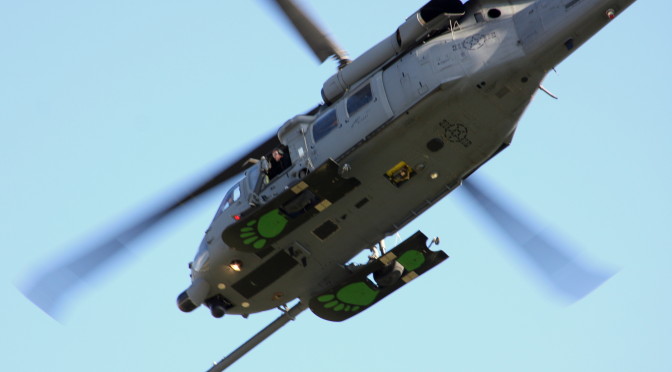
In case there are any experts out there who want to critique this picture… it isn’t of a rescue operation. The helicopter is from the 210RQS from the Alaska Air National Guard. It is a rescue craft and crew, however in this case it was rigged up to carry a sling-load of batteries and other equipment to a remote instrumentation site in the Alaskan bush – hence no guns on the mount and the exposed cargo hook. Thankfully, I never ended up in a situation where the helicopter had to fight it’s way in.
I was on a flight home recently after an involuntary extension of a business trip, and happened to be seated next to an aspiring author who felt like striking up a conversation. As we talked, he talked about how he had begun writing to deal with the loss of his mother. That revelation led us down a series of wandering paths, along which it came out that I also write as a form of self prescribed therapy. He asked if I had published anything, and seemed shocked when I told him no (other than scholarly/profesional journals) and that I wasn’t sure I ever would. He seemed surprised and confused. While he agreed that he wrote mostly for himself, keeping the result to ones self seemed inconceivable. Why in the world wouldn’t I try to earn money off of the result. His reaction got me thinking, leading me to analyze why I feel the way I do. The analysis is still incomplete, and probably will remain so, but I have come to some preliminary results that are adequate for my purposes.
I suppose there is a fairly big part of me that dreads rejection. What I write is meaningful for me, and I don’t want to be in a position where I am confronted with the reality that paints my work as a picture of futility, triteness, or inadequacy. I am content with the knowledge that I have captured something of myself, and don’t need the approbation of others. However, once exposed and rejected, that withheld acceptance stings in a way that it would’t have had I not gone looking for it in the first place. In seeking for public praise, I risk losing the satisfaction and joy I would otherwise find.
While I don’t like the prospect of rejection, that kind of pain is something I have dealt with successfully many times, and would willingly face again if I felt it was worth it. So the question turns to one of determining the cost-benefit relationship and weighing the result. To satisfy the engineer in me, I would normally want to evaluate every aspect and understand the failure modes, associated probabilities, costs, alternatives, and system impacts. This desire to tear apart and analyze the situation is unhealthy in many cases since it often leads to paralysis. However, my nature has been moderated by a life that generally forces me to work with something less than an 80% solution. Given the limited time and energy I am willing to dedicate to this pursuit, I think I’ll settle for 30% in this case and hope reality looks something like what I come up with.
The first question that comes to my mind is whether or not anyone who doesn’t have a personal interest in me would find my babblings and musings worth reading. Without an interested market no product can be profitable. This applies to publications just as much as it does to any other product. Unfortunately, I have no clear idea of market dynamics in this segment, and hesitate to even look hard for someone who might have a better read on the situation because doing so risks rejection and unfavorable or nonproductive feedback. Furthermore, marketing myself makes me feel dirty and false while severely grating on me. As an illustrative example, it makes me uncomfortable when my boss plays up my academic credentials in the small environment that is my professional circle. I generally feel that if you need to know that information to take me seriously, you are to shallow for me to waste my time on. However, this kind of self promotion is absolutely required in order to have any hope of success breaking into the publishing world. That kind of self promotion really bothers me.
The costs of self promotion are high, but high costs can be justified by good odds of a high payout. Unfortunately, I don’t believe the odds are particularly good that I could reap a reasonable payout. Very few aspiring authors, even excellent ones, ever make much return on their investment. Even if there were sufficient demand for the type of product I might produce, I have no reason to believe the material I could produce would be competitive. What feedback I receive comes from rather biased evaluators and is limited in scope. To my knowledge, nobody reads what I write with an eye to evaluating its commercial potential. Without credible feedback indicating my assessment of the odds is demonstrably false, I have no reason to believe there is a market adequate to make it worth my time and energy.
Next on the question list is whether or not seeking publication would still satisfy the needs that drive me to write in the first place. I don’t write to please others. I write to please myself, and I question whether I could maintain that perspective if I were to focus on publication. I imagine it would be like golf… I like the game, but would hate it if I had to do it for a living when the pressure of getting it “right” would disallow the hearty laugh that comes with a slice that takes the ball to the neighboring fairway. I question whether pursuing writing would take the joy out of it all. If I take the pleasure of of it I will have nothing worth writing, and in one fail swoop I would have robbed myself of both my dignity in becoming a shameless self promoter, and an element of happiness in ruining one of the few things I can find the time and energy to do strictly to please myself.
Would I like to make money publishing poetry, essays, commentary, and stories? Yes, but I doubt I have what it takes, either from a product standpoint, or from a personal investment in the cutthroat tactics and power plays required to push a good product to market. I am generally happy with what and why I write, and taking steps to make it more than a form of self prescribed therapy would jeopardize that – without a high likelihood of a substantial return on investment. So… After thinking it through, again, I come back to where I started. I don’t plan to look for publication. The three or so people who ever peruse this blog can enjoy it with the added pleasure of knowing they are part of a rather small and exclusive club of initiates. And if you happen to get a chance to read the novel (if I ever decide to finish it) and other short stories I don’t post here, you are in an even smaller and more exclusive club unless something intervenes and changes my mind about publishing.
As with any of my stories based in reality, it is true and accurate only to the extent that my memory is correct. This is an account of things as I remember them.
Spring Break
Many years ago I felt a strong desire to break free of school and work in order to spend some time tooling around Southern Utah. I had time off, a small pickup truck, and enough money to pay for gas and any incidental expenses that happened to arise, so I made plans to take a bunch of back-roads through the red-rock country. While I might have wanted to spend this time alone, I also had a sister who had just finalized a rather ugly divorce and was struggling to put her life back together. After talking it over with both my sister and my parents, we (my sister and I) agreed to spend spring break together. We threw a tent, sleeping bags, cooler full of food, camera, and a bunch of other gear in the truck and headed out for our first stop on the trip – Moab.
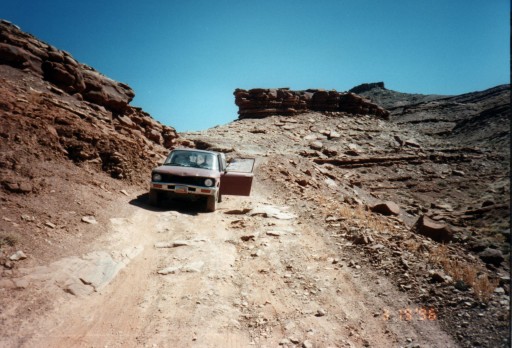
The truck I owned at the time was a small, rickety, rusted-out, 4×4 Chevrolet Luv that was almost as old as I was, and was in much worse condition overall than I was. In spite of being four-wheel-drive, the small street tires it had made it ill suited for substantial off-road driving. It wasn’t particularly well suited for street driving either. The doors were so rusted you could see daylight and passing asphalt through them, and they did nothing to keep the overly loud muffler and other road-noise out. To crown it all off, when loaded down with more than just the driver, the truck had great difficulty maintaining anything above sixty-five miles an hour unless I was on a steep negative incline. But… it was what I had, so we set out for adventure anyway.
My torn-up Chevy Luv on a trail down to the river-level in Canyonlands National Park
In spite of the truck’s limitations, we made good progress up to the point where we were about an hour outside Moab. Through some unexplainable mechanism, the truck had managed to pick up speed to over 70mph on a 60mph road, and a highway patrolman coming the other direction noticed. He flashed his lights at me, so I pulled over to wait for him to make a U-turn and give me a ticket. However, instead of writing a ticket and sending me on my way with the admonition to slow down, he became highly interested in me and my cargo.
Among the first questions he asked was if I had any drugs or alcohol in the car. I answered “No.” Then he asked if I had marijuana. I kind of stared blankly at him, which probably piqued his interest, then responded with something along the lines of “I thought that was an illegal drug…” He asked for the registration papers, and when he saw my mom’s name on them assumed it was my sister’s car. When she replied no, he was instantly suspicious until we explained it was our mom’s. I’m not sure he believed her, but he quit going down that road at that point. Still doubting she was my sister, the officer instead decided to ask me what was in the film canister on the seat between the two of us. It had never occurred to innocent me that someone would use a film canister (something that has become exceedingly rare these days) for something other than film. Again, I hesitated in wonderment over why he would ask such a dumb question before responding blankly “film.”
This line of questioning progressed in a similar fashion until it finally dawned on me the officer was looking for evidence of a pot stash since I was clearly a college age spring breaker headed to Moab to get high. By the time I managed to convince the officer I wasn’t what he was looking for we had been on the side of the road for probably twenty minutes. In the end, he seemingly forgot that I deserved a ticket, gave me a warning, and let me go. I considered myself lucky that he didn’t decide to make me empty out all the crap I had packed under the shell in the bed of the truck. Had he done that, I would have been there for hours playing a roadside version of Tetris to load it up again. Getting off without a ticket (which I felt I deserved) was gravy.
The final point on this interaction came a few minutes later when the CB Radio crackled with someone asking me what I thought about the cop who had me on the side of the road. I looked down and realized I’d tuned it to channel 9, a channel reserved for emergencies, and one that you wouldn’t assume a guy like would be monitoring. The only way someone would have known to call me on that channel was if they had seen the radio. I’m convinced it was the highway patrolman trying to bait me into saying something bad about him. Rather than complain about the incident, I instead replied that he was a good dude, and that the other person shouldn’t be broadcasting on that frequency. We continued on our way without further incident, and spent the next day in Arches national park seeing Delicate Arch and several other spectacular formations. However, the real fun was in Canyonlands the next day.
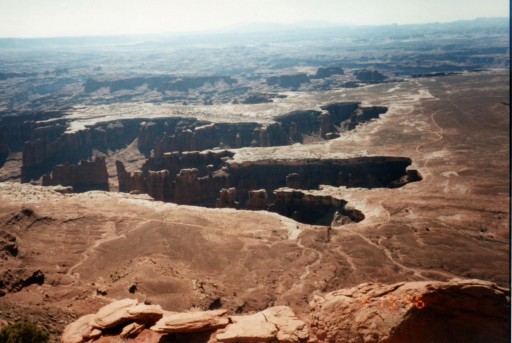
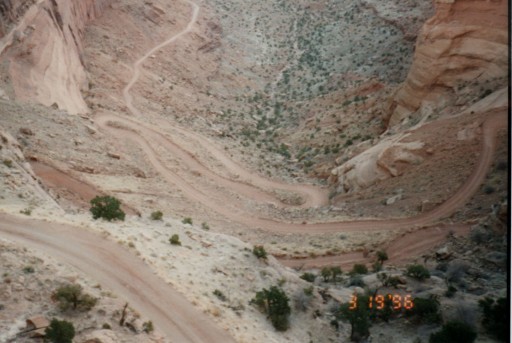
Canyonlands is in reality two separate parks who’s joint-border is formed by the confluence of the Green and Colorado rivers. To the north is “Island in the Sky” and the “Needles” to the south. Another unusual aspect of Canyonlands is that the majority of the “roads” in the park require a 4×4 with good ground clearance. From the Island in the Sky, the best scenery is found by taking the Schaefer canyon trail down a 1500 ft vertical cliff face to the White Rim, a ledge half-way between the Island in the Sky and the rivers. A trail (the white rim road) ran from Schaefer canyon along the rim, following the Colorado river to the confluence and back up the Green river to another trail up to the Island in the Sky. The entire trail is near 100 miles start to finish and extremely rough in places.
Looking down at the White Rim from Island in the Sky. The white rim road is just visible snaking along down below.
Undeterred by the bad and steep road, I decided I wanted to head down the canyon to the white rim. No sooner did I start down the canyon road than my sister decided she wasn’t up to it. Being the obliging brother I am, I ignored her and pressed onward down switchback after switchback, having to back up to a wide spot a few times so a jeep coming up could pass. Every turn and steep incline found my sister’s fingers digging deeper and deeper into the dashboard. By the time we hit the bottom of the canyon my sister wouldn’t talk to me other than to insist that she would rather hike out than do that again. Over the course of the day we saw amazing things, but none of it seemed worth it to my sister who found off-roading with me too frightening to continue much longer. Finally, after an aborted attempt at a particularly difficult and steep trail down to the river level, I agreed to head back and get on more friendly terrain.
As we were about to turn up the steep canyon road, we came across a man standing next to his mountain bike staring in dismay at the canyon road. He was obviously in distress, so we asked if he could use a ride. The look of relief in his face was palpable. Even the prospect of fitting three across in my tiny truck wasn’t enough to cause a second thought. We tossed his bike in with the rest of the crap in the back and squeezed into the cab together for the long ride up the canyon.
Looking down Schafer Canyon. Many of the switch-backs are not visible, and it’s a lot farther down than it looks in the picture, especially when you consider the small green dots at the bottom are decent sized juniper trees.
Along the way, this poor man explained that he had left the visitor’s center early the day prior expecting to complete the white rim loop in a single day. He’d read a guidebook that claimed water could be pumped out of puddles along the trail, and that the distance was eminently doable in a day. He had hit the trail without a tent, anything to make fire with, enough water for the day, or any clear idea for what he was getting into. By the time darkness fell, he was halfway through the loop, out of water, out of food, and out of options.
In the high-desert, temperatures drop rapidly when the sun goes down, and while daytime temperatures were in the mid-seventies, there had been frost on my truck that morning and the wind had howled all night long. This poor man had ultimately resorted to taking shelter overnight in a pit-toilet at an unoccupied primitive campground. Without enough room to lie down, he spent the night squatting over the hole and leaning against the wall. Between the cold, his inadequate clothing and shelter, and the sheer discomfort of having to sleep while sitting up in a smelly outhouse, I doubt he slept more than a few minutes the entire night. When day broke, he set out again, rationing his water and hoping to find help along the way. When we met him along the trail he was dehydrated, exhausted, hungry, and unsure he had the strength to climb up that monster of a trail leading back to the visitor’s center. After a drink, a granola bar, and some conversation, we dropped him off at the top of the trail. He gave us a hearty thanks before heading off to his car and hotel room.
The next day, my sister wanted nothing to do with rough roads, but I really wanted to explore an area in the needles section of the park that included a trail out to an overlook of the Colorado river. My sister and I made a deal… I would go into the ranger station and ask for intel on the trail, and if it wasn’t bad, we could head out to the overlook. After a young (and rather pretty) ranger assured me that the trail was “smooth sailing and only a little rough towards the end” we took off to see what was out there. She was right about the first part of the trail. It was flat and coated with a shallow layer of sand that made for smooth sailing. Unfortunately, the conditions changed radically almost instantly… I was over-confident, and going too fast when I saw the drop-off coming. My truck went airborne and we flew several feet before landing on the down-side of a 2-3 foot near vertical drop in the trail.
Looking back at the obstacle, I didn’t see any way I was going to be able to crawl back up that rock-face. But… since we were already past it, I decided to press onward and deal with this particular problem later. After all… the trail was only supposed to get a “little rough” and maybe that drop was what she meant. I was wrong about that point. The next three miles were highly uneven slickrock sandstone where I rarely had more than three tires on the ground at any given moment, and frequently heard the scrape of the skid-plates under my transmission and oil pans against the rock. My sister swore she would never forgive me.
When we hit the overlook, there was a guy out there with a newer Jeep Wrangler crying over the dents in his oil pan. He looked at me in wonder, openly questioning how I got my short, crappy truck out there. I didn’t have a good answer, and after a few minutes admiring the view, we decided to tackle the trail back to civilization. The ride back is somewhat fuzzy at this point, and to this day, all I can say about how we got over that drop-off is that it helps to have a vehicle you aren’t afraid of scraping up. I’m not sure how I did it, but I’m pretty sure it took a few layers of steel off of the skid plates and a few years off of my sister.
The rest of the trip was uneventful but amazingly fun as we visited several state parks and remote areas across southeast Utah. In the end, it was a great time for both me and my sister, and I believe she did eventually forgive me for the stress and fear I put her through. To this day, I want to repeat that experience with my family, but lack the 4×4 and the time. Maybe in a few years…
As with any of my stories, this is true and accurate only to the extent that my memory is correct. This is an account of things as I remember them.
Lightning Strikes and Skinny Dipping
From as far back as I can remember, I have loved opportunities to escape civilization and make my way into the wilderness. Growing up in Utah, there were plenty of opportunities to do so, ranging from the High Uintah wilderness area a few hours east to some of the emptiest high desert on the continent to the west and south. As a kid, my mother’s family made annual trips to both the mountains and to a set of sand dunes southwest of town. These trips set a precedent that would forever shape my perceptions of what a vacation was supposed to be. Instead of dreaming of Las Vegas, Disney World, or the Bahamas; any time I had the opportunity, I would load up what I needed and make a break for the desert, the mountains, or both. Many of my better memories growing up revolve around camping out in the bush. Whether it was with my family, Boy Scouts, or friends, I always felt at ease far away from the conveniences of modern life.
One of the things that attract me to the wilderness is the very real sense of the power and majesty of nature. One of the most visible aspects, and one I love to watch, is lightning. Now, I don’t have a lot of first-hand experience with lightning other than watching it as a storm rolls through, but that on its own can be quite powerful. One of the most incredible experiences I can remember was watching, hearing, smelling, then being enveloped by a thunderstorm that rolled across the west deserts of Utah to overtake and nearly drown our camp outside Delta. If you’ve never experienced the feel and smell a desert thunderstorm soaking parched ground, there is no hope of explaining what it’s like. I’ll never forget the rolling thunder and flashing bolts as we watched them approach from many miles away. However, I do have a couple of rather close experiences with this particular expression of nature’s power — both of which occurred in the four-lakes basin of the High Uintah Wilderness Area.
Over the course of several camping and backpacking trips through the Uintahs, I learned that the weather at altitude is highly unpredictable – especially in the summer. Many times I’d been caught in a hailstorm when only minutes before the sky was clear and the air was warm. Not wanting to be caught unprepared, I made it a point never to sleep under the stars, putting a tent between me and the rain if at all possible.
On my first backpacking trip into the four lakes basin, things had been completely unremarkable other than the scenery. We had arrived at the camp site happy to be at a point where we could stop for a few days rest, and we immediately began setting up camp. I chose a spot in the shade of several large pines with a soft layer of needles covering the ground and set up my tent, feeling quite happy with my selection. The remainder of the day was spent goofing off or fishing without incident. I went to bed tired and happy.
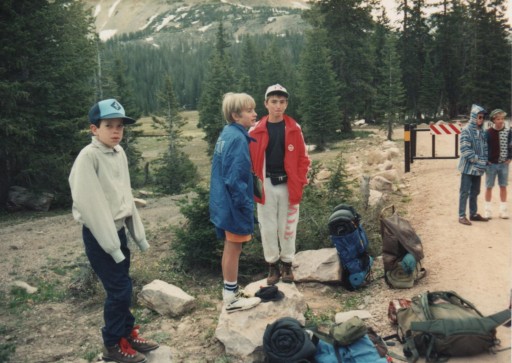
The only picture I have of either trip into the four lakes basin. This picture was taken as we were dropped at the trailhead on the first expedition. From left to right: Alan Lundgren, Mike Brady, me, someone I don’t remember, and Tom Mosier.
Somewhere in the night, a powerful storm rolled in bringing hail and lightning with it. I awoke to flashes of light, crashes of thunder, and the sound of hailstones bouncing off of my tent. As I laid there watching and listening to the power of nature, there was a blinding flash accompanied instantly by a deafening crash of thunder. My hair stood on end, and before I could react, I heard the sound of several things much larger than hailstones hit my tent and the ground around it. I wondered what it was, but didn’t dare go out until the storm had passed. The next morning, after watching the sunrise through the golden color of my tent fabric, I crawled out of my sleeping bag, unzipped the tent, and found a large piece of tree bark resting on the rain fly with several large chunks of green wood scattered all around. Lightning had struck a tree only a few feet away and literally blew it apart. Nature’s power is awesome, and I felt blessed that I hadn’t shared the fate of that all too nearby tree.
The basin we were in was right on the main trail, and while remote, was rarely unoccupied. The heavy traffic brought lots of fishermen competing for the limited stock in the lakes. Consequently, fishing wasn’t particularly good, and as young men, the thought of depending on a couple fished out lakes for food wasn’t something we looked forward to. After most of a day trying to make due with the played out lakes, several of us took a hard look at the map and decided to hike over “cyclone” pass and along an unmarked trail to a remote lake to see if the fishing would be better where there had been less traffic.
Cyclone “pass” wasn’t much of a pass. Rather, it was more of a saddle between two high peaks, with even the lowest part of the saddle above the tree-line (roughly 10K feet). Once over the pass, the trail on the map disappeared, but the lake would be easy to find by following the ridge-line north a few miles from the pass. We took off with minimal gear and supreme confidence in our abilities. We climbed over the pass, pausing only briefly to catch our breath and enjoy the spectacular views, then dove into the unmarked wilderness. After several miles of jumping between Volkswagen Beetle sized boulders we arrived at Thompson lake. The fishing was awesome, and we limited out within a few hours. The hike back to camp was uneventful, if tiring. We had caught enough fish to feed us for the rest of our stay in that area, and the rest of the trip was beautiful and drama free.
When our Scout troop returned to the four lakes basin the next year, there was a group of guys who wanted to head back over to Thompson lake and see if the fishing was as good as it had been the year before. I don’t fully remember the reasons why, but I decided not to go with them. If memory serves, I think I was feeling kind of sick and wanted to rest rather than tackle the steep climb up the pass and the mountain-goat version of a trail once I got to the other side. In any event, I was one of a few people who stayed back at camp and watched as everyone took off to head up the pass.
Several hours later, a black cloud rolled in with threats of a flash thunderstorm. Almost as soon as this cloud arrived, enormous thunderclaps reverberated through the trees and across the basin. I was glad to be under cover of a rain fly instead of out on the trail, and was sitting back enjoying the sound of the storm when a handful of guys came trotting out of the trees through the rain. They had been on their way back to camp when the storm rolled in. As a matter of fact, they were nearing the top of the pass when they first saw the darkening skies. The ones we saw coming out of the trees had decided they weren’t comfortable standing exposed above the tree-line with a storm rolling in, and had taken off at the best speed they could make to get out of the open.
A few, however, had decided that they weren’t in any danger, were too tired to run with their packs, and thought it would be neat to watch the storm from their vantage point at the top of the pass. Apparently it hadn’t occurred to them that a graphite fishing pole sticking up out of a pack would make a pretty good lightning rod. As they were standing up on the pass watching the storm flash and crash, lightning struck close enough to daze them and make all their hair stand on end. These few, who had been too tired to jog down the hill earlier, sprinted all the way to camp. By all accounts, the lightning struck within a few feet of Tommy Mosier. He looked very rattled when he got back to camp, and I doubt he ever took another chance with being out in the open during an electrical storm.
As with the previous trip, the remainder of the hike was fantastic as we hiked from lake to lake on a fifty mile trek. However, a full week on the trail doesn’t make for the most fantastic of personal hygiene conditions. By the time we made the last overnight stop at Granddaddy lake, we stank, and we knew it! The thought of going back into town smelling and looking like we did didn’t appeal to us. Since we were still several miles inside the wilderness and hadn’t seen anyone for several days, and since we had a full day to rest at the lake before we hiked out to the trail-head the following day, we decided to strip down, wash our clothes in a creek, and jump in the lake to wash off the worst of the stink and dirt.
Something to understand about the lakes and streams in that area is that they are all snow-fed. Even in late August there can still be pockets of snow and ice in shady areas. As a result, the lakes are rarely, if ever, much above freezing. Jumping into one of them is likely to cause an involuntary contraction of every muscle in your body followed by some form of audible exclamation. Jumping in to get clean is a very rapid process… wet, rub, rinse, then climb out and into the sun to dry out and warm up.
We had stripped down, washed our clothes and hung them out to dry, and were just getting into the water to clean up when a large group of young women came trundling up the trail and into view. Everyone in the water sunk down to their necks in an attempt to stay modest while we waited for them to pass. Unfortunately for us, they didn’t just continue down the trail. Apparently they had noticed us, and had slowed down to gawk at the spectacle. By this point, I was getting horribly uncomfortable as various parts of me either turned blue or shrank into nothingness. As near as I could tell, they wanted to see something they weren’t seeing with us hiding in the water, wouldn’t leave until they saw it, and I was tired of being cold and wet. I stood up in all of my naked glory, smiled, and walked right through the line of girls who had stationed themselves between us and our camp, greeting them with something stupid like “hello ladies,” or “water’s fine, care to join us?” as I passed. I’m certain they were more embarrassed than I, but I doubt they were more mortified than my scout master.
Earlier this week I had the misfortune to have a meeting in the Washington D.C. area that required me to be physically present. There was a blizzard in the forecast, but travel arrangements were made that should have allowed our small party to escape the region before the storm hit. Unfortunately, our return flights connected through a city that was affected by the storm almost a full day before the D.C. area, and our morning flight was canceled. Attempts to re-route my travel through another city before the storm arrived were only partially successful. My travel companions got out before noon, but the only flight available by the time I got through to the travel agent was scheduled to take off two to three hours after the snow was to start. The airline sounded optimistic, but I was suspicious.
When I woke yesterday morning, I checked the flight board in the hotel lobby and found that almost all of the flights in or out of the airport had been canceled. There was one cluster, all on the same airline, that still showed as departing on-time. My flight was among them, and it was the last flight of the day that hadn’t already been canceled. I was ultimately doubtful I would make it home as scheduled. However, in an effort not to be hyper-cynical I checked out of my room and headed over to the airport. The hopefulness didn’t last long, however. When I got to the gate there wasn’t an airplane waiting, and conditions were rapidly getting to the point that landing a plane would be quite dangerous. In the two hours I stood there waiting for them to cancel the flight, I don’t think I saw more than two planes land, and neither taxied to my gate. Forty-five minutes prior to the scheduled departure time the airline announced the landing of the last plane of the day — much to the relief of a bunch of passengers headed to Phoenix. Those of us on my flight were left to weather the storm and fend for ourselves for at least the next two days while the airline cleared both the snow and the backlog.
To make matters worse, I have another meeting scheduled for D.C. next week. Were I to take the earliest available flight home, I would have been home for only one day before I would have had to get on a plane and come back here. The solution… I make the clothes I packed for a three-day trip last for a week and a half and stay here. Normally, I don’t mind extra time in D.C. because I can spend it wandering the national mall, museums, etc… Unfortunately, EVERYTHING here is shut down, including the restaurants that would provide any alternative to the expensive and crappy hotel restaurant. The METRO, Smithsonian, National Monuments, and just about everything else is closed, and everyone who lives here is holed up in their apartments waiting for the storm to pass and the snow-removal crews to clear their path. For today and tomorrow, at least, I get to kill time in a hotel room with nothing but an Internet connection and 77 channels of nothing to watch on TV.
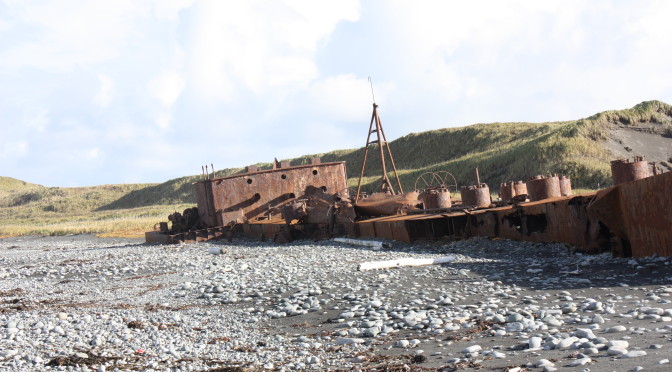
Far north of the sun on the sands of a beach
A hulk lies half buried on land
Who knows what it carried when last leaving port
Now it's holds carry water and sand

Abandoned in place when the sea broke it's back
For decades it's been here and will
Forever remain 'till the steel rots away
Ground to dust in nature's great mill
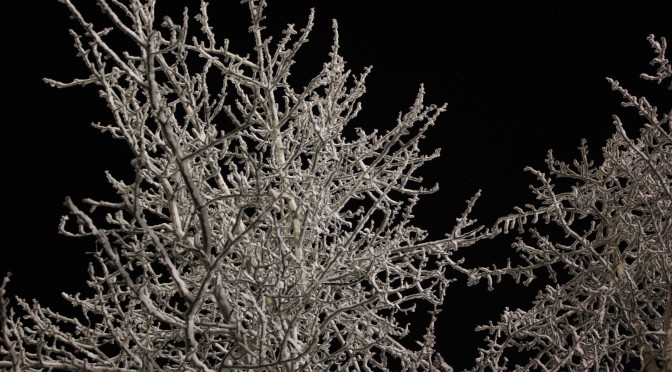
Searingly cold, I am chilled to the bone
Crystalline ice coats the ground
Darkness paints over the bluest of skies
Snow muffles the loudest of sounds

Rational beings are tucked in warm holes
To hibernate is natures great plan
But standing here now, knee deep in new snow
I marvel at a brazen lone man

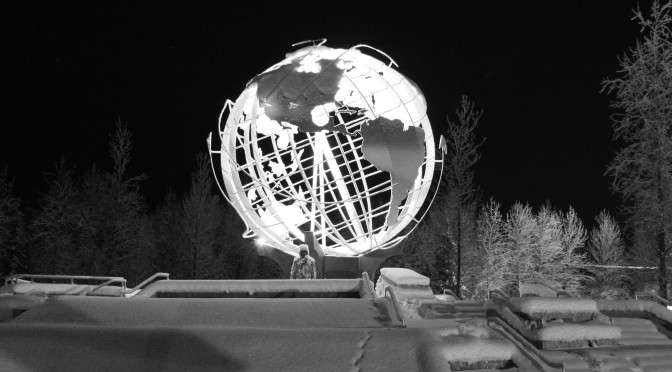
He stands there alone, protecting the globe
Keeps watch with a resolute stance
A sentinel silent, a witness as well
He begs us to not miss our chance