Paint the trees a vibrant red,
Or yellow, orange or brown,
The signs of summer fade away,
And fall sings all around.
Paint the trees a vibrant red, Or yellow, orange or brown, The signs of summer fade away, And fall sings all around.
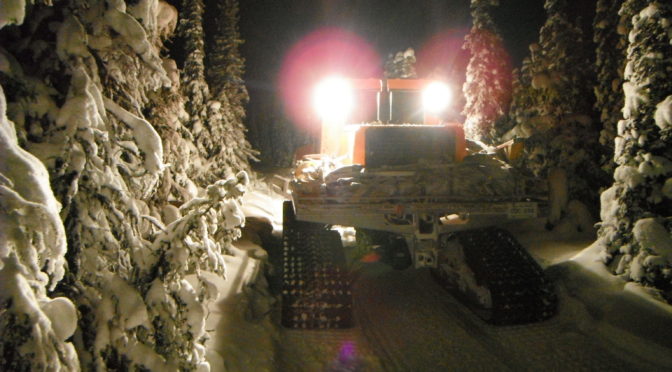
Down a dark trail through deep frozen spruce,
The lights peering outward bright halos produce,
As we crawl over snow that squeaks under our tread,
Pushing farther from home into darkness ahead,
Breathing smoke as warm vapors freeze and turn white,
Tiny crystals suspended in the breath of the night,
Collecting on eyebrows and all sorts of hair,
The heater flat failing to warm the harsh air,
Our mission's a clearing far out in the wood,
Some broken equipment that must be made good,
So onward we press 'till the work is complete,
And fend off the frostbite that threatens our feet.
About 12 years ago, Kara (one of our friends) had just had a second child and was struggling with the adjustments required to bring a new kid into their home. Their oldest son was a handful to say the least. He was more than normally bright, and exceptionally energetic… a combination that often leads to trouble, and this kid was trouble in so many ways. Kara had been having a hard enough time dealing with this fireball of destructive curiosity and energy, and adding another baby with the additional burdens of postpartum depression and general life difficulties only complicated matters.
In a moment of frustration Kara vented some of her self doubt to her doctor, wondering what she had done wrong with her oldest to make him so difficult to manage and how she was going to cope with another of the same breed. The doctor, who had apparently been in practice some time, responded simply that she just needed to have another kid. Kara was horrified. However, the doctor continued his prescription by saying something along the lines of “By the time you have three kids, you realize none of it is your fault, they are all different, and came hard-wired like that in spite of anything you do to try to change it.” In Kara’s case, her second son turned out to be a sensitive, quiet, and easy-going baby. Her two boys definitely came from God distinctly pre-configured with personalities and characteristics of their own. Yesterday, I got another piece of evidence to add to my collection in support of this theory.
I have satisfied the doctor’s prescription, and have three highly unique and wonderful children. True to the doctor’s predictions, they came hard-wired to be very different from each other. The most recent example revolves around learning to ride a bike. I had spent some time this week getting Isaac’s bike fixed up for a mountain-biking trip with Scouts, and consequently had bikes on the brain when I found myself with a few unaccounted for minutes. Looking around the garage, I saw Isaac’s old bike and realized I was overdue teaching Michael how to ride. I aired up the tires, lubricated the chain and wheels, grabbed Michael’s helmet, and called him out to the front yard to start the potentially long and painful process of teaching him to ride.
When Sydney was learning to ride, she was overly cautious, afraid of everything, and would take a long time to get over a crash and be ready to go again. It took months of refusing to give in to her pleas to re-install the training wheels to get her stable and pedaling on her own. Even after she’d learned to ride, she would often crash in anticipation of a crash or freeze up and crash when something different happened anywhere near her. Teaching her to ride was a slow and painful process. To this day, I have difficulty getting her on a bike.

Isaac, on the other hand, was utterly fearless. When we bought his first bike, he informed me he wanted me to take off the training wheels and that he could do it without me. He was simply going to climb on the bike, start pedaling, and be an expert immediately (incidentally his approach to almost any physical activity). I didn’t comply with that request right away, but it wasn’t long before he had his way. He was overconfident. Because of his over-confidence, his crashes were often somewhat catastrophic both physically and emotionally, requiring some time for him to recover his willingness to move on. However, he universally recovered and it didn’t take long before he was tearing around the neighborhood at full speed every opportunity he had.

Given the wide differences between these two experiences, I was interested to find out how Michael would do. Personality-wise, he falls somewhere between Sydney and Isaac. He is fairly tender, crafty, and cuddly. However, with a big brother like Isaac, he is also fairly hardy… He learned early to recover from being knocked over (by Isaac, the dog, the goats, or just tripping on something out in the barn), and for the last six months of city life has been learning all kinds of physical skills at the “Ninja Park” gym where the workouts consist of things like climbing or jumping over and off of walls, walking on balance beams, and stuff like that.
When I told Michael he was going to learn to ride a bike, he was a little nervous at first, but excited at the same time. Unlike Isaac, he asked for training wheels… I said no and he mostly accepted my answer in spite of being nervous. He asked me to hold on tight as he straddled the bike, and I got him rolling with my hand on his back to steady him. Almost immediately he was stable, and I lifted my hand off his back and he rode for about 20-30 feet on his own. Balance wasn’t going to be a problem for this kid.
As promising a start as this was, we still had a ways to go. Because Michael had essentially grown up on a farm where there were almost no paved surfaces, he had never had much experience pedaling tricycles, and the concept of pedaling forward didn’t resonate immediately. He’d get going, get relatively stable, and push down on a pedal before it was over the top of the turn. On my bike, that’s not a particular problem because the crank will just cycle backwards. However, on Michael’s bike, that motion activates the breaks, and every few seconds he would come to an unexpected and screeching halt, followed by a crash. I didn’t think I’d ever run into a scenario where balance and steering weren’t the problem, but pedaling forward was. To Michael’s credit, though, every time he crashed he would dust himself off, grunt or growl like his dad often does when something frustrating like that happens, and get back on the bike. Within about 15 minutes, we had made it to the park nearby and he was riding laps around the playground without my direct intervention.
This proved to be something of a challenge for me though… I was supposed to jog along beside him to keep him from any serious danger, but I had started the day with a 2.5 mile trail run with Liz, followed it with a 2 1/2 hour hike up the mountain with the boys, and now running for another 30 minutes along side of Michael was taking it’s toll — especially since I’m still not acclimated to the altitude here after spending months at sea-level. I needed to quit, but Michael was having none of it. I used the convenient excuse that we needed to show Mom the amazing progress he had made to convince him to head home. It didn’t stick though… no sooner had he shown Mom his progress than he was adamant he needed more practice. This time I figured he was doing well enough that I could get away with trailing him on my bike, and this adjustment made it possible for him to spend another hour riding around the park. Before long he felt comfortable enough to ride the circuit while I sat on a park bench and enjoyed the beautiful spring afternoon.
Eventually Liz reminded me I needed to come home and clean up so I could take her out to see a live performance of “South Pacific” and take her to dinner. Michael would have stayed longer, but you can’t argue with Mom when she’s planning on going out on a hot date. All told, Michael spent less than two hours start-to-finish learning to ride a bike. He never had training wheels, had little experience with pedal-driven equipment, and yet was by far the fastest learner of the three. Three kids… three rounds teaching them to ride a bike… three totally different experiences driven by the highly distinct nature of the kid being taught. I’m no expert in the broader world of kids, but I can say from many different experiences that my kids, at least, came hard-wired with certain traits and tendencies.
I honestly have no idea who originally taught me this, but one of the more useful lessons I tried to put into practice while dating was to get in good with my date’s parents. I suspect it was a bit of wisdom from my parents coupled with suggestions from other influential people and a dose of common sense. In any event, I made it a point to do things in such a way that my date’s parents wouldn’t worry about me or my intentions. I tried to make sure to have my dates home early or at least on-time, I made it a point to talk to them and help them get to know me, and above all I tried to be myself around them knowing that I would fail in the long term at trying to be something I wasn’t.
In my effort to develop a relationship with my date’s parents, I even got in trouble from time to time for spending too much time talking with her parents, especially when it came to the beautiful girl who would later be my wife. However, in the end, getting in good with the future in-laws was more a matter of being genuine and doing the right things than it was me deliberately trying to “shape” the relationship. In any event, my in-laws quickly learned to trust me in ways that when I think back almost shock me. One example came up not long after Liz and I started dating…
Liz bought a lightly used car through a wholesaler not long after turning 18. Despite smelling of cigarette smoke, it was in solid shape and a major boon to Liz and her family while it served as her family’s second car, quickly becoming critical to the logistics of the household. However, her car had a bad habit… it would randomly refuse to start. Universally, this would happen when Liz was alone somewhere, and would magically fix itself whenever someone else showed up to help. Because her family only had one other car, they weren’t always available to help her out when her car acted up, so I would come to wherever she was to provide the magic touch required to get the car to start. I didn’t really mind… having an extraordinarily pretty girl who was grateful to you for helping rescue her couldn’t be a bad thing.
Unfortunately for the purposes of troubleshooting it, it NEVER happened when I was around, and I was around a LOT. In fact, sometimes Liz felt like people didn’t believe her when she described the problem because it was so intermittent and because it never happened when anyone else was around. However, I was working fixing electronics at the time and was well familiar with what I called “the magic workbench effect.” Intermittent issues in electronics would disappear as soon as someone brought their television, computer, or other item into the shop. I could often run them on my workbench for days without seeing the problem; and without seeing the problem, it was almost impossible to diagnose and repair. The same applied to Liz’s car. I could make educated guesses about what was wrong with the car, believed it wasn’t just a user error, but couldn’t do anything to fix it unless and until it became a more common problem.
One day, I was at work when I got a call from Liz’s mom. Liz had been headed out to work when her car began to act up again. Running late, she took her dad to work and took the family car rather than deal with the issue. Her mom, at home teaching piano lessons throughout the day, went out and tried repeatedly between lessons to apply the magic touch to get the car started again. After several attempts to start the car failed, she decided to call me. This decision seems kind of odd in retrospect. Liz and I hadn’t been dating all that long, and I’m not even sure where her mom got my number or what motivated her to call me except that I had a reputation for fixing things. While I’m not really sure why she called me, I was (and still am) grateful she was comfortable enough with me to ask if I could come take a look at the car.
I don’t remember if I was at school or work, but either way I was in a position where I could leave at my on recognizance. I grabbed a toolbox, jumped in my car, and headed over with the hope that the problem would continue long enough for me to troubleshoot it. I had suspected it was simply a starter solenoid that was misbehaving, and had even stopped to purchase one on my way over hoping to get the car back to a reliable running condition before Liz got off work. Sure enough, when I got there, the car was still misbehaving. However, a quick check proved that the problem wasn’t with the solenoid or the starter. There was a problem in the electrical system inside the car that would require a little more digging.
Liz’s mom stood by and watched as I tore the dash apart. I can only imagine the doubt that would have gone through my mind if I were standing over a 19 or 20 year old kid who I barely knew as they tore apart my kid’s car. For some reason, she trusted me just the same. As I tore into the steering column to get access to the ignition switch and wiring, I found the reason they weren’t able to get rid of the smell of smoke… a lit cigarette had fallen into the plastic shrouding of the steering column and burned into a pile of ashes in a place that wasn’t accessible. That problem was solved!
Another thing I found was that the ignition switch was working fine. It was delivering power to all the right places to get the starter to turn, but that power wasn’t making it to the starter itself. Theoretically, there wasn’t anything but a wire connecting the two, so I had to trace the wire from one end to the other. What I found was unexpected. Apparently the previous owner had installed a starter lockout device under the dash that nobody knew about. It worked by interrupting the wire connecting the ignition and starter solenoid, and used a special key to determine whether or not the car should start. The previous owner had left the key in the interlock, so nobody had even noticed it was there. Apparently this little gem of a device was going bad. The relay contacts must have been dirty, so it would occasionally make contact… and occasionally wouldn’t. It just so happened that it would make contact when anyone but Liz was around. A few quick snips, crimps, and some shrink-wrap later, the interlock was removed and the car started flawlessly. Liz was validated in her belief that it wasn’t just her doing something wrong.
That hour or two of working on a stupid little car in front of my girlfriend’s house wasn’t anything substantial for me. It was the kind of thing I did, and still do on a regular basis for almost anyone. I have always liked using the skills I’ve developed to help other people, and if it happens to help me it’s a bonus. However, this act of service was a good way to solidify a growing trust with the parents of the girl I would later marry. My mother-in-law still mentions this episode from time to time when we get to story telling, and I am grateful for the opportunity it gave me to show them the kind of person I am and strive to be.
The house I grew up in was a little unusual… It was built by the neighborhood developer for his daughter, and was the carpenter’s version of the mechanic’s car. It was the smallest house on the largest lot in the neighborhood, and seemed like it was built using leftovers from the other homes. My parents told stories about the piles of crap they had to haul off when they bought it, and strange behavior of the lady who lived there before them — including letting a Shetland pony wander in and out of the sliding glass door that opened from the basement into the back yard.
The basement of our house was generally unfinished, but there was one room that was nominally habitable. The room had drywall on the walls, complete with about an inch gap at the bottom where baseboard should have been that was usually full of spiders, dust bunnies, and cobwebs. The closet was under the stairs and had no door or even door frame… It was a black hole into a place of mystery (at least to young kids). Because of it’s partially finished nature and thrown-together construction, we had a name for the basement room… the “ugly room.” I seem to remember my mom even using time-out in the ugly room as a punishment and fearing going in there. For the first several years of my living memory we didn’t really use that bedroom. In fact, some of my earliest memories are pulling a couple of old couch cushions out from under my sister’s bed at night to make my bed on their floor rather than use the ugly room. Eventually, sharing a room with my sisters wasn’t a viable option, and we moved a couple of the kids into the ugly room full-time. By the time I was about 12, my brothers and I shared the room.
Throughout my youth, my brother and I would toy around with electronics, usually stripped from garage door openers our neighbor’s dad brought home after installing new ones. One of our innovations was to reconfigure the remote control circuitry to switch on and off almost anything we felt like hooking up to it. I decided it would best be utilized as a remote-control light switch and wired it into the wall-switch in the ugly room. I could sit in bed and switch the bedroom light on or off. Not only that, but I could do the same thing from anywhere in the house so long as I had the remote control.
During the time when I had this magical power over the ugly room, my uncle Kenneth brought his two boys over to stay with us overnight. Since there weren’t any extra rooms, they would be sleeping on the floor in my room. Neither Tolon nor I relished the idea of sharing our room with a couple of snot-nosed kids (they were probably 4-5 years younger than us) so we decided on a plan to add some entertainment value to the situation. That afternoon, we entertained our cousins with stories about the ugly room. We told them that the previous owner had locked her crazy daughter in there, and that she had died in there.
The ghost of the ugly room, as we described it, would occasionally make noises and tell us that if she ever turned the lights on and off it was because she was going to kill anyone who was in the room. By the time the boys went to bed, we’d filled their head full of all kinds of crazy stories about the house, the ugly room, and the ghost who haunted it. My cousins laughed it off, at first, then went to bed on-schedule. Tolon and I, however, stayed up for another hour.
About ten o’clock, I picked up my remote, waited outside the ugly room, and switched the lights on. The boys laughed nervously and started to get out of bed. I switched the lights off. They rushed back to bed. I started flicking the lights on and off in rapid succession… they came screaming out of the room, terrified that a ghost was about to kill them. Tolon and I couldn’t stop laughing, and no matter how many times we showed them the remote and how it worked, my cousins wouldn’t go back in the room. My parents weren’t amused, but we had our room to ourselves for the rest of the night.
Earlier I wrote a bit about what I would do to cut the Department of Defense down to something more limited in scope and expense. Granted… some of the proposals weren’t strictly Department of Defense, but that’s not particularly important. In that post, I mentioned I might get around to explaining some of my rationale for my recommended changes, and at the moment I have some time, so I’ll start and see how far I get.
My first, and most important, recommendation was to recognize that there are no existential threats to our territorial sovereignty and survival of the United States. All my other recommendations pivot on this point. However, after further reflection, I need to slightly modify this one… We need to recognize that there are no substantial external threats to the aforementioned. If there are no external threats, and we are committed to not using the military for domestic security, there is no need to maintain a large standing military with all the infrastructure that goes with it.
Our geography is such that the majority of our borders are protected by vast expanses of water, and forcefully invading a well armed country by sea is not an easy undertaking, nor is it one that is likely to succeed given the substantial segment of the population that is privately armed and the resources that would be available in the National Guard and Reserves if I were to get my way with those organizations. No nation in the world currently possesses, or could reasonably quickly acquire, the fleet of vessels required to force entry from the sea.
An invasion across the borders to the north is similarly unlikely to succeed. To the north there is either 1) a nominally friendly and ethnically similar culture that lacks the military capacity to seriously threaten invasion, or 2) arctic wilderness. Even had they a desire to invade, Canada doesn’t have enough people and equipment to seriously challenge a United States focused on homeland defense. We will not be invaded from the north unless the world unites and convinces Canada to allow them to stage an invasion from Canadian territory, in which case there would be an extended build-up providing ample time to prepare a potent response. I find the prospect of a world revolt against the United States astronomically unlikely, especially if we quit interfering in other people’s business (intervening would be a more politically correct but less accurate term).
The border to the south is more problematic, but not when it comes down to essentials. First, the only threat currently present at that border is a criminal element that has overwhelmed Mexico’s capacity to deal with it. While border crime, drug trafficking, and human smuggling all have substantial impacts on our nation, it is not an existential threat. The drug cartels aren’t interested in replacing our government. In fact, they rely on the US as a principal market for their goods, and would suffer if it collapsed. Laying the criminal element aside, Mexico (like Canada) lacks the resources to invade… even without the rampant crime siphoning resources. Any attempt by Mexico to invade would require an extended period of build-up and preparation that would be highly visible and allow the United States to prepare an overwhelming response. Additionally, Mexico is significantly dependent on trade with the US, and would suffer greatly by any serious deterioration in status-quo relations. There is simply no motivation for Mexico to attack.
I’ve never come across anyone who would argue that we are likely to ever be forcefully invaded. So the question remains: “what then are the external threats to our vital interests that justify the expense and risk of maintaining a large standing army and constantly using it around the world to interfere in other nation’s business?” This is a much thornier issue, but one I believe has an answer that is much simpler than the big-brained think tanks would have you believe. I’ll give you a hint… it starts with “N” and ends in three letters that spell out a number between 0 and 2.
To set the stage for my argument, consider the political environment between the 1920s and 1960s. A new political ideology developed by Karl Marx and Friedrich Engels and fundamentally opposed to the capitalistic principals on which this nation was founded was gaining steam around the globe, including in the US. Multiple nations fell into its grasp as one corrupt dictatorship or government after another crumbled. There were reasonable fears (especially in the ’30s and ’50s) that this revolutionary wave would flood over the US, and that it was being supported by foreign governments. This fear of communism was among the factors contributing much of American intervention in Greece, Korea, Cambodia, Laos, and Vietnam.
The question remains, was this a valid external threat to survival of the United States? The answer is a clear NO. Communist insurgencies have only ever thrived in locations where oppression and corruption created conditions where the message of communism resonated. To paraphrase Thomas Jefferson in the Declaration of Independence — A satisfied people, secure in their persons, property, and prospects are extraordinarily unlikely to ditch an existing governmental system in favor of revolution. No matter the extent of foreign involvement and support, without corruption, oppression, and inequality creating conditions for growth, communism or any other form of government inimical to the American system of representative democracy will never get enough of a foothold to threaten national survival. In fact, I’d argue that foreign involvement only strengthens the will of a people to resist that influence… Cuba being a case in point. I claim this logic applies to any form of externally driven or supported revolution. Any revolution, whether supported externally or not, is a result of issues internal to a state, and is therefore not an external threat.
One last aspect to consider is the potential that perceived or real external threats could be a means for stabilizing internal dissent. Rather than get into conspiracy theories, I’ll offer up that this tactic was/is used regularly by the likes of the Kim dynasty in North Korea, Hugo Chaves and his successor in Venezuela, and the Castros in Cuba. It’s a cheap move that does tend to galvanize support, but one that can’t be used regularly without the public catching on to the scam. Furthermore, investing the resources wasted in “dealing” with the external threat in actually dealing with the underlying issues is much more likely to produce long-term results. Made-up or manufactured external threats aren’t a legitimate strategy for national survival.
Finally, I will admit that there are substantial threats to our long-term viability as a nation. The nation is in tremendous debt. Our families are falling apart. Our morals and standards are sinking faster than a lead brick thrown into a deep pool of water. Our primary and secondary education systems, struggling against a relentless tide of parental disengagement, over-regulation, political correctness, and sense of student individual entitlement are putting out generations of poorly educated zombies who don’t know how to think about hard problems, ask hard questions, and come to logical and supportable conclusions. Our post-secondary education system openly espouses moral and political philosophies, political and pseudo-scientific theories, and other ideas fundamentally opposed to the foundations on which our nation was built. Our society has become so politically correct we cannot label anything as wrong or right without offending the sensitivities of some politically connected group who crush anyone who disagrees with their opinions. Our government has grown into a behemoth that reaches into every aspect of the lives of ordinary citizens and has been heavily corrupted by special interest groups and a small class of privileged elite. We continue to pour our nation’s blood and treasure into half-hearted wars in foreign countries. We have out-sourced almost all manufacturing and manual labor. We are dependent on a very narrow range of food sources and subject to minor disruptions causing mass hunger. We are raising generations who don’t value hard work, denigrate traditional values, despise traditional gender roles, and view parenthood as an unfortunate and optional consequence of sex. Our financial system is built on a fiat currency with striking resemblances to a Ponzi scheme. The list of real threats to our future could continue much longer, but those above should be sufficient to demonstrate that none of them are an externally driven threat except to the extent that we have out-sourced a problem we created in the first place.
Many may interpret my feelings and preferences as being those of an isolationist. That is wildly inaccurate. I recognize that no nation on the face of the planet currently is fully self-sufficient. Even were the United States to re-tool the economy and resources to become self-sufficient, doing so would be anti-competitive, inefficient, and fundamentally against my personal economic and political philosophies.
Now, that said, I don’t think it is in our interest to “intervene” or get involved in the internal and even international affairs of other nations. Our track-record of intervention is abysmal. Even in Iraq, where Saddam Hussein was widely despised throughout the Middle East as a brutal dictator, our intervention destabilized the region, created conditions for a sectarian civil war, enabled a radical Islamist movement to occupy and destroy cultural heritage across vast swaths of territory and terrorize huge numbers of people, and has re-written the Saddam narrative to portray him as being a hero of the people who resisted the imperialist invaders. Our involvement in the Philipines, Nicaragua, Egypt, Lybia, Somalia, Lebanon, Bosnia, Afghanistan, Vietnam, Cambodia, Laos, Cuba, Iran, Saudi Arabia, Kuwait, Tunisia, Columbia, Mali, and other places have resulted in significant second-order backlash without much by way of positive outcomes.
External solutions to internal problems are almost never optimal. Our attempts to impose a Western-style government in Iraq demonstrated an unrealistic understanding of the cultural dynamic in the area. Similar failures have characterized our experience in Afghanistan. Our support for corrupt governments in South Vietnam helped to harden Ho Chi Minh towards communism as opposed to ethnic nationalism and anti-imperialism. Our support for the Shah in Iran was, and continues to be, a major factor in anti-American sentiment in that country. The Bay of Pigs invasion was an astonishing failure, and actually strengthened the Castro regime. Short of the Marshal plan for rebuilding Europe and MacArthur’s dictating terms in reconstituting the government of Japan after WWII (cases where the long-term cost/benefit calculations are debatable), I am taxed to find a case where American intervention ultimately created conditions favorable to the United States.
I believe we would be better off letting other nations sort out their own issues. International relations should deal principally with ensuring fair access to markets without passing judgment on their form of government, cultural values, political affiliations or preferences, and national character.
One of the core functions of the Federal Government is to provide for the common defense. There is a clear requirement for a capable and credible force to respond to aggression or large-scale threats on the order of World War II, but having that capability embodied in a standing military is an enormous burden on the economy, an easily accessible tool for international interference, and has historically been a threat to the government it ostensibly serves. Consequently, the founders feared large standing armies. So how can the government provide for the common defense without a standing army? The answer is pretty simple, and is consistent with what the founders had in mind… namely a large militia composed of people trained, equipped, and ready to respond in a crisis.
I can’t say how often I’ve sat in meetings where the services complain about the high and escalating personnel and health-care costs. Cutting the military to a core staff capable of overseeing and managing training for the reserves and handling the administrative and acquisition tasks of the restructured military would bring enormous cost savings in reduced personnel, retirement, and health care costs. Furthermore, the reduced training schedule for reserves would extend the service life of expensive equipment while simultaneously reducing operational costs.
Moving a large portion of the military into the reserves would also put a large number of personnel who are essentially bottomless resource sinks back into the economy where they can contribute to the overall economic activity of the nation. Doing so would also tend to reduce the appetite for deploying the military to deal with every perceived crisis around the globe. Local governments and populations would be less insulated from the military and feel the effects of deployment more substantially than under the current model. Activation and deployment would be much more likely to have enough of an impact to engender the kind of debate and discussion that should be warranted before we sacrifice our brothers and sisters in armed combat.
Bases on foreign soil really only serve only a handful of purposes. Primarily, they enable global access for the US military, or otherwise stated… they make it much easier to get involved in the affairs of other nations. Initially, many of the bases we maintain overseas were built during or after major conflicts such as WWII or the Korean War to help stabilize the regions and prevent regional nations from rearming and igniting another war. However, after six or seven decades of the United States subsidizing foreign security these bases remain, and are used as jumping-off points for international adventures.
We deliberately maintained an occupying force in Europe and Japan after WWII, and as a result the affected nations have under-invested in their own defense, relying on the US security guarantee, while spending broadly on social programs and other domestic expenditures. The net result is American taxpayers funding generous medical, retirement, and other social programs throughout the territories of our former allies and adversaries. I firmly believe the security situation in Europe would quickly stabilize to a new norm if we were to withdraw, saving the US untold costs.
This proposal won’t make me any friends among my marine brethren, but it is long overdue. The USMC is essentially an offensive force postured for forcibly entering foreign territory and securing port or beach head access. They have served as a separate Army and Air Force, while refusing to integrate into the broader joint fight. If we decide as a nation to abandon our practice of interfering the internal affairs of other governments, we have no need for an amphibious assault force. Furthermore, this would eliminate redundancies and institutional conflicts with the other services. While the USMC brags about their low-cost force, their budget only encapsulates personnel costs with the Navy picking up the tab for all their equipment and facilities. Finally, eliminating the USMC would also allow the USN to cut it’s large fleet of amphibious ships and support capabilities.
The US military maintains a fleet of ships loaded with tanks, trucks, helicopters, bombs, bullets, and just about everything you would need to start a war. These ships are stationed at various places around the world and require staff, transportation, and maintenance… all so we are in a position to more rapidly involve ourselves somewhere overseas. If you haven’t noticed, I’m not a fan of getting involved overseas, and anything that makes it easier to do that is on my chopping block. I can conceive of no situation where we would use the pre-positioning fleet to defend the homeland, and major world crises on the scale of a world war don’t break out on timescales that would preclude shipping equipment from the territorial limits of the United States.
The number and type of nuclear weapons in the current inventory far exceed the quantity required for maintaining a credible nuclear deterrent. China, for example, maintains a nuclear deterrent consisting of a comparatively small number of weapons, yet is in no danger of suffering a “first strike” attack. The infrastructure required to produce, maintain, and field the broad array of nuclear weapons and associated equipment is enormous and expensive due to extensive safety, security, and certification requirements for anything that comes within earshot of a nuclear weapon. Any reduction in the number and type of weapons would yield significant savings.
Personally, I don’t like tactical nuclear weapons. Any time someone considers deploying a weapon capable of this scale of destruction, it is strategic, and it had better be worth it. Tactical nukes are not necessary as a deterrent, and use as a tactical weapon would be a human tragedy on a massive scale. Get rid of each and every one of them.
Similarly, I don’t like silo-launched nuclear weapons. They are at fixed locations and are consequently easily targeted. I believe a small fleet of nuclear capable bombers with strategic weapons (B83s) and the current inventory of submarine launched weapons is more than adequate to ensure we are capable of responding to an attack and providing a credible deterrent.
There are a wide variety of intelligence agencies spread throughout the DoD and other government agencies. The NRO launches and manages spy satellites. The NSA manages technical intelligence operations. DIA manages the DoD’s intelligence programs. The CIA does it’s thing, and so do all the other 3, 4, and 5-letter agencies who are part of the overall Intelligence Community (IC). Within that big, happy family of the IC, there is intense competition for resources, infighting, secret keeping, rice-bowl politics, overlapping and disputed authorities and operations, competing priorities, and all the other crap that goes along with big parallel bureaucracies. Restructuring and consolidating these organizations would cut waste and simplify setting and following-through on priorities.
Another change the IC desperately needs is to place less trust and emphasis on technology and technical intelligence. We have become fascinated and intoxicated by the information we are able to gather and process using imaging, signal collection, and cyber operations, but tend to forget the human aspects of the situation. The wealth of information available tends to lead analysts to believe they know more than they really do, and can also put analysis in a position where they see what they expect to see. What was supposed to be an adjunct to traditional spycraft has become the principal tool for the work.
In addition to providing often incomplete or wrong pictures of the targeted individual or group, technical capabilities are also profoundly expensive to develop and maintain due to the frequency with which technologies become obsolete both on the sensor and target side of the equations. Rather than continue in this arms-race of technical means, we should refocus our efforts on more traditional spycraft. If it’s not worth the risk posed by boots on the ground and eyes on the target, it’s probably not worth bothering with.
That’s it for now… Maybe I’ll work my way down the rest of the list another night.
As I sat in church today, two men wove their way through my thoughts in a way they haven’t for years. It happened during a discussion about talents, and using them to further the Lord’s work. It crossed my mind that one talent that has greatly influenced my life was the talent to tolerate young boys.
When I was quite young, I was part of a pack of boys at church. We were what you might label “challenging” to the extent that the church leaders had trouble finding anyone who could put up with us for more than a few Sundays before deciding they weren’t cut out to deal with the likes of us. We went through a number of teachers in just a matter of a few months. Somewhere in the course of this saga, they called a man named Clifford Heber to keep us out of trouble during Sunday school. For the next several years, Brother Heber would diligently show up every Sunday with a lesson prepared, and make patient and often futile attempts to teach us something about the nature of God.
As an example of the kind of issues Brother Heber had to deal with, I remember one Sunday when Ben and Craig were sitting behind Amanda making small balls of wet chewing gum and throwing them in Amanda’s 1980’s big hair without her noticing. The rest of us boys saw what was happening and did nothing to stop it. This kind of stuff happened every Sunday, but it never stopped Brother Heber. Instead, he would put his arm around our shoulders, tell us he loved us, and that he expected us to be gentlemen. He made us open the doors and let the girls in first. He made us treat the girls with respect. We hated it.
While we may not have appreciated it at the time, Brother Heber’s lessons, expectations, and actions made a big impression on me – even if not on the all of rest of the pack. Along with my father and a few other men, he was responsible for making me the man I aspire to be. Unfortunately for me, Brother Heber died of cancer about the time I graduated high school and began to understand the impact he has had on me. I never got a chance to tell him how grateful I was, so I am left to hope that he sees the man I am from the other side of the veil and understand the role he played in that.
Another man who had a profound impact on me was Carbon Lundgren. The way our church organizes youth, there is a marked separation between those under 12 and those between 12 and 18. When my cohorts and I turned 12, Brother Heber got a break from us and we were handed off to Brother Lundgren who served as Scout Master for our congregation.
Brother Lundgren took on the task of leading a bunch of stupid boys out into the wilderness to teach them skills and life lessons. Along the way, he picked up a nickname that stuck… Grouchy Bear. Though I’m not sure that brother Lundgren didn’t just give himself that moniker, Grouchy Bear earned his name. He was quick to correct us… we thought… and didn’t tolerate some of the more egregious things we did. We thought he was overly mean sometimes.
Looking back, though, he was actually highly tolerant, patient, and gave us lots of room to learn and grow. In fact, by modern standards of helicopter parenting, he was grossly negligent (something for which I am eternally grateful). However, he had expectations of us, and wouldn’t accept anything that fell short. When he was grouchy, it was to help get us back on track. Grouchy Bear was a teddy bear, and I owe him a lot. Any time I get to go to church with my parents, I look for Carbon and Cindy Lundgren and say hi. I hope he understands why.
I believe it’s the nature of any bureaucracy or bureaucrat to take whatever territory, responsibility, or power they have and expand it through any means possible. Walking around Washington, DC, there is ample evidence of that trend. If you visit the Smithsonian Castle on the National Mall and make your way to one of the corridors you can see a display of two panoramic pictures taken from the top of the castle tower. One of these pictures was taken roughly in 2005, and shows the area as it is now with the exception of a few new buildings. The other picture, however, is quite remarkable to me. It was taken somewhere in the neighborhood of 1910 and shows a much different city. The major landmarks are there, and some of the large government buildings are there as well, but houses line many of the streets, there are open spaces in the neighborhoods, and there are even what looks like a few small animal paddocks or pastures. All of what was once a semi-rural suburb is now covered in massive buildings housing either government bureaucrats or the contractors who depend on them.
Over the last 100 or so years, our government has grown remarkably – each branch, division, and office bowing to the inexorable pressure to expand its size, scope, and influence. What begins as a small organization slowly expands as authorities are assumed, stretched, or granted to meet some perceived need – often derived from some form of crisis or another – and never relinquished. Power granted in an exigency is almost never withdrawn when the crisis is over, and suddenly we find we can’t live without something that previously wasn’t even a consideration. Individual bureaucrats seeking personal validation and believing in their personal superiority in whatever specialty for which they were hired or appointed push their boundaries into new territory, setting precedent for those who follow. This constant push for more influence and control spans the full breadth of the institution from the lowest level secretary or technician clear through to the President, and ultimately results in an ever growing enterprise that has more and more control over the everyday lives of us mere citizens. Of these influential organizations within the government, one stands out to me as a particular behemoth in dire need of a reduction. Oddly enough, though, it happens to be the one that employs me. In spite of the fact that I belong to the Department of Defense (DoD), I firmly believe that it is much too big and plays far to great a role in the lives of ordinary people around the globe.
In the early years of our nation, there was great skepticism by both the founding fathers and much of the general population with regard to large standing armies and foreign entanglements. Standing armies represented a concentration of power in a few people that had high potential for abuse. Large bodies of armed and angry men wield enormous power, and armies have used that power to depose governments and infringe on the rights of the people repeatedly throughout history. Recent history has demonstrated the potential for conflict represented by a standing army as several nation states have been victims of military-led coups. In an effort to limit the potential for this kind of event here in the United States we have instituted controls such as posse comitatus and civilian control of the military. While those controls have been largely successful in this nation, they are no guarantee. The existence of an apolitical and civilian-subservient military is an anomaly in the grand scheme of history, and there is nothing more than tradition and culture preventing it from going extinct. Tradition and culture are never more than a single generation from demise at any given time.
Standing armies are also expensive, especially when they are staffed by mercenaries (volunteers). The men must be fed, clothed, and paid enough to make it financially advantageous to other jobs in the economy. Unlike laborers and other employees, in the absence of a credible and substantial threat members of the military produce nothing of value for their pay. However, they do produce a source of power for those in control – power that can be used and abused. Leaders who come to rely on the power of an army are obliged to justify paying for them, and justifying a standing army has typically meant a combination of empire, international adventurism, and a string of exaggerated or invented crises. Without a public perception of an existential threat, the public might find it difficult to justify the costs. Additionally, with a large and capable army ready and waiting it quickly becomes the go-to solution for situations that should probably be dealt with in less violent manner. In essence, having a standing army is akin to having a toolbox where all the other tools are buried under a large number of expensive hammers — anything pointy begins to look like a nail that needs hammering.
Following World War II, the United States military was used all over the world to fight the spread of communism. Bureaucrats and politicians hyped up the threat posed by the communist ideology and deployed America’s strength and youth to fight in the fields of Korea, Vietnam, Cambodia, Central America and South America. We supported corrupt dictators and strongmen all over the world or stirred armed rebellions in shitholes around the globe including Vietnam, Korea, Saudi Arabia, Kuwait, Iraq, Afghanistan, Pakistan, Iran, Cuba, the Philippines, Guatemala, Haiti, Argentina, Columbia, Nicaragua, Mali, Somalia, Lybia, Tunesia, Egypt, Syria, Yemen, and many others. None of the “interventions” I’m aware of have resulted in a positive outcome or enhanced security for the United States. In the bigger scheme of things, most of the attempts to shape the outcome have resulted in nothing but badness.
As an illustrative and essentially typical example, consider Afghanistan and Saudi Arabia. Prior to the Soviet invasion, Afghanistan was reasonably developed, and the United States had no real strategic interest in the region. It was geographically distant, politically and economically insignificant, and incapable of producing a real threat against the United States or its core interests. In spite of this, we intervened by supplying military goods and expertise to the “freedom fighters” who ultimately succeeded in bleeding the Soviet forces until they gave up and left. The resulting instability ultimately led to the collapse of the government and a major power vacuum. That vacuum was filled by the same religious zealots we had helped arm… the disciples of the Deobandi school of Islam known as the Taliban. We helped to create a world-class incubator for Islamic extremist ideologies.
Side step into Saudi Arabia… American oil companies were reaping huge profits drilling the easily accessible oil reserves of the Arabian Peninsula and needed a compliant government in Riyadh. Consequently, they structured their agreements with the Kingdom to greatly enrich the royal family and ensure their access. The large royal family proceeded to spend their wealth in riotous living that caught the attention of the local population made up of poor and highly conservative Muslims who began to stir. To counter the PR problem, the royal family started a new sport… competitive religiosity. In founding the kingdom, King Saud had enlisted the support of the Wahabi warriors to secure the kingdom, and now turned to them to solve the PR problem. The royal family put on a public show of piousness, pouring vast amounts of money into advancing the extreme Wahabi school of thought and building madrasas to propagate their message. One student of that school of thought was Osama Bin Ladin who cut his teeth with the Mujahadin in Afghanistan.
Stepping next-door to Kuwait, a corrupt dictatorship was stealing Iraqi oil by slant-drilling into Iraqi oil fields. Once our ally against revolutionary Iran, Sadam Husein (a violent dictator in his own right) reacted by invading and occupying Kuwait. The US responded by deploying a massive invasion force to Saudi Arabia. To Bin Ladin and many other Muslims, this was an act of extreme desecration of the most sacred places on earth, an act of disrespectful imperialism, and would shape Bin Ladin’s message for the remainder of his life and career as an anti-American antagonist and terrorist. If this weren’t bad enough, the US invasion of Iraq in 1992 started a fight that has continued uninterrupted to this day. US forces have been engaged in combat operations in the middle east non-stop ever since. The end result is an entire region devastated by war and instability.
I have to ask myself how this would have turned out had the US not had a large and powerful military it could turn to to provide arms to insurgents and jihadists and invade foreign countries. Was Vietnam actually an existential threat to the United States? History tells us no. We lost that war after spending immense sums of blood and treasure, only to watch Vietnam sit as an international backwater after we left. Was Kuwait of vital interest? Again, the answer is no… The United States has vast untapped oil reserves that could meet our needs. Even more significantly, any government in the middle east will only survive so long as they can sell oil, and in a global market it is essentially impossible to block the sale of oil to any given market. No matter who controls the oil in the middle east, the end result will be oil available on the global market.
Now… given this long-winded context, I get to my proposal summarized as follows:
If I ever find the time, I’ll talk through my thoughts and justifications for these recommendations, but for now, take them at face value. I will say, however, that they all are grounded in the idea that we have no real enemies who are likely or even capable of causing a no-kidding non-nuclear disaster, that we are safest when we give fewer people a reason to hate us, and that we can best defend ourselves by staying home and protecting the ground that belongs to us. Just think about the potential economic impacts if all the human and financial capital we flush down the drain by wasting it on military adventures overseas were available to the general economy.
I am often reminded that the Lord is conscious of, and cares about, even the small things in our lives. Today, I was given another of those reminders.
Before I left to come to DC, I felt impressed to tell Liz that she would be working with the youth of our church. Given the fact that she would be managing the household alone, coupled with other long-standing challenges, this sounded and felt like a rather unusual piece of counsel. She has never worked extensively with the youth, and telling her she would be involved with them while I was gone seemed unnatural. However, within a month or so of my leaving, she was asked to put together a youth choir to perform at the stake conference (a regional meeting of multiple congregations).
While Liz has been extraordinarily musical her whole life, and has had vast experience participating in choirs and other performance groups, she has never been in a position to lead one. Being asked to put together a group of mostly involuntary or unexcited youth to perform in front of a large audience seemed kind of daunting. However, Liz remembered what I had felt inspired to tell her and decided to trust that this was the Lord’s hand in motion. She set aside her reservations and agreed to take on the task.
To say the least, many of the youth weren’t particularly thrilled about participating, and Liz was unsure she would have a choir to perform in the first place. After utterly failing to get anywhere near enough participation to make it work for the first several rehearsals, Liz let the Stake President know that things weren’t working, and that he probably ought to plan on an alternative musical program. However, a few pleading phone calls from the Stake President to the various youth leaders garnered enough support for the last rehearsal, and things were a go for performing at the meeting.
Last night, however, our dog decided to get sick. He was in and out all night with loose bowels, and Liz was afraid someone would have to stay home with him or else she would come home to a poop explosion all over the house. Sydney and Isaac were both supposed to be singing, and Michael was too young by far to stay home by himself and take care of the sick dog. Liz was at a loss for what to do, so she said a short prayer… The answer was rather quick and simple — Isaac and Sydney both needed to be to stake conference, and the Lord would take care of the dog.
Letting the dog out for one last urgent pit-stop before she left, she trusted the situation to the Lord, believing that things would work out. She bundled the kids into the car to head to the church hoping that her return in a little after two hours wouldn’t find her cleaning up a putrid mess.
The choir performance, by all accounts, went very well. The kids performed well, and Liz was quite happy with the result. It was quite validating, I think. She had succeeded in doing what the Lord had asked of her, in spite of the limitations and roadblocks that had sprung up along the way. However, the final and potentially most significant tender mercy came when she opened the door to the house. There was no stinky dog mess to clean up.
Now, having a dog hold his bowels for two hours might not seem like an earth-shattering experience. Many might argue that the Lord doesn’t care at all about small things like that, but in this case he made it clear that he cared, that he would take care of it, and that Liz and the kids would be able to have the experience they needed at stake conference. There are many cases where the hand of the Lord is evident in big things, and we are all to willing to accept and even expect it in those cases. However, I think it is in these kind of small tender mercies that I best get an appreciation for the infinite power, love, and condescension of God. He cares enough about the little things in my life to heal an old dog with a stomach bug so my wife and kids can perform a musical number. To me, that is a powerful reminder of the majesty and power of a personal relationship with God.
It’s amazing to me how much confidence can be contained in a young, inexperienced male. I was once afflicted by this malady (okay… maybe I still am). In general, that confidence has enabled me to take on large projects I was probably unqualified for and manage to grow and learn enough in the process to succeed while building new skills and converting what was once unwarranted confidence into surety justified by knowledge. Occasionally, however, that confidence has a way of getting the practitioner of it into trouble.
As long as I can remember, I’ve been fascinated by machinery and vehicles. Anything that was capable of moving under its own power was a source of fascination. This fascination over time grew from lawnmower-powered mini-bikes and go-karts to motorcycles and automobiles. The confidence of youth convinced me I could buy old motorcycles and get them running again. It also convinced me that I could ride them through the wilderness and all through creation without any dangerous consequences. It convinced me that I could find my way back home from wherever the trails led me without extensive study of the land, maps, or terrain. In these regards, I was lucky. Luck favors the prepared, but in these cases, luck favored the bold and stupid.
Looking back, I wonder how I made it through the things I did as a teenager. The fact that I never had a real accident on my motorcycles, never got lost in the desert on my rides and drives, and managed to get my way free from whatever I got tangled in is more a testament to divine providence intervening than it is to my preparation and skill. As I take a mental inventory of the various stories I tell, there is a common thread through them where I get committed to something I could or should have avoided and the story turns around what it took to wriggle my way free of whatever it was that caught me in the first place.
Two short stories from my late teens are illustrative… One of the things I often did to get away and unwind was to climb in my small Chevrolet Luv equipped with noting more than street tires and with no more ground clearance than the average sedan, and make my way to the mountains or deserts to tackle an old mining trail or survey road. I rarely ever thought hard about the isolation of the area I was in, difficulty of obtaining help in the event of an emergency, or mechanical frailty of the truck that was nearly as old as I and not particularly well suited for what I was doing, None of these things prevented me from jumping at the chance to do something that should rightly be considered stupid.
One particular trip out of town my brother Tolon and I decided to drive up Butterfield canyon on the west side of the Salt Lake Valley and take an old mining trail up the side of the canyon looking for a good overlook to view the enormous copper mine that filled the next canyon over. As I wound my way up the canyon looking for likely trails, I found one I had never attempted before and turned off the beaten path, starting the climb up the side of the canyon. Neither Tolon nor I had told anyone where we had planned to go, nor had we any idea what the conditions were like further up the trail. To make it worse, we hadn’t really planned on taking rough trails, expecting only to ride up moderately rough dirt roads. As a result, we didn’t bring the come-along and other tools I usually carried when I thought there were good odds of getting stuck.
As we headed up the trail, things got progressively worse. The trail went from dirt to slate, with loose chunks piled deep over bedrock. The slate was slipping under my tires as I climbed, making it difficult to get enough traction to maintain control. In spite of the worsening conditions, I continued to climb, figuring gravity would make climbing traction a non-issue. If I could climb up, I could certainly come back down. As I crested a ridge, the trail turned to follow it, jogging abruptly downward before rising again and continuing to the top where I expected to find the overlook. No sooner had we started down the trail than I realized I would have almost no traction trying to come back up that particular section. Even a slight tap on the brakes would result in a slide of several feet. There was no apparent way I was going to be able to get enough traction to make it back to the top.
Undeterred, and believing that going forward wouldn’t materially decrease my odds of getting back up that section of trail, I continued up the trail until we ran into a snowbank that hadn’t melted yet. I wasn’t equipped for snow, seeing as how both Tolon and I were wearing nothing more than shorts and sandals. However, there was a set of tracks through the snow that looked like they’d been made by a truck neither wider nor taller than mine, so I got a good run at it and plowed into the snow. Unfortunately, my estimate of the depth was off by at least three inches, and I found myself stuck fast with hard-pack snow holding up every square inch of my truck, one wheel in the front spinning freely, and one in the back doing the same.
Tolon and I looked at each other, shrugged our shoulders, and got to work. The only tool I had available was a small folding entrenching-tool, and if memory serves, Tolon had the use of it. I had my hands. Using those two limited tools, we spent well over an hour scraping, digging, and pushing snow; completely soaking ourselves and thoroughly freezing every part of our bodies. By the time we got free of the snow bank, we were cold and exhausted.
As we made our way back down the hill, we reached the place where it turned back uphill and was covered in loose slate. One attempt to get a run at the hill was enough to prove that I wouldn’t be able to use momentum and traction to cover that ground. I was at a loss. After a quick look around for things that might help, I saw there was dirt and grass covering the slate on either side of the trail that might provide enough traction if I could get on it. However, there was a problem… both sides of the trail were blocked with saplings and young trees that were squarely in the middle of the area I would have to climb.
I had nothing with which to cut those saplings down, and using my bumper to slowly push them over was hopeless given the slope and poor traction conditions. I decided the only chance I really had was to get a run at it, and try to just knock them over and drag them with me up the hill in one shot. The truck I owned already had a bent bumper from a previous incident with an instructor at my university, and was rusted clear through in several places. The prospect of adding a few new dents didn’t bother me particularly. I backed up the opposite hill as far as I could go, and made a run for the dirt-covered side of the trail. By miracle or mercy, the trees in front of me didn’t have particularly deep roots, and fell over on contact with my bumper. I was able to claw my way to the top of the hill with saplings dragging along under my truck. The new dents and dings were barely noticeable.
Were I wise, I would have learned from this experience and done a better job preparing before jumping into a situation like that. I can’t say I did… at least not at first. It wasn’t until years later that I stocked the toolbox of my truck with things like an ax, shovel, rope, come-along and machete. In addition, the odds of somebody finding me in the place where I got stuck were pretty bad. You’d think I would have learned, but I still have issues with telling folks where I am headed and when I plan on being back because the truth is that when I’m headed for some solitude and exploring, I rarely know the answers to either of those questions.
Another example where overconfidence and underpreparedness nearly cost me dearly was on Stansbury Island. Not too long after the Butterfield canyon episode, I was with my other brother Bryce out on Stansbury Island in the Great Salt Lake. We had been shooting, and decided to explore some of the trails in the area. Unlike the previous episode in the canyon, I had told my parents where I was headed. However, this was before the days when everyone had cell phones, and even had I owned one, the odds of it working that far from civilized society were slim to none. If something went wrong, getting help would mean an 18 mile drive or hike along a deserted dirt road to the small town of Grantsville.
Something to note about Stansbury Island is that it is very much a desert. While it’s surrounded by water, none of it is potable. In fact, the only place I’m aware of with saltier year-round standing water is the Dead Sea. As you drive down the causeway to the island, you pass large evaporation ponds where the Morton Salt Company dries out the lake water to harvest salt. If you want something to drink out there, you have to bring it with you. I hadn’t planned on being there for more than an hour or so, and consequently hadn’t brought much by way of hydration fluids. I might have had a Coke in the cab.
As we tooled along the trails, we found one climbing up the face of a steep hill that looked like an interesting challenge, so I pointed the front bumper that way and started to climb. About the time I lost traction and had to start turning around, I felt the clutch pedal kick back at me. I thought it was unusual, but was more concerned with getting back down the hill without rolling the truck than troubleshooting something I was only partly sure had happened. However, as I rolled to the base of the hill and went to shift gears, it became clear something was wrong. While the shifter switched cleanly between gears, the truck wouldn’t move when I went to let the clutch out.
I got out of the truck and crawled under it, looking into a small inspection port in the bell housing. There were pieces of friction plate everywhere except for where it belonged. The part of the clutch that actually connected the engine to the transmission had disintegrated. I was stuck with no means of connecting power between the engine and the wheels 18 miles from help on an island that was unpopulated and infrequently visited. To make matters worse, Bryce was quite young (I think he was about 10 or 11 at the time) and was starting to panic. With no other options, we started the walk towards Grantsville.
As we walked, Bryce was highly unhappy, claiming that he was sure we were going to die out there and our dead bodies eaten by the millions of sea gulls that called the lake home. It was all I could do to keep him walking. Luckily, only a few miles into the trek we ran across someone who was headed out to the northern tip of the island to shoot off illegal fireworks. They seemed highly irritated when I flagged them down to ask for a ride into Grantsville, from which place I planned to call my dad to come get us and help me tow my truck home. The offer of $20 for gas (all the cash I had at the time) only slightly improved their disposition, but they ultimately agreed. Within two or three hours, my dad had arrived with his van and a tow-strap, we were on our way home, and I was about to start another enterprise I was unprepared for… fixing the clutch on my now broken truck. But… that’s a story for another time.