The dreams of the present viewed in sleep long ago
Bear no semblance to what I now see,
Wishes fervently made with the best of intent
Have passed by and never will be.

Looking back through the fog of memories past
I know now that the path I have trod,
Seeming crookedly bent, twisting this way and that
Has been mercifully guided by God.

The pitfalls and dangers I couldn't observe
Would have swallowed me up in their depths,
So wand'ring along the strange course of my life
I'm content to let Him guide my steps.
Blog
-
Crookedly Straight
-
A Trip to Gettysburg
A while ago I decided to cash in a few of my hotel rewards points, secure a room somewhere near Gettysburg, PA, and make the sort drive north to go see the battlefield.
Now, I’m no civil war historian, so I’ll not bore anyone with a detailed description of the battle. However, for those who need a quick refresher, with the strong caveat that anything I write is subject to fact-checking and errors… The battle of Gettysburg was fought when the Army of Northern Virginia ventured north out of confederate territory. Virginia was suffering from the effects of the previous fighting and needed a break to rebuild and resupply. Moving the battle into Union territory would provide much needed breathing space and also enable rich foraging as the poorly supplied confederate army moved through previously untouched farmland.
Another factor in the decision to head north was the Union siege at Richmond that was taking a strong toll. Some thought/hoped that a campaign in union territory would relieve that pressure as troops were pulled back to protect Washington and deal with the incursion. Anti-war sentiment in the North was building, and General Lee believed taking the war to the doorsteps of the union civilians would strengthen that sentiment. General Lee had also been highly successful against frightening odds, and was confident his army could break down the Union army and threaten Washington sufficiently to put the Union in a position to sue for peace.
On the union side, leadership was aware that public perception of the war was turning as the Union suffered a string of embarrassing defeats at the hands of Lee. Lincoln had struggled to get Army leadership to take the initiative, and the result had been turmoil in the top Union ranks as one general was relieved after another. Other nations like Great Britain might become more willing to join on the Confederate side if the Union continued to flounder. The Union desperately needed a win.

Cemetery Gate at Cemetary Ridge, essentially unchanged since the civil war. The national cemetery dedicated by Lincoln is just to the right of this gate. 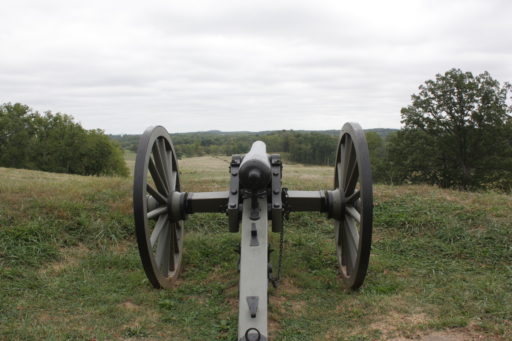
Cannon on cemetery ridge looking north-east. This position was the fall-back position on the first day of the battle. 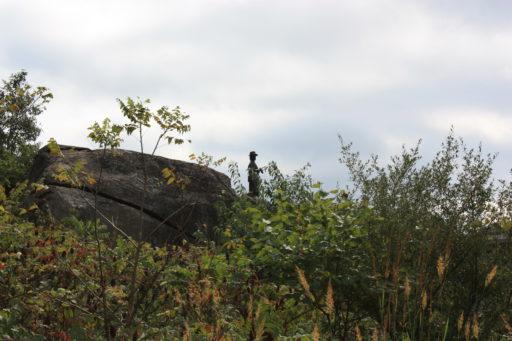
Looking up at little round top. 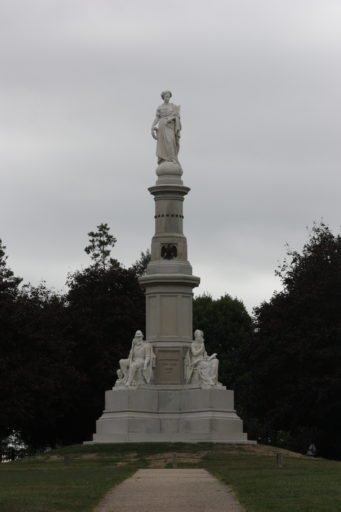
The monument at focal point of the Gettysburg National Cemetery. Lincoln gave the Gettysburg address near this spot during his dedicatory remarks. 
The center of the union line on the east-end of the battlefield. Confederate lines advanced across the open field from the tree-line on the other end of the fields. 
The “Angle” – the high-water mark of the confederate advance during Pickett’s charge. One of the bloodiest locations on the battlefield. 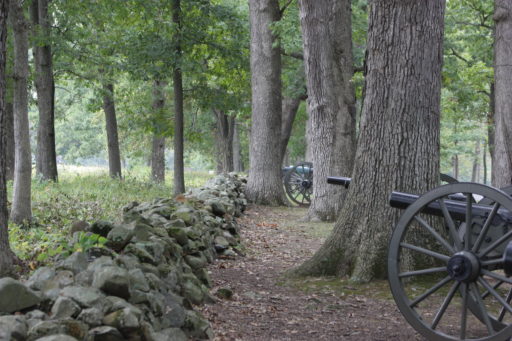
Confederate artillery just behind the tree-line. Artillery located here bombarded the union lines for two hours before Pickett’s charge in an attempt to soften up the defenses. It was largely ineffective. 
Rocks of the Devil’s Den. Confederate sharpshooters harassed Union soldiers a few hundred yards away on little round top from here. 
Another look at the confederate artillery emplacement 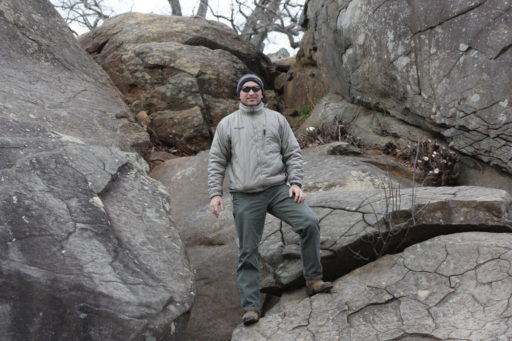
Me standing in one of the crags of Devil’s Den -

Satan’s laugh
Hateful things in human thought
Twisted minds this sin have brought
Barking dogs pull at the chain
Howling shrieks and moans of pain
Mothers weep and infants cry
Above the gate - ARBEIT MACHT FREI
Shuffling feet of broken hearts
Pause for families torn apart
Wives and children stripped away
Screams and cries that cannot sway

One by one sent there and here
For some the end is very near
While others hear the orders barked
For brutal labor they were marked
The crack of whips and thud of fist
The whimpered hope you're on the list
Yet labor's toil halts not the end
It just delays the captive's friend
Released as smoke to float away
To rest in peace 'till judgement day

The aircraft's roar makes rain of steel
The rumbling tank with squeaking wheel
The cannon's bark and tongue of flame
Cackling guns no man can tame
Hateful shouts dehumanize
All morals lost to human eyes
Torture, torment, words of hate
Pain designed to grind and grate

Little children weaponized
With vacant stares and hollow eyes
Mothers, fathers, infants, kids
Thrashed and killed as leader bids
Allah's name they shout aloud
And purify by purge the town
They claim to be his army true
Do horrid things no saint could do

Hate and malice, selfishness
Idols finely shaped and dressed
Lure distract and lead away
Those who stumble on their way
To wanton riot, heinous deeds
Anything to feed their greed
Shattered lives and broken dreams
Whimpered cries and shouted screams
Calls for vengeance swift and sure
Find neither answer nor the cure

These horrid sounds assault the ears
Tender hearts sprout monstrous tears
But hardened souls cannot be moved
Though hell itself their deeds reprove
Rumbling, thundering waves of sound
O'er the earth reverb, rebound
Satan's laugh with mortal voice
Cackling glee at human's choice
Oh what fools these mortal souls
who let me in to take control
-
DC at night
Spent a cold night wandering the national mall with a camera and tripod. A brisk night, brisk walk, and some pretty cool pictures.

National WWII memorial looking north. 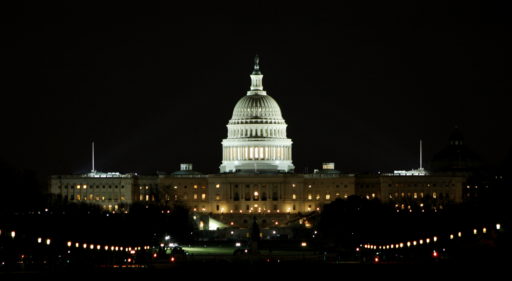
The capitol as seen looking down the national mall. If you look close, you can see the platform where the inauguration will take place January 20th. 
One of many government office buildings off the national mall. I don’t recall what agencies call this one home. 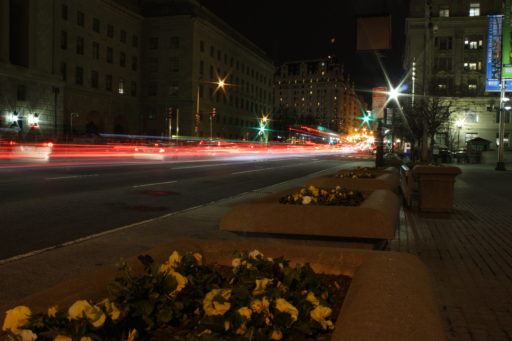
Just watching traffic headed north. 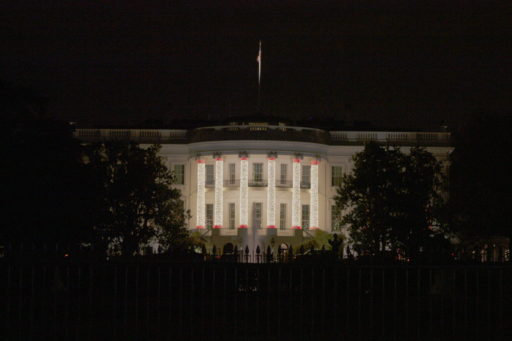
The white house dressed up for Christmas 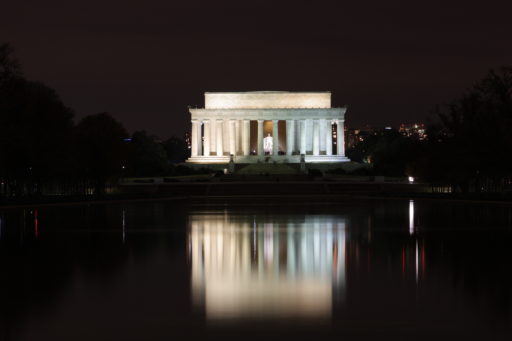
The Lincoln memorial viewed from just west of the Washington memorial 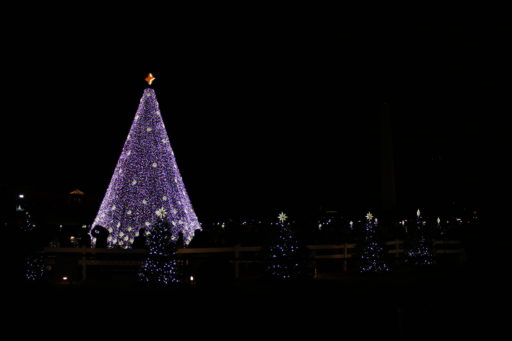
The National Christmas Tree in the “oval” just south of the white house 
Another view of the WWII memorial 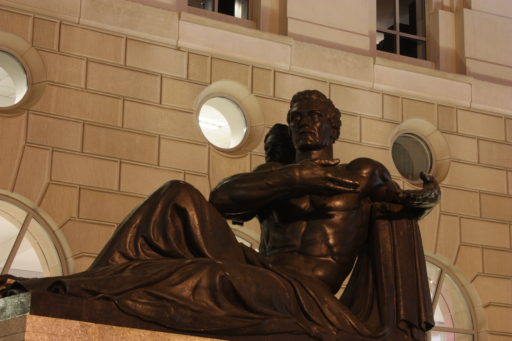
One of many random sculptures paid for with taxpayer dollars -
A Rant on Modern Science
When I was a kid, my best friend Zeke (not his real name) was what we all considered “fat.” In addition to being heavier than the rest of us, he had a complexion that would have been described as sallow, had a tendency for profuse sweating, bad teeth, and delayed mental development. He was different, and that made him a target. Aside from Zeke and one or two other kids in my elementary school, I can’t remember a single kid who would be labeled overweight by today’s standards. Fast-forward thirty years, and my experience would infer that Zeke would be quite normal in a modern school.
There appears to be near universal alarm, hysteria, and media hype about an “epidemic” of obesity; childhood obesity in particular. Everyone from the First Lady to self-help authors are on the bandwagon, shouting to the hills about the evil of one perceived cause or another and schilling for their particular remedy. Assuming you believe the publicly circulated reports, obesity is responsible for or contributes to more untimely deaths than smoking, and the rate of occurrence is reportedly on the rise. Based on my personal experiences observing and interacting with every-day people, I would have to agree that something has gone seriously wrong in the thirty or so years between my generation and the current one. The real question, and one that I don’t believe has been adequately answered, is what?
Given the wide acknowledgement of a problem and poor public understanding of the causes and cures, industry writ-large is exploiting the vacuum to bleed the public. The diet and supplement industries are playing to this tune and stripping billions from the pocketbooks of people who have fallen victim to this plague. It seems every day there is a new “miracle” diet that completely contradicts yesterday’s diet d’jour and will cure you of your ills for a price. I’ve lost count of the number of miracle supplements and “natural” products (all of them expensive) that were supposed to make weight loss easy only to see them pulled from the shelves as unsafe or fade away into oblivion as the public gained experience and found the results to be wanting.
The pharmaceutical industry too has stepped up to the plate by introducing new miracle drugs that promise to end heart-disease by lowering cholesterol, cure obesity by interfering with our ability to digest fat, and in general make us healthier and happier through chemistry – for a price. It almost seems to be a point of pride for some (some quite close to me) how many different drugs they are taking. The food industry has also responded by introducing an endless stream of new “healthier” alternatives to traditional foods. Diet sodas, low-fat snacks, processed whole-grain cereals, cholesterol free refined vegetable oils, and so on and so on. In addition to providing “healthier” ingredients, the industry is saving us the trouble of having to think about what goes into the food we eat by providing these items to us in a processed form that is ready for consumption, complete with labeling to reassure us that science is on their side. Looking around me, it is clear that science has failed us in many respects. “Science” has been promising painless progress and perfect cures for this health epidemic and it’s close cousins since before I was born, but the overall trajectory in many ways has been increasingly downward.
One thing I’ve not seen, though, is a willingness to reexamine the fundamental premises of the current hysteria. Historically, obesity was an affliction of the affluent. The kinds of heart disease and other chronic illnesses that make life miserable or short for a great many people today were reportedly almost unknown in preindustrialized societies. As recently as the 1930s, Weston Price was able to find societies who hadn’t adopted modern lifestyles and eating habits, and where rotten teeth and heart disease were virtually unknown. None of these people followed the advice of modern science for caring for their cardiovascular system or teeth. They ate diets that for the most part would be condemned by modern science as an irrefutable recipe for an early heart attack. Science has been unwilling to question how and why this is the case, and either writes these cases off as aberrations or statistical anomalies, or looks for other factors that they can use to make the data fit their existing hypothesis. The science of heart disease and tooth decay is “settled,” and the debate is over. Never mind the fact that nearly 40 years of low-fat, low-cholesterol hysteria has done nothing to reduce the actual prevalence of the condition it was supposed to fix. One of the truest tests for the utility of any scientific theory is it’s ability to make predictions that match observations. In this case, the predictions have been abysmal – enough so, I believe, that the theory should be scrapped. Yet we are unwilling to go back to the beginning and re-examine the underlying assumptions. We seem unable to give up on something new and go back to reevaluate the wisdom of the past.
I think it is a part of the American psyche that we tend to want to look forward, to “progress.” There is an implicit trust in anything labeled as science and deriving from experts, and a serious prejudice against the preferences and traditions of prior generations. This mindset has been at the heart of some of the greatest inventions the world has ever known, but it can also lead to devastating consequences if our trust is misplaced. In the past it has resulted in products such as methamphetamine being openly marketed as a cure for fatigue and a miracle diet pill. It brought in kudzu to the American south for erosion control. It brought African honey bees (killer bees) into South America. We have a habit of arrogance that can be astounding, and a willingness to remain blind to our own limitations and limited understanding.
It is a fundamental characteristic that the capacity for evil inherent in any given object, capability, or idea is almost directly proportional to the capacity of the same thing for good, and it requires great diligence, thought, and analysis to distinguish between the two when the messages are controlled or shaped by those with an interest in the outcome. What’s more, we are truly adept at ignoring those things that are somewhat inconvenient or that would require us to move away from the preformed ideas we hold. In my mind, there is at the core of much modern debate a fundamental inconsistency – one that we tend to ignore just like other the inherent flaws and contradictions in our attempts to “fix” the human condition through “science.” This inconsistency, if truly examined and acted upon, would radically change the way we look at the world around us; and it is this kind of change of perspective that I am seeking for myself.
Foundations
“He is like a man which built an house, and digged deep, and laid the foundation on a rock: and when the flood arose, the stream beat vehemently upon that house, and could not shake it: for it was founded upon a rock.” – Luke 6:48
Not too long ago my wife and I purchased land and contracted to have a home built on it. Before any other work was done, the contractor dug a hole in the ground near where the house was planned in order for a specialized engineer to evaluate the soils and design a foundation that would be strong enough and anchored deep enough to prevent it from shifting, heaving, cracking, and generally undermining the construction. After evaluating the soil, the engineer retired to his firm to do the required analysis and design. His results indicated that the standard foundation construction for which we had budgeted and scheduled would be inadequate. We would have to spend significantly more money and allow extra time.
This was a significant challenge for our family. We had already delayed construction several months due to difficulties closing on the land and construction loan, and were facing a period of homelessness between our extant lease expiring and our house being ready for occupancy. Unexpected costs at closing had sapped much of the reserve we had allocated for cost overruns. The additional costs and delays required to evaluate and design the foundations were a significant inconvenience. However, there was never any doubt about the path we needed to take. Weakness in the foundation would undermine the entire house and jeopardize everything we had put into it.
What does this have to do with the topic at hand? The answer lies in the foundations for many of the positions and arguments made today. I believe we have built many of our exquisite explanations and justifications on the weakest of foundations. Foundations that were cracked even as the first bricks were laid for the enormous house of cards that we have built. However, because we are deeply invested in what we have built up we continue to patch, re-level, brace, and generally bandage the teetering tower of sophisms rather than look at the root cause of the repeated need to patch.
In order to get a clearer understanding of the problems we face, and find any hope that we can begin to correct them, we need to start by acknowledging the failure of current foundations, then identify the requirements for a solid foundation on which we can build a durable and strong structure capable of enabling clear understanding.
What then is the foundation upon which modern thinking is based? In short, my view is that our cultural and intellectual foundation is grounded on the belief that man has evolved or progressed miraculously in the last 100 years or so, overtaking and overcoming all the wisdom of the ages with irrefutable and indisputable science. We seem to believe that we are fundamentally different from our ancestors, and that anything produced before our living memory is as crude and barbaric as bleeding a sick patient in order to “re-balance the humors.” We believe we can accurately explain anything, and are quite adept at developing explanations and theories that fit conveniently with and support our biases, prejudices, and preferences. We also believe that we actually understand the intricacies of the universe we live in and the relationships between the numberless components and influences. We also tend to reject or write-off data or theories that don’t fit with our pre-conceived notions or current understanding.
I claim this foundation is perhaps as shaky as any ever built. Each aspect I evaluate seems as solid as a cloud, glued to the rest by little more than air. To begin with, consider the basic premise that science has answered or will answered our questions irrefutably and that using scientific methods, we have proven theory beyond any shadow of a doubt. I personally find this belief preposterous for a very simple reason. We are inside, affected by, and affecting in the course of observation or even existence the system we are attempting to describe. Our ability to objectively and fully observe any phenomenon is fundamentally limited. At best, we can view or account for only a small subset of the conditions, variables, forces, and other interactions that make up even the smallest and most controlled of physical experiments.
Humility
“Oh what fools these mortals be.” – Shakespeare
As an illuminating example of how insignificant our capacity and understanding are, consider the anecdote of the butterfly flapping his wings in one hemisphere tipping the scales and initiating a hurricane in the other. Every aspect of the atmosphere is interconnected. On a very small scale, we have written equations and theories for how the major constituents of the atmosphere react to pressure, temperature, motion, etc… and have shown that these equations accurately predict observable changes in controlled environments. Analyzing the theory has resulted in insights and additional predictions that became the basis for great discoveries and inventions such as the jet engine and common refrigerator. These developments have been practical and important, and were based on principles derived from the same fundamental theories that should govern butterfly wing turbulence and hurricanes. The problem with applying these theories to the global-scale is that complexity makes the problem intractable (a scientist’s or mathematician’s way of saying impossibly complicated and unsolvable).
Things in the real world are impossibly interconnected and involve an almost infinitely dense set of relationships. This fact makes definitive theory useless for application on that kind of scale. In the case of the butterfly flapping it’s wings, we would need to know the texture of the wing in exquisite detail, the precise motion of the wings, the location and physical shape of the butterfly and every object in the vicinity that would impact the induced air currents, the terrain and all other physical features of the global environment that would affect the movement of air. Each of these factors are potentially related, with one affecting the other, requiring specification of the first-order (how one thing affects it’s neighbor) and higher-order (how multiple things combine to affect other things) relationships between them.
As an example of how ridiculously complicated this becomes, consider one method for modeling where we cut up the space into small cubical “blocks” of air that are next to each other. This division into discrete blocks is not reality, but is a simplifying approximation required to even begin framing the problem. Each block interacts with at least the six other blocks which border it (top, bottom, left, right, front and back). At a minimum, all six of these interactions must be described by at least one relationship (equation with at least one variable) and initial conditions (starting points) for each variable. For the approximation of the “block” of air to be moderately accurate, the block must be small enough that the stuff inside it is easy to fully account for and everything inside the block is uniform… Nothing inside the box is affected by anything outside it, and there is nothing inside the box to perturb the internal conditions. The entire box of air reacts together to the influences of the boxes surrounding it.
Now, rather than tackle the entire globe at once, consider a 2000 square-foot house with eight-foot ceilings. For simplicity and illustrative purposes, assume that we can adequately describe the atmosphere by chopping it up into one cubic foot blocks (about the volume inside a mid-size microwave oven). Also for simplicity, assume there is a single, one-term, relationship between each face of the block and the block next to it. Assuming the house is a pure cube with no walls, ceiling, heat sources, furniture, or other factors that could influence our butterfly turbulence, there are 16,000 “cubes” of air, resulting in at least 96,000 starting data points and first-order/nearest neighbor relationships.
This sounds pretty difficult already, but with modern computers systems of even millions of interrelated equations are easily solved. I personally have written programs to grind through extremely large problems, and am enamored of the computing capacity we have developed. Our 96,000 element problem is simple once the relationships and starting conditions are defined. However, one cubic foot is HUGE compared to our butterfly. If we break up the atmosphere into one-foot cubes we will loose the butterfly to the assumption that the air inside the box is uniform. In order to preserve any of the effects of the butterfly, we’d have to break the box up into pieces less than about 1/10th the size of the smallest feature in the system. For the sake of this example, think of something on the order of one cubic millimeter (roughly a grain of kosher salt) or even smaller. In this case, our 96,000 relationships for the 2000 sq-ft house become more than 2.7×10^12 (2.7 Billion) relationships and starting conditions. Add to that the need to describe every square millimeter of air contacting non-air (walls, floor, furniture, etc…) in 3-dimensional space, and an expression that adequately captures the way the air interacts with it (for example, foam would be substantially different from steel), and it would take well over 20 terabytes to digitally store just one double-precision value for each cube.
In addition to cutting up space in to blocks, time must be discretized in order to compute the effects of our butterfly. Think of it like watching a movie… Each picture in the movie is a single snapshot of what things look like at that time. If we are only working to the fidelity of the human eye, we only need to cut time into segments of about 1/24th of a second each (24 frames per second) since the eye can’t really respond faster than that. However, if you use this frame-rate to record something that happens very quickly, all you see is a blur that washes out the very thing you were trying to record. This is why National Geographic and other documentarians love extreme slow-motion cameras for filming amazing things like a great white shark attacking a seal, a humming bird flying, or a chameleon catching a fly. These scenes are created by breaking time up into much smaller chunks. In a similar fashion, to model the effect of the butterfly’s wings, we need to break time up into chunks small enough that the “wave” of turbulence generated by the butterfly doesn’t travel across any of the blocks of air between time slots. What this means, is that the entire gargantuan system of equations we’ve developed to model the system has to be solved over and over again for each tiny time slot until the effect has reached the time we are interested in. Assuming access to a supercomputer large enough to store and process data on this scale, the time required to process a single slice of time would be substantial. Continuing the computation to describe the immediate effect just across the room (not to mention the late-term and second-order effects) would be phenomenal.
Solving this system might be conceivable in the future if Moore’s law continues to hold (roughly stated – computing power doubles every 18 months). However, the complexity doesn’t stop there. We could continue to refine the problem (and make it more realistic) by adding second and third-order effects, further breaking down the discretization (blocks) into smaller blocks, and including an almost infinite list of external influences ranging from the effects of gravity on the density of the air as a function of altitude to the temporal and spatial variations in solar heating caused by variable absorption in the atmosphere and so on, and so on… Our ability to even comprehend all the factors that may influence even a highly artificial and controlled situation is fundamentally limited. At some point, we become part of the data set ourselves (our breathing and movement for example), and in the act of setting up our measurements we perturb the experiment and invalidate the results to some degree.
Finally, perform this mental experiment: Look up your house on your favorite mapping software that includes satellite imagery. Think how complex the problem of scientifically describing your house is, then slowly zoom out until you have an appreciation for how small your postage-stamp on planet earth is in the grand scheme of things. That zoomed out picture contains a great many houses of similar complexity with additional “stuff” between them that must be similarly described. Continue the exercise by mentally backing out further until the earth is a speck in the solar system, the sun a dot in the galaxy, the galaxy a small speck in the universe, and so on… The closer we look, the smaller we are, and the more we understand how little we actually KNOW.
There are good reasons why weather guessers have a hard time predicting the weather more than just a few hours in advance. Even equipped with the best models, super computers, and science to back them up, their computations are necessarily based on simplifying assumptions and approximations. The best they can hope to do is run a whole bunch of simplified simulations with varying amounts of randomness added in to simulate the unknown contributions of the real world to their idealized model and hope the average comes out somewhere near the truth. This isn’t unique to weather. All of human endeavor is clouded by the limitations of finite understanding, precision, and capacity. Sometimes the effect is obvious (like the weather), and sometimes it is hidden or small enough that we ignore it either willfully, deliberately or through ignorance of its existence.
Even if by some miracle we were to completely observe, describe, and incorporate all influences within a system into a universal theory that worked all the time, there is no real way to prove the theory is in fact the way things actually are. We can demonstrate the adequacy of the theory for describing and predicting observations. We can similarly disprove a bad theory by showing counter-examples. And, once certain underlying conditions have been set down we can “prove” a theory in some sense provided our underlying “facts” are in fact correct. However, all proofs begin with a statement of the given facts, and as much as we would like to dis-believe it, facts in an absolute first-principles sense are difficult to come by. The best we can hope for is confirmation that the theory is capable of predicting the behavior of the system for which it was created.
As an example, consider one of the fundamental “givens” in physics: opposite charges attract in quantifiable terms, and like charges repel in a similar fashion. We can demonstrate easily that objects imparted a “charge” of “like” or “opposite” character will attract or repel each other in a well behaved and well defined manner. If we add to this the concept of magnetism and describe the observed effects in equations laid down based on scientific observations by Gauss, Maxwell, and others many moons ago, we can take those relationships (equations) and use them to predict certain observable behaviors that explain things like stereo speakers, power generators, radio waves, light, and so on… Using the core concept of charge and magnetism, we have been phenomenally successful at identifying means to leverage and manipulate the world around us for our own convenience. This is the true utility of science. It allows us to describe interactions in a way that enables comprehension and understanding sufficient for predicting the outcome. However, being able to describe something in useful terms and being able to give the definitive specification for what something actually is are not necessarily the same.
As an example, the concepts of “charge” and “magnetism” have proven very useful; expanding from the extremely small-scale universe of quantum mechanics through to grand-scale cosmology, and have stretched into the even more esoteric realms beyond. I don’t believe there has been a single data point or theoretical instance that casts doubt on the utility of these concepts. However, we don’t often stop to think and ask ourselves – what is a charge? I contend we don’t actually know, and fundamentally cannot know. All we can hope to do is describe it’s effects. We can’t inspect it directly. We can’t see it. And even if we could, we would be limited by the fact that we are part of the system within which the concepts exist, and therefore not in a position to step back and pass absolute, impartial, and correct judgment. It would be a bit like asking a blind salamander who had spent his entire life in a dark cave to describe the universe based on the minerals dissolved in the water he drinks and the detritus he cannot see that makes its way into the darkness of his cave.
Unlike the blind salamander though, we have been amazingly adept at using our limited capacity to comprehend the universe to build theories and explanations that conform with observation. As we have gained experience with these theories, we have historically become more and more confident in their correctness, to the extent that we become blinded to our own nothingness. Prior to the 1920s, physicists believed they were just about “done.” They had built up a theory of how the world works that could describe almost every observable phenomenon when viewed in isolation. There were just a few inconvenient aberrations like why a heated incandescent light-bulb filament is the color it is and why different materials retained heat better than others. Many physicists were convinced these trivialities would surely be fixed in due time and the theory of how the universe works would be complete.
Scientists can be a rather arrogant lot. When we think we know the answer, we tend to push back at anything that seems “counter-factual” or inconsistent with our understanding. We look for plausible explanations for “outliers.” We get comfortable with a theory and forget the limitations and uncertainty upon which it is built. We begin to confuse belief and knowledge, model and object, master and servant. This behavior is not unique to the big-brained academics. We all tend to assume we “know” things that at their heart are fundamentally unknowable, and to discount anything that is counter to our predetermined outcome. In the case of the initial forays into quantum mechanics, the professors of classical mechanics didn’t react well to the radical new theories that fundamentally undermined their understanding of the world.
Unfortunately for Sir Isaac Newton and those who followed in his footsteps, the inconvenient aberrations or oddities early 20th century physicists explored shook the very foundations of science in ways nobody could have predicted. The resulting innovations in thought and theory resulted in new ways of describing the world that opened the doors to an amazingly wide range of modern innovation ranging from the amazing contributions of chemical engineering to the world of digital electronics that surrounds us now. In the course of exploring the oddball “boutique” problems, brilliant minds would introduce the theory of quantum mechanics and turn the scientific world on it’s head, all while demonstrating the absolute inadequacy of what had been all too recently declared as essentially “done.”
This up-ending of understanding is not unique, and won’t stop with the current generation of experts. However, there are limits to what we can observe, and therefore limits on how much we can usefully predict and begin to understand. In every generation, there have been those who argued vehemently against any form of theory or thought that went against conventional wisdom. In every case I’m aware of, every single professor of wisdom who declared the argument over and science settled has, in the end, ended up on the trash-heap of history. I find it an amazing mark of arrogance and stupidity when I look around me and find an entire generation who have bought off on the message that science has “proven” this, that, or the other, and that the debate is over. To think that we are capable of completely comprehending, understanding and accounting for all of the influences and interactions that make up this amazing universe of ours is indeed one of the most stupid things I can come up with.
If we as a people are to have any hope for increasing our understanding and improving our situations, we need to be honest about our own inadequacy. When we are arrogant or self-certain, we close the door on learning. There is no student more difficult to teach than one who believes they already know the answer, and the most unfortunate part is that the answer itself is rarely the point of the learning. We must be humble to be teachable. We must comprehend our limitations and be willing to acknowledge that even our most exquisite and best developed theories are no more than that… theories that are useful within the context for which they were developed.
Down With Intellectual Laziness
“For even when we were with you, this we commanded you, that if any would not work, neither should he eat” – 2 Thessalonians 3:10
One of the most important lessons life has taught me is to question everything with an open mind. I believe we as a society have become too mentally lazy to do the real work required to thoroughly analyze a problem, research answers, organize and arrange the results and come to a conclusion based on rational and defensible conclusions. The human desire for simplicity and ease is natural, and is to a great degree responsible for many of the improvements in our lives. The desire to get more out of the limited resources we have is the driving force behind innovation but also lies at the heart of laziness. Very few people, indeed you could argue that no one, will sacrifice short-term gains unless they perceive a long-term payoff that makes the sacrifice worthwhile. The distinguishing factor behind laziness is the inability or unwillingness to look forward into the future to identify areas where sacrifice or hard work will pay off.
The American public has become intellectually Lazy. It is much easier for us to accept a party line, polished explanation, or the confident explanations of experts than to spend the time and effort to truly evaluate the substance of the messages we hear. More often than not, positions are taken based on popular appeal, fair speaking, hollow promises, uncritically examined ideologies, or blind acceptance of the status-quo. This mental flabbiness seems to extend to all aspects of modern life. We have reached a stage of society where the 6-second news clip can incite riots, the most repeated opinions are taken as truth, and true debate and discussion are displaced by unthinking partisan bickering, intellectual dishonesty, and unreasoned and inflexible dogma.
In my personal efforts to overcome this mental laziness, I have read and considered some of what would have passed for mass media early in our country’s history. A case in point that illustrates how far we have wandered from our roots as a thinking society are the Federalist and Anti-Federalist Papers. These papers were originally written as series of newspaper articles intended to inform the public and shape the public debate surrounding the adoption of our current constitutions which represented a much more powerful and expansive federal government than existed under the Articles of Confederation. The pubic debate they represent could not happen in today’s society. The arguments are too dense, discussion too long, and thoughts too deep to survive the attention span and understanding of the masses. We are simply too lazy to put the work into understanding the issues, dissecting the arguments, and forming our own opinions.
To complicate matters, we are constantly bombarded with predigested and analyzed sound-bites informing us what the “correct” opinion is. In this “information age” many had hoped for an empowered populace who could freely share information and allow all to discover the “truth” independent from the media moguls and other power players who historically shaped opinion by using their printing presses or bully pulpits. However, as we have gained more and better access to instant information, major information brokers have risen up and established themselves as the filter for what is true and newsworthy. In spite of our incredible access to information, I believe the average American is more poorly informed on important topics than his antecedents. While you could argue that keeping abreast of the current status of ones friends, family, pop-stars, pets, and other random strangers is being informed, I disagree. We live in an age where some of the most thought-provoking items are pictures of an angry cat with a few words emblazoned across it. We have drowned ourselves in worthless information to the exclusion of truly important issues.
We, as a society, must get better at shutting out the trivial and prepackaged messaging that would lull us into a thoughtless stupor. We need to deliberately work to strengthen our critical reasoning skills. We need to deliberately work to learn new and challenging things. We need to deliberately work to understand both sides of complex and contentious arguments. We need to deliberately work to understand our own beliefs and the foundations on which they are built. We need to deliberately work to probe, push and expand the boundaries of our capacity. All of this is work – hard work – and work is antithetical to laziness. We must not be lazy.
Healthy Skepticism
“the unexamined life is not worth living” – Emerson.
Skeptics can be hard to live with or be around. The incurable skeptic is rarely happy, and seems to delight in toppling the cherished beliefs of those around him. This is not the kind of skepticism that I advocate. We should be willing to look at anything with a healthy dose of caution, but I’m not talking about the biting skepticism that sees no truth in anything and draws it’s strength in only tearing down and demolishing. Rather, I’m talking about the kind of skepticism that leads one to look at an argument for more than its fit and finish. Healthy skepticism should lead us to at least question the motives of information brokers, the strengths and weaknesses of the source, understand and look for holes in arguments, compare what you find against your own personal stores of truth, and be willing to accept something only after careful consideration. Several years ago, I worked for an organization who’s motto was “Trust but Verify.” This, in essence, is the kind of skepticism I believe is called for in most things.
Science of all kinds has a long history of being biased in favor of those who fund it. This is occasionally overt, cynical, and self-serving; but more often it is a result of unacknowledged biases, unrecognized blind-spots, and group-think that can lead the investigator to discount the truth in favor of something they hope to find. When we are presented with a new set of data, it would behoove us to question the biases and motivations of both those who paid for it, and those who generated it. One simple test I have used for blind bias has been to look at how one reacts to criticism. Reactions that are more appropriate for a religious zealot, and show the kind of arrogance and hubris I’ve already described, are sure signs of internal bias that will undoubtedly taint the data. Intolerance of dissent or questioning is a characteristic of a cult, not a scientific endeavor.
Respect the Past
“Study the past if you would divine the future” – Confucius
We are all too prone to look at history as being peopled with a different race of being who was all together less intelligent and capable than us. While there were many beliefs and practices throughout history that were truly barbaric and ill conceived, the basic nature of humanity hasn’t changed nearly as much as we think. While our technologies have enabled us to see things that were previously unseeable, and we have gained insights that were previously inconceivable, that is no reason to discard wholesale the wisdom of the ages.
As a case in point, I recently heard a story of a team decided to comb through an ancient viking medical text for insights fighting antibiotic-resistant bacteria. The team discovered a recipe for an ointment that was noted as working very well for a particular form of eye infection that can be refractory to conventional treatment. Rather than dismiss it as hocus-pocus or snake oil, they decided to follow the recipe exactly and see what came of it. To their surprise, the resulting product had phenomenal antibiotic properties against some very difficult to treat bacteria. The medical community was not only skeptical, but openly hostile when the discovered the original source. Now, I doubt the original developer of this recipe understood that the infection was caused by bacteria, and that the particular mixture he developed had antibiotic properties; but I do believe that it was based on observations of what worked, and that explanations of magic or the like were used to describe what they saw in terms familiar to the audience.
Humankind had spent millennia observing their environment and conducting experiments based on those observations. While some theories and practices that resulted had, in the end, no justifiable basis and were ultimately harmful (bloodletting and the medicinal use of mercury for example), others have proven much more useful. One case in point relates to the anecdote with which I opened this essay. As shown by both the fossil record and studies by those like Weston Price, traditional societies who eat the way they did hundreds or thousands of years ago, and eschew the kinds of highly processed low-fat foods that are now the rage, have little to no tooth decay, heart disease, or obesity. Coincidentally, those same groups tend to eat a diet high in saturated fat, cholesterol, and animal protein. I think, as a general rule, a healthy respect for what tradition says about what is good for health and society should be given the benefit of the doubt, and that new evidence that “proves” that what has been considered “wisdom” for generations is false should be subjected to intense scrutiny. We are far to quick to discard tradition simply because it is old. Let us respect tradition and look for ways to integrate it with our modern world.
-
False Advertising
My wife will tell you I have issues — one of which is keeping a hold on my wedding ring. In some marriages, this could be a sign of infidelity or weak commitment, but thankfully for me, Liz understands me well enough to know that rings and I just don’t get along. One ring disappeared while I was riding my motorcycle and the cold air caused my fingers to shrink enough that the ring fell off while I was waiving at a biker in the oncoming lane. It disappeared along the freeway. Another disappeared when I shook cold water off of my hands while I was camping. In spite of an extensive search, it never surfaced again. I lost one while wake-boarding because it got caught on the tow-rope and almost took my finger with it as it fell to the bottom of the Banana River in Florida. Another got stolen from a locker where I had left it so it wouldn’t get torn up while I was in the gym. I don’t have a great track record with jewelry.
In addition to losing rings, during the intervals between losses where I possessed and wore one, I had a bad habit of getting them caught in machinery, scratched up on rocks, tools, equipment, or engines, or inadvertently shorting out electronics I was working on. As a result of my work habits, absent mindedness, and rough hobbies, I quit wearing a wedding band all together almost eight years ago. Liz has accepted this fact and gave up on me wearing any form of jewelry long ago. The heart of the reason she is so accepting is because of who I am… If you know me at all, you know I’m married. It’s so central to who I am. She knows that, and so isn’t concerned that I don’t have a visible wedding ring.
However, the dynamic in my current environment is substantially different from what I’m accustomed to. This area is rich with single people. In fact, the church building nearest my hotel has three separate congregations of single adults, something I’ve never seen before. In addition to the dedicated singles wards, the family ward I attend is populated with something between thirty and fifty percent single adults. It isn’t enough, however, to say there are a lot of singles around here. That would be a serious mischaracterization by way of omission. As an example, consider a recent experience at stake conference:
A few weeks ago, the stake where I am attending held a stake conference. None of the buildings in the area are capable of handling everyone, so conference was broadcast to all the buildings throughout the stake. Given that the building where the singles met was substantially closer than where the family ward my cohorts and I attend, and that there wouldn’t be any other activities that day, we decided to walk over to the closer chapel. As the four of us (Brent, Nate, Nate’s visiting sister, and I) walked into the building, we were immediately under close scrutiny. Nate had his sister with him and a visible wedding band, and was therefore immediately written off as being spoken for. Brent and I weren’t so lucky. As fate would have it, neither Brent nor I wear a wedding band, and we were both subjects of intense curiosity.
As we took seats towards the back of the chapel, Brent and I left an empty seat between us without really thinking about it. “Man spacing” is pretty standard, and the fact that it would cause controversy didn’t cross our minds. However, within a few seconds, there was a queue of women headed our way to occupy the open seat. They all looked very disappointed when Brent slid over when the first of them asked to sit there and filled the gap himself. As we sat watching conference some of the reasons for disappointment became more clear. Two full rows of pews in front of us were completely occupied by single women. Beyond that, almost every male in the room was either visibly “spoken for” by the presence of a female neighbor, or had visible characteristics that indicated they were likely single for good reason. Many of the other pews also contained a large imbalance in the sex ratio. Brent and I were fresh meat, and they were obviously disappointed when we were not to be found in the market.
After the broadcast, the four of us laughed it off as we walked back to the hotel for the night. We were happy that we didn’t need to go back to the singles building. However, this most recent Sunday in the family ward I was caught off guard. Both Brent and Nate had their families visiting, which left me by myself on a short pew towards the back of the chapel. As I sat there oblivious to what was going on around me, two sisters took up position on the next pew back and made it a point to introduce themselves to me immediately after the meeting and begin chatting me up.
As we talked casually, I mentioned something about my wife and kids back in New Mexico. Almost immediately one of the two got up and left, and at the same time, the demeanor of the other shifted perceptibly. Within a minute of the “revelation,” the remaining sister informed me I was a “false advertiser” by virtue of the fact I wasn’t wearing a ring, and thanked me for not waiting to bring my family up in the conversation before she got her hopes up too high. I didn’t get the feeling she was really all that grateful. It wasn’t until this point that I understood what was going on.
I’ve got to say… if you’re a single, male, worthy member of the Church of Jesus Christ of Latter Day Saints who doesn’t mind big cities and is looking to improve your odds of matrimony, you might consider moving to the DC area. The unfortunate reality is that the sisters are more likely to remain faithful than the brothers, and that there just aren’t enough worthy men to meet the demands of all the women… especially around here. I imagine it’s about like it would have been to be a single man in gold-mining boom towns back in the 19th century.
It’s quite sad, actually, to see so many fine women compete for even the prospect of meeting a potential candidate for matrimonial bliss. I feel for them. It’s almost enough to begin to understand how polygamy could be a desirable solution. But, as for me… I just bought a silicone band that doesn’t cost much, won’t tear my finger off if it gets caught on equipment, won’t get scratched up or bent, won’t short out electronics, and will help me avoid those kind of awkward situations where someone is flirting with and feeling me out in the hope that I’m available. No more “false advertising” for me thank you!
-

Buried
Bury me not in the cold an dark earth,
Where the roots and worms churn the ground.
Rather lay me to rest in the folds of your heart,
Where your rarest of treasures are found.
-
Touristing
Updated with captions/commentary
One of the consequences of my career choice is that I tend to spend a lot of time away from home. Many of my co-workers who suffer from the same condition like to spend their free time and money while they are on the road on alcohol and public buffoonery. There is an all too common mentality among them that holds the rules don’t apply when away from home, and that it’s okay to indulge as long as word doesn’t get back home. I’ve never subscribed to this form of thinking, and as a result I tend to spend my extra time alone hiking trails, visiting parks, and generally trying to get the most out of whatever opportunities the local environment has to offer without burning my bank account and being able to look my wife and kids in the eye when I get home. In Hawaii, I drove the coast and hiked up the ridge that divides the northern and southern halves of Oahu while the others watched bikinis in Waikiki through the lens of a half-empty cocktail. In Germany, I drove through the countryside in Bavaria to visit Dachau and other WWII sites while others got so drunk in the beer halls that they weren’t likely to remember much about the evening when they sobered up. It always seems that, regardless of where I go, there is plenty to do that is interesting and entertaining.
At present, I’m stuck in DC for an extended stay. If there is anywhere in the world with a rich array of interesting and mostly free stuff to see and do, DC is it. I think I could spend a full day at each of the Smithsonian museums without even beginning to lose interest. Then there’s the monuments, other museums, civil war battlefields, architecture, Mount Vernon, Monticello, and numerous other places… As many times as I’ve been here, I’ve never run short of things to go and do (with the exception of snowmageddon when EVERYTHING was shut down and I had no choice but to sit in my hotel room and do nothing). While I generally detest working here, and have great issues with the general pace of life, high cost, and types of behaviors considered “normal” here, I do appreciate the area for it’s historical and other tourist attractions.
One thing I’ve found is that the best time to visit any of the outdoor attractions is early in the morning before the museums open. The sun isn’t as hot, and you’re much more likely to get a good look and time to ponder without having to push through crowds. Each of the following photographs were taken yesterday morning as I wandered the National Mall waiting for the museums to open. Each has meaning that would require explanation, and at the moment, I haven’t time to do justice to my thoughts. So, for now, I offer them up for your enjoyment without sharing my probably unwanted observations…
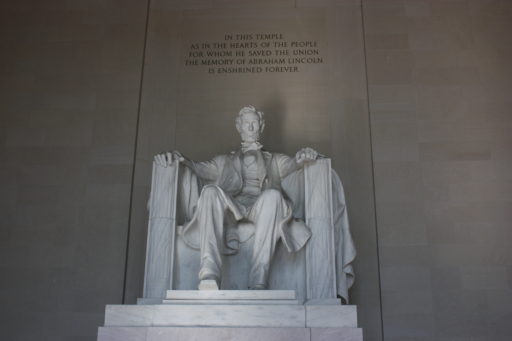
The Lincoln Memorial at the West end of the National Mall. Lincoln was a highly complex person, and the more I learn about him as a person and the decisions he made, the more of an enigma he becomes. However, he deserves his place here on the mall even if for no other reason than because he was the pivotal voice that brought down institutionalized slavery. The nation we have now would not have existed in it’s current form without his often unpopular actions. 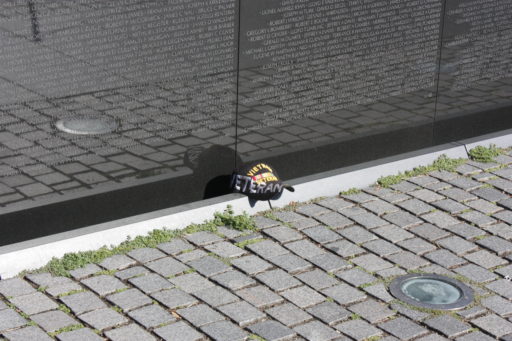
There are over 50,000 names of soldiers, sailors, airmen, and marines who died as a result of US involvement in Vietnam engraved on the memorial. Every one of those names represents the heartbreak of family and friends, and a stolen future. I think we would do well to remember this kind of human cost the next time we are tempted to send our future to fight on foreign fields. The veterans of this conflict are beginning to disappear, but I hope our cultural memory of their sacrifices will continue to echo through the minds of our leaders. 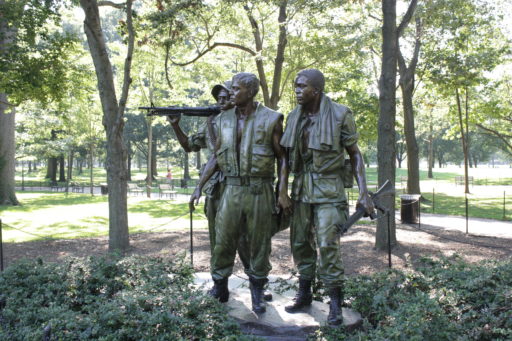
When I look at the pictures, statues, and raw facts surrounding warfare, I am always struck at the youth of those called to die for a cause. The soldiers depicted here in the statue at the Vietnam memorial were very young in the grand scheme of things. I doubt they understood the complex and often flawed reasoning that justified their deployment. 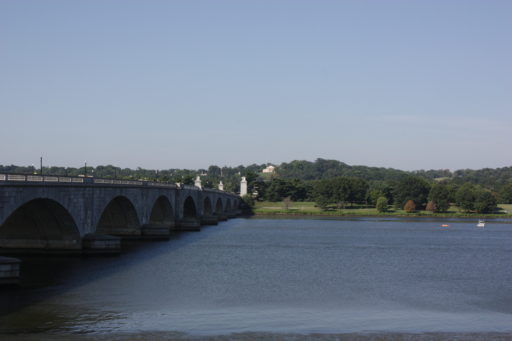
This picture was taken from the west end of the national mall, behind the Lincoln Memorial. The dome seen across the bridge is Lee’s home at his Arlington plantation that was appropriated for use as a national cemetery. The northern border of the confederacy during the Civil War began here, just a short walk from the office where President Lincoln shaped the Union response. I commute from the territory of the former Confederacy to the Union capitol every day by bicycle on my way to work. 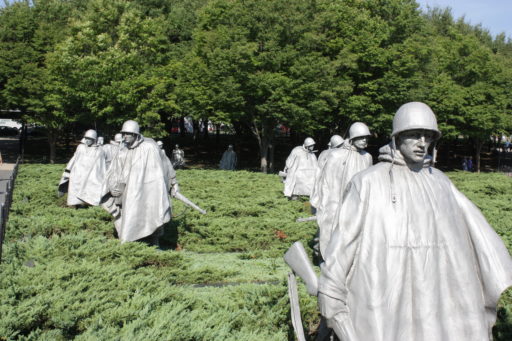
Statues in the Korean war memorial. Misery is in the face of every statue, and is reflected in the eyes of a great many combat veterans of the current fight. I doubt if anyone in congress or the senior levels of the executive branch really understands. 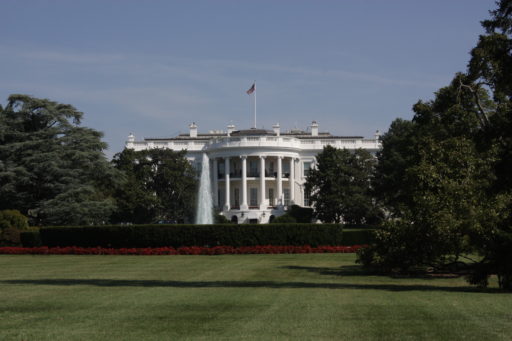
What you don’t see are the layers of protection that prevent anyone from getting near this building. Just after I snapped this picture, the Secret Service came through and closed off the park and pushed tourists substantially farther back. We have placed our leadership in a bubble where they no longer see, feel, smell, and experience the things that make up a human existence. We coddle them and protect them from inconvenience. We provide them with luxury and deny them the privilege of a normal life. It shouldn’t be a surprise, then, that they make decisions that don’t make any sense to the rest of us unfortunate plebes. -
Hippochondriac
Harry the zoo hippochondriac
was a wonderful pain in the butt.
The zookeepers all sat and wondered
what went on there inside of his nut.

He never went out
to enjoy the warm sun,
and never would venture
to swim, play, or run.

He'd moan and he'd groan
then flop hard in the hay,
convinced some zoo patron
had bubonic plague.

When spring cottonwoods bloomed
and sent tufts on the breeze,
he was sure that pneumonia
was what made him sneeze.

Once a blob of dried mud
stuck behind his left ear,
convinced him he'd cancer
and life's ending was near.

He would bellow and blow
that the flies overhead,
Brought pestilence deadly
sure to knock him down dead.

Any kindly meant checkup
by the resident vet,
was surely an omen
and for days he would fret.

So through forty two years
he would miserably wait,
for the deathly bad illness
that would seal his sad fate.

'Till age-ed and slowing
he looked back on his days,
and realized the joy
he'd let pass on the way.

Determined to master
his time that remained,
he rose and went out
to soak up the sun's rays.

Happy at last
to be out in the sun,
he started to trot
then broke into a run.

But his bones and his muscles
had grown wasted and thin,
his heart had grown weak
and beat frailly within.

The years of seclusion
left him withered and sick,
his irrational fears
played a horrible trick.

He collapsed in a heap
landing hard on the ground,
frantically looking
at the scenes all around.

Children were happy
the birds singing songs,
a light cooling breeze
moved white clouds along.

The pond's glistening waters
were just out of reach,
His cousins relaxing
stretched out on the beach.

He closed his weak eyes
knowing now what he'd missed,
by letting his worries
hold his soul in their fists.

His time wasted away
life now left him behind,
and passed on to others
who could happiness find.
-

Leaving
Precise to plans I drew myself,
To house my future and my past.
Space for children, work, and play,
Built strongly - made to last.

Connected with community,
Deep roots and friends abound.
Invested in longevity,
We'd planned to stick around.

The children learned to love this place,
We parents did the same.
Now plans have changed, and we must go,
A pawn in life's harsh game.

In packing up and leaving here,
I go as duty calls.
With heavy heart and misty eyes,
To cope where my lot falls.