CAVEAT: The design described here has fatal flaws. I’ve since re-designed it, and have left this here as a way to document the process and share the realities associated with designing even relatively simple things with whoever might read it. The current design is available here.
I don’t seem to be able to function well without some kind of project. Usually I have several waiting patiently for my attention. However, at the moment all my current ones require either time, money, or energy I just can’t afford to give. I have a coding project to finish the user interface for the antenna analyzer I designed and built. But that’s at a point where the interesting work is done, I’m stuck on something that should be easy, but there’s something I’m missing. I’ve been using the project to get better at C++, and have run into issues that probably stem from my poor understanding of class objects and their use in my implementation. I’m out of ideas, frustrated at my inability to figure it out, and just can’t convince myself to re-attack it. I’ll tackle it again, but not until I’ve quit being frustrated with it.
Many of the other projects require large enough chunks of money to move to the next step that they have to sit and wait for that arbitrary future when I’ll have enough cash to make more progress. Sometimes incremental progress isn’t really viable, so things just sit and collect dust. The rest (like my writing projects) require motivation and energy I just don’t have at the moment. I don’t have a good excuse other than I’m burned out on them. They’ll sit until I change how I feel about them.
I needed a project I could work on that didn’t take much creative energy, would keep my mind active, and that I could reasonably finish with the small budget I get to spend without having to impact the household finances. Thinking about it, I decided I’d try designing and building a Transcranial Direct Current Stimulator (TDCS). I’ve been seeing reports on the technology for years, and have watched agencies from DARPA to the Air Force research lab study it and demonstrate measurable effects. I’ve been curious to try it, but the controllers are either expensive, or I question the safety features in the slip-shod designs of products coming from places like China or fly-by-night hobby shops just trying to make a quick buck.
The basic concept behind the devices is really simple. The circuit applies a voltage just large enough to induce a small current through the head. Done right, the current is way below the threshold for causing any physiological damage. It can tingle or sting some, will probably leave a metallic taste in your mouth, and might cause a perception of a brief flash of light, but that’s about it. The theory behind its effect is that the small current creates a marginal potential in the brain that modulates the much stronger natural electrical signals already there. That modulation is thought to help selectively dampen or enhance those natural signals.
TDCS has shown clinical significance treating some forms of depression, anxiety, and chronic pain. It had been shown to increase user focus and accelerate learning. There are claims all over the place that it does everything sort of washing the dinner dishes for you. Some claims are backed up by robust research, others are anecdotal or even outright crap. I’m mostly interested in trying the more researched claims associated with depression and focus.
In particular, I’m interested in seeing how effective it would be against my particular variety of mood disorder. However, I’m not interested enough to buy a good device and not willing to risk attaching electrodes to my head driven by a device built and sold by Fast Eddy in his garage. I trust myself and the things I build in my garage. Not so much things built in other people’s garages.
So, with that in mind, I’m going to design my own. Over the next few posts, I’ll share the process and details. So without further adieu, on to Part 1 – Design.
How often do we casually ask someone we encounter how they are? Passing a casual acquaintance in the grocery store isle, the nearly universal greeting is to ask how they’re doing. Run into an old classmate you haven’t seen in a few decades who has their arms full of kids and is clearly on their way somewhere, and we ask how they’ve been. I know I’m guilty of it, and I’m pretty sure almost everyone else is too. This kind of callous or ignorant questioning needs to stop. We don’t really want to hear about our former classmate’s recent divorce and the ensuing financial difficulty. We don’t really want to know about how our co-worker is beside himself trying to figure out how to help a suicidal teenage daughter. They don’t want to hear our side of the story either.
Nobody’s life is boring enough to answer that question in a few syllables; and in reality, nobody really wants to answer it regardless of how much time you have to talk. The truth is, nobody can honestly say “fine” or “good” without perjuring themselves. Life is complicated. Those answers are not. However, those answers are the only socially acceptable variety.
When someone asks me that question, they aren’t really interested in hearing about how much I hate my job. They don’t have time to hear about the struggles I’m having raising my kids. They aren’t really interested in the difficulty I’m having with various medical issues. They don’t want to be faced with the reality of a midlife crisis in the makings. In short, they don’t really want to know how I’m doing. It would take too much time and emotional capital to listen, and then they would feel bad about being powerless to help. All people really want is to hear that you’re “fine” and then move along in their bubble of blissful ignorance.
Occasionally, someone actually does care, but then there is a different problem. Almost no one actually wants to talk about how they are doing. It’s depressing to think about it honestly. Even more than the people asking, I don’t want to think about how I’m doing. Life is easier when I can plug along mechanically without spending time thinking about things I can’t change. I’m happier when I don’t think about the things that make me unhappy. If you ask me how I’m doing, I have to ask myself; and the answer that returns isn’t often reassuring or comforting.
I suppose I could do the routine thing and mechanically answer “I’m fine,” but doing so makes me miserable because I know it’s at best a mischaracterisation, and more frequently an outright lie. Lying makes me even more miserable. I’d rather not do that.
I could tell the truth, but when you answer with any variant of “not good,” people instinctively ask why. Nobody (including myself) has the time or even the capacity to talk through complex and intractable problems then come out on the other end feeling better. In fact, it generally just makes everyone involved feel worse. Besides, the people asking are dealing with their own challenges, and life struggles shouldn’t be a competitive sport. They Don’t need to be weighed down with what I’m facing, and I don’t need to feel like you are trivializing my difficulty by sharing how much harder yours have been. You can’t compare pain and suffering, but that’s exactly what we tend to do when people start honestly talking about how they are doing.
So… After that rant… Can we please stop asking each other about how we are doing. It’s none of your damn business, and you don’t really want to know anyway.
When I was young my parents would take us over to my maternal grandfather’s house almost every Sunday evening. I have a great many memories of that house and the people in it.
My Grandfather’s house was a small pale-green concrete-block structure built shortly after World War II in Kearns, UT. As originally constructed, it had three bedrooms, two bathrooms, a small kitchen, a living room, a small family room, and not much else. I doubt it was much more than about 1200 square feet. Grandma and Grandpa occupied the master bedroom with its rather small attached bathroom. As you came through the door to their bedroom, the wall on the left was covered with a number of cabinets enclosed with sliding doors. On the right wall was a small walk-in closet and the bathroom. The far wall and almost all of the floor was full with the bed. A desk and some shelving took the remainder of the space on the wall with the door.
The front door of the house opened into the living room, but we never used that door — friends and family came in the back door without knocking. If you did walk through it, you came past a small closet and entered the room with a black wood/coal burning stove immediately to your right and backed up against the wall to the closet. Beyond the stove on the right was the hallway to the kids’ bedrooms and the small shared bathroom. Grandpa’s room was across the living room to the left. A pocket door (that I never saw closed) opened into the kitchen from the back left corner of the living room adjacent to Grandpa’s bedroom door. I remember a piano on the wall between the kitchen and living room, a couch and a chair or two, but mostly I remember the stove.
By the time my memories become more than shadows, all of Grandma’s nine kids had grown up and moved away, so nobody slept in the kids’ rooms. However, there were only a few months between the oldest of my cousins and my youngest aunt. There was never a time when there weren’t a gaggle of kids around Grandma’s house, so the toys never got put away. Whenever we visited, we would eventually gravitate to the girls’ room (the one on the right), open the closet, and start pulling out the toys. In particular, I remember an old Fisher Price parking garage, Lincoln Logs, and Tinker Toys. All well worn and polished smooth with use, and all considered far too dangerous for young children these days.
I have fewer memories of the boys’ room. However, I do remember an electric exercise bike that was in there. The thing was built like a tank, and had an electric motor on it that could have driven a car. When you turned it on, the pedals would turn and the seat and handle bars would oscillate up and down. I never understood how it was exercise to let the motor push you around, but it was fun (if dangerous) to get on it in any number of unintended ways and turn it on — especially when we turned the speed all the way up.
In the hallway before you reached the kids’ rooms there was a cabinet built into the wall where Grandma and Grandpa kept games. Board games and card games like Uno were a staple at their house, but never face-cards. I have many memories of playing the game “Memory” with Grandpa. We would lay the tiles out on the floor in the living room, and Grandpa would play with us. As we took turns flipping over tiles looking for a match, Grandpa would invariably take the lead. He would always apologize with a giggle when he made a match at our expense, and we could tell he wasn’t even remotely sorry. Grandpa liked to win.
Behind the master bedroom and just off of the kitchen was the family room. This, along with the kitchen, was the center of the home. They had a television and two comfortable recliners where they would sit and enjoy shows like The Laurence Welk Show. I don’t remember if there was any other furniture, but there was another wood/coal burning stove set in a corner with brick behind and under it. There were nooks in the brick where there were small trinkets, and Grandpa hid his matches there under the bad assumption that we wouldn’t notice them. This room would house the Christmas tree (set in the corner and blocking the back-door to the master bathroom), and was where we did all the Christmas rituals.
When I was about eight or so, Grandpa and Grandma decided they wanted a little more space in the kitchen and somewhere to put a regular washer and dryer instead of the small stacking unit they had in the already crowded kitchen. I remember standing in the family room looking out the sliding glass door watching while Grandpa, Dad, and several of my uncles poured the concrete foundation for a small addition. I had been under the impression that I would get to help, but that wasn’t the case.
Grandpa’s yard was among my favorite places. Grandpa had grown up poor during the depression, and as such he worked hard to be self-sufficient. As a result, he always had series of gardens around the yard that grew all manner of vegetables that Grandma would can. There were also many fruit trees including at least two apple trees, an enormous cherry tree, a few peach trees, an apricot tree, and a plum tree. In case that weren’t enough, all the fences and a several trellises were covered in grapes. Anywhere you looked in Grandpa’s back yard, he was working to make it both beautiful and practical.
Towards the back of the triangular shaped corner lot he had built a play house and heavy-duty swing set with a teeter-totter. Behind the play house, he had built a sort of merry-go-round out of the hub and break drum of an old car axle. The swing set had to have been almost 12 feet tall, and you knew you were swinging high enough when your feet started to hit the branches of the nearby cherry tree. On more than one occasion, the teeter-totter functioned more like a human catapult than anything else.
There was a front porch across the house that had a few steel chairs that were painted white and designed so that the legs of the chair were more like leaf springs so you could rock/bounce in them. The driveway was on the left-side of the property, and was really quite long. It was wide enough for two cars parked next to each other, and long enough for probably four cars before it made it’s way back to the one-car garage. This large expanse of concrete was frequently full of cars from my aunts and uncles. However, one space was always occupied by the pop-up camper that Grandma and Grandpa used when we had our annual family reunion camp-outs in the Uintah Mountains or at Payson Lake.
The garage only fit one car, but it was rather wide given that limitation. Grandpa had built the garage with room for a workbench all along the right side of it. Under that workbench was a collection of tools and equipment, a bin for scrap wood, and the trap-door to a root-cellar he had conned my uncles into digging as a fort before building the garage over the top of it. I remember going out to the scrap wood box and getting out random scraps to play with and Grandpa telling us about how he used to do things like that during the Depression when money was so tight there weren’t any real toys to play with. I also remember going down into the root cellar and bringing up slightly withered apples to snack on.
Another feature Grandpa had built into the garage were coal bins on the right side. He would periodically buy a load of coal and fill the bins so he could heat the house with the two stoves. I remember going out with him to get a few shovels of coal on a few cold visits. Finally, the back three or so feet of the garage was a storage room that was only accessible from outside the garage.
Now… For some of the memories. There was always a small bowl of dried prunes, apricots, and apples sitting on the kitchen table. We would pick out the apricots and prunes because there were fewer of them, and they were sweeter. It usually only took a minute for us to clean it out, so grandpa would go to wherever he had more stashed (often the cupboards on the wall in his bedroom) and come doll out small handfuls with a warning that eating too many would give us belly aches. He seemed to have an almost endless supply thanks to the hard work he put into raising the fruit and harvesting it.
I also remember frequently coming into the kitchen through the back sliding glass door to smell fresh bread cooking and find my grandma there working on something delicious. Often we would ask for a snack, and she would offer up crackers. Almost always she would pull out salteens and graham crackers, then act surprised when we only really wanted the graham crackers. She knew before she offered that salteens were only acceptable if there were no other options.
I was always fascinated by the wood burning stoves. Fire has always had an indescribable draw, and I remember sitting on the fender of the stove in the living room feeling the warmth while I watched the glowing embers. One day, while I was quite young, my brother and I watched Grandpa build a fire in one of the two stoves. We realized that there was a place like that in our house. A metal box with flame inside.
Not long after, my brother decided to test that theory by loading the gas furnace with wood, starting with a broom sick. The end caught fire on the pilot light, and he pulled the stick out in a panic. It was very dry wood, and so it burned quite well and was sporting a two to three inch flame. My brother immediately snuffed the flame in the piece of carpet my parents had laid over the concrete under the furnace. It burned a perfect round hole in that carpet that stayed there for years.
I don’t have a lot of patience for quitters. I’ve spent so much of my life pushing hard through difficulty and frustration to accomplish whatever it was I was working towards that it irritates me deeply when someone (especially someone close to me) gives up on something that is ostensibly important. To some degree, giving up feels like a moral weakness or failure. Setting something aside for a while is one thing… An inevitable thing in mortal existence… An uncomfortable but bearable thing… An acceptable thing. Giving up with no intention to circle back and try again later is quite another.
Given my feelings as just described, you would think that quitting wouldn’t be something I would seriously consider. However, if you believe that you would be wrong. I am seriously thinking about quitting something I’ve been working on for years. I’m thinking of giving up on writing anything with the intent of sharing it. I’m thinking of giving up my mostly unvoiced hope that what I write means much to anyone but me. I’m about ready to take all of what I’ve written out of the public sphere and quit my attempts to find someone to represent it, giving up hope that any of it will ever be published anywhere other than on this generally unread blog.
Why would I do that? I’ve spent years writing poetry, essays, a complete novel, and parts of three other books. I’ve spent countless hours polishing and piecing together stories, thoughts, and images. Usually I’ve done that just because I liked the outcome… Just because I wanted to do it for myself. The process and the result were the reward. If all I am looking for is self actualization, there could be no reason to quit. However, that idealistic view is only partly true, and only sometimes.
I have to admit that I want others to read and appreciate what I write. I believe that is true for every artist or author, but I wonder how they manage to not let the need for acceptance and an audience contaminate their work and take the joy out of it. As I got closer to finishing a novel, I started hoping (occasionally) that I could get it published. When I started assembling my poetry into a format to print for archival and my family, I allowed myself to hope for a wider audience. When I started a math textbook, it was the first time I actually intended a wider audience.
Over the last several months I’ve made attempts to get people to read the novel, and I’ve offered up my poetry collection. Both have been disappointments. Even among close friends and family, only a very select few have bothered reading the novel. It would seem it’s just not worth the time it would take to tell me what I need to do to make it better. None of the literary agents I queried thought it worth reading either — none requested more than the first few pages that I submitted with the initial query. Clearly I overestimate my ability. Combine that with the fact that I don’t constitute one of the “under represented voices” nearly 100% of the agents openly admit to heavily favoring, and my efforts are flatly futile from the start. A waste of time and hope.
Worse, in hoping for positive feedback (or any feedback for that matter), I’ve learned to almost hate the book. The failure of most people who initially expressed interest to ever get back to me with anything even as simple as “it was too boring to finish reading it” leaves me to conclude that it’s much worse than I had thought. In hoping for acceptance, I’ve become dissatisfied and unhappy with something of which I was once proud. The product that absorbed free time for several years appears worthless. My judgment and creativity seem to be worthless, or worse. It now looks to me like an utter waste. A waste of one of the most precious things i can call my own — free time. I liked my story better before it became a thief. I liked it better when it was just for me.
My poetry collection didn’t fare much better. In an effort to afford to print a few copies, I put it out in the public on Kickstarter. I shouldn’t have. It let me hope someone other than family would give a crap. Unfounded hope. In fact, a rather large part of my impressively large family opted not to participate. I shouldn’t be disappointed, but I definitely was. Even after printing and distributing the few copies that I could afford to print, I’ve watched as the copy on my bookshelf at home collects dust. Nobody lifts it from it’s testing place and peers inside. I liked my poetry better when it was just for me.
In fact, I like all of what I write better when I write it for myself. It’s really hard to keep that focus when there is even an unvoiced hope for something more, and this isn’t the first time I’ve come to this conclusion. Over a year ago, I temporarily took everything off of this blog that I had written since I pulled over posts Liz had done on a blogspot page. One of the three semi regular readers of this site asked what had happened, and I silently relented and made those posts public again. One reader was enough, I guess, but I really shouldn’t care if I even have that many.
I don’t think I’ll pull everything back again. That was an angry reaction while depressed, a condition I still frequently face, but those particular urges have faded since I quit looking at the site visit statistics and better embraced the fact that this blog is 100% for my own benefit. In fact, I might post more here instead of privately working on stuff with the hope I might eventually be able to sell it. But I won’t promise that.
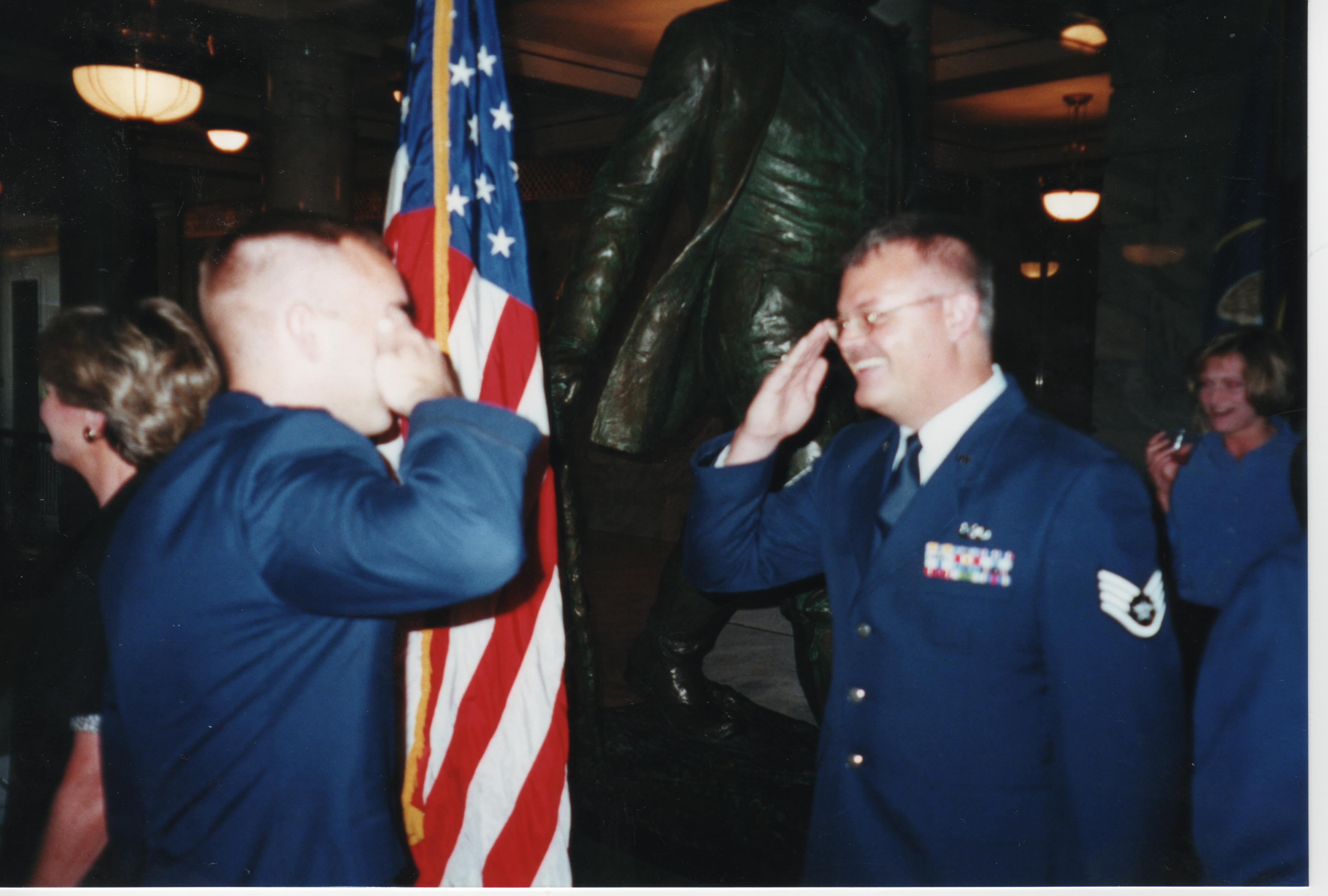
My uncle John giving me my first salute as a Second Lieutenant
One of the core principles everyone who has ever gone through basic training will understand is that being invisible has it’s advantages. When your bus drives through the installation gate for the first time on your way to training, you develop a pit in your stomach and start to wonder just what you have gotten yourself into. As you watch others get chewed on, you try to shrink into oblivion and do everything you can not to get noticed. At least, that was my experience. No sooner had we crossed the threshold of the base than the Military Training Instructors (MTIs or just TIs) who had met us at the airport and who had been at least moderately tolerant and helpful turned into demons, lashing out at anyone or anything that stood out. The happiest among us were the ones who weren’t worthy of notice. As I sat contemplating invisibility and thinking about the reality of being trapped in this jail-looking compound, I knew I could survive it but wondered if it was worth it. I was determined to stay off the radar. My hope for anonymity, however, didn’t last long.
As it turned out, just one year prior I had three uncles who were stationed there. All well known. All happy to make my life a little uncomfortable. And one of them was still stationed there and working at the confidence course. What I didn’t know, was that these fine family members had apparently let the cat out of the bag and told all their buddies that their nephew was inbound for training. I would soon find out that I was destined for a lot of special attention.
After a short drive through the base, the buses from the airport generally pull up to a training complex and trainees shuffle off under the very close supervision and barked instructions of half a dozen angry looking men wearing “smoky the bear” hats — the TIs. Commands like “ground your bags” universally result in at least one trainee not understanding what was meant, which immediately draws the attention of the pack of TI piranhas hovering just a few inches away waiting for an opportunity to chew on some fresh meat. The pack would circle and divvy up the likely victims based on how it would have the most effect.
As an example of the kind of effects they looked for, one of the TIs in charge of our group couldn’t have stood taller than about five foot five. He universally paid special attention to the tallest and largest trainees. He would find something they were doing wrong (which never took long), get right up against them, stare upwards into their face as he stabbed a pointed finger into their chest, and yell at them while almost foaming at the mouth. The moment they would look down at him, all hell would break loose with one-sided discussions about why it was wrong to look down on a superior like that.
A contrasting example was another of our TIs who was well over six foot six, was very muscle bound, and extremely dark-skinned. His tactic was to find the shortest, most timid little white girl and tower over her, whispering in a menacing tone. He almost never spoke loudly, but when he did, everyone for miles heard what it was you were doing wrong. He terrorized short people.
As for my bus, we entered the gates at Lackland Air Force Base in unremarkable form and proceeded to the training complex. However, instead of the typical routine of ejecting passengers and corralling them into a formation, a TI came on the bust shouting for Johnson. There were several, me among them, and we had the pleasure of being the first off the bus and a few minutes of special attention. As luck would have it, my uncle John had told some of his friends about his nephew, and they were on the look-out. Apparently they had done this on every bus that had come in that day, and in the process had made me a bunch of rather disgruntled friends that had the misfortune of sharing my last name. Instead of being invisible (as I had tried hard to be), I had an enormous target tattooed indelibly on both my front and back sides.
On the whole, the theatrics all looked to me like a comedy routine, and I had great difficulty not losing my composure. In fact, much of the special attention I got all was justified because I had been “smirking,” or something like that. Thankfully, after a few days people mostly forgot about my linkage to SSgt Johnson and I was able to at least blend in with the worst of the trouble makers. I never did manage a week where I didn’t have so many demerits that I would be policing cigarette butts or cleaning toilets on Sunday afternoon, but at least the most interesting of the attention faded away.
Towards the end of my training, we were shaken out of our bunks at roughly 2:30 and forced to go through a simulated deployment line. The remainder of the day we went through the process of out-processing for deployment, a simulated flight to Korea, and a full-day of “ground operations” on the Medina Annex before finishing up a very long day with an exhausted run through the confidence course.
Everyone was exhausted after weeks of little sleep and hard training, and the day’s activities added a rather acute insult to the underlying injuries. As I lined up to begin the course, I was put behind a very tired female who was almost in tears. She climbed up to start across the monkey bars that hung over a greenish pit of swamp water, but didn’t make it past the first rung before splashing down into the slime. Unsatisfied with her effort, the TI barked at her to do it again. I stepped aside to make room as she swung her now soaking body to the second rung before falling off again. Again, the TI wasn’t satisfied she had tried hard enough, so she circled back around and I watched her make it three rungs before falling off and finally being granted the mercy of moving to the next obstacle.
I reached out to the first bar. It was completely soaked and very slippery. I made it to the second. Then, on the third and final wet one, my grip slipped and down into the green water I fell. The TI chuckled, knowing exactly why I had fallen. I got the distinct impression she had tormented the girl in front of me just to make sure I fell in. Since I had so obligingly complied, I was sent forward to the next obstacle without getting the bars any more wet for the people behind me.
Besides the discomfort of being soaking wet in humid 90+ degree weather, falling into the pit meant that the low-crawl under camouflage netting through sand was akin to turning every article of clothing I had on into 80-grit sandpaper. It chafed, rubbed, and generally tore skin away from anywhere that came into contact with. However, as uncomfortable as it was, I finished the course and stumbled my way towards the dinner that was waiting for us. The camp commander had promised us barbecue for our last night before graduation.
As I shuffled along in line, I was surprised to see my 15 year old sister dishing up food. It turns out that the camp commander had contracted my uncle (who did barbecue on the side) to feed us, and my uncle had co-opted my sister (who was in town visiting family) into helping. She didn’t look 15, and was dangerously pretty. All the guys were trying to flirt with her, and anyone who was brave enough to try immediately earned a set of supervised push-ups.
Unlike everyone else, I had no desire to flirt, but that didn’t change the fact that she came right to me and gave me a big hug right in front of everyone. Instantly, I was completely surrounded by TIs who were in the process of fully dressing me down for my breach of decorum (even though I had just stood there blankly when she came up to me). At that moment, I resigned myself to an hour or two of supervised pain, but that resolve was short-lived. John came jogging over to me and shooed away the other TIs.
“Hey,” he said, “what’ve I gotta do to get you off base to see grandma?”
Unlike regular basic trainees, they didn’t allow the officer candidates off base after graduation the next day. We were restricted to inside the fence until we got on the buses to go home. Just as John asked me this question, I noticed the camp commander walking about 20 yards away and told John that he’d have to ask “the old man,” pointing to the Colonel. I didn’t think John would do it, otherwise I would have never suggested it. I should have known better. John is every bit a Johnson, and he ran straight to the Colonel to ask him.
In the mean-time, the other TIs had been lurking just out of ear-shot waiting for their chance to reengage. As soon as they saw John talking to the Colonel, they closed in and went to work. But just about the time they had wound up to full-speed, John came back and scared them off again. He had succeeded in convincing the Colonel to let my grandmother take me off-base after graduation as long as I was back in the barracks by 11:30 that night. While my cohorts were wandering between the BX and bowling alley, I was enjoying all-you-can-eat Chinese and taking a nap in an air-conditioned room on a soft easy-chair. I got back to the barracks at 11:29, and had just enough time to back my bags before taking the first bus to the airport at 3:30 the next morning. It turned out, in the end, that knowing one of the TIs had its advantages.
A little under three years later, John had been reassigned to Hill AFB just south of Ogden UT; and I was ready to graduate from the University of Utah, commission, and start active duty. Now, there’s a tradition in the Air Force that newly commissioned officers give a silver dollar to the first enlisted member to salute them. I honestly don’t know where that tradition comes from, but I wasn’t about the give away a silver dollar to just anyone. Since John was close-by, he would get my dollar. In fact, I had to turn to him for help finding a real silver dollar. He rounded one up for me from a great uncle who had a collection of them, and was there and waiting when I commissioned to relieve me of it. I couldn’t have found a better recipient.
My work interactions with John didn’t end there though. Immediately after graduation, I was assigned to Hill, and moved into a house on-base just a few blocks from John and his family. He got no end of fun out of the fact that a Lieutenant was mowing the Staff Sergeant’s lawn while he was out of town, and I didn’t mind having a Staff Sergeant shovel the snow out of my driveway while I was gone. Having family on-base was a nice way to start my career.
About two years later, John was slated for reassignment and I was getting ready to go to graduate school. Before he left, John needed to reenlist one more time in order to get all the way to retirement, and he offered to let me officiate. I showed up at his shop for a commander’s call and helped him sell his soul for another six years. It was the first time I’d done a reenlistment. Six years later, he blamed me for the fact he was still here and let me officiate his retirement, another first for me. The extra attention I got in training was a small price to pay.
It’s supposed to be fun, I return exhausted
To a pile of work not done
And no extra time to do it
With a wallet that’s empty
And experiences I could live without.
For almost a year, I’ve been trying to get spare change together to have a collection of poetry I’ve written printed. However, I have teenagers, and the unfortunate thing about teenagers is that they are expensive. In spite of my best efforts to sock away a few dollars here and there, every time I had almost enough cash set aside something would come up, and I’d have to start over.
In the mean-time, though, I’ve gotten occasional feedback from the few people who were actively waiting for the final result. It seems they are getting impatient. As a result of my inability to follow-through with the final step in the process, I was contemplating the budget and trying to come up with a realistic time-line so I could manage expectations. It wasn’t looking promising. Then, a few weeks ago, I had a flash of either desperation or inspiration and looked into Kickstarter. They sell themselves as a platform for crowd-funding creative projects, and it seemed that my little book would fit their criteria pretty well.
So, without further adieu, say hello to my Kickstarter project: