Frigid air that sears the lungs,
Stings the nose and burns the eyes;
Crystallizes air itself,
Grows diamond reaching to the skies.
Category: Peter’s Writings
Things Peter writes for his own benefit, not necessarily intended for or made available to the general public.
-

Crystal Cold
-
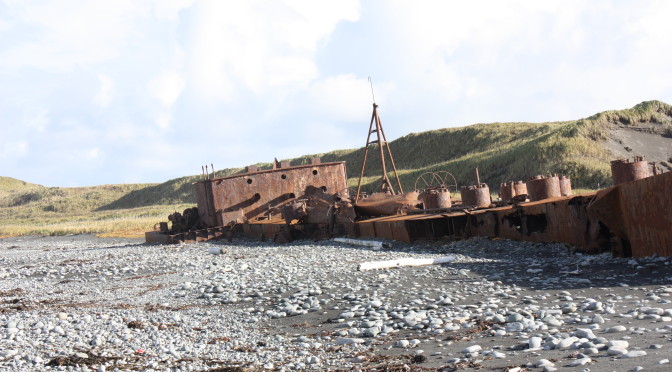
Abandoned
Far north of the sun on the sands of a beach
A hulk lies half buried on land
Who knows what it carried when last leaving port
Now it's holds carry water and sand

Abandoned in place when the sea broke it's back
For decades it's been here and will
Forever remain 'till the steel rots away
Ground to dust in nature's great mill
-

Winter Watchman
Searingly cold, I am chilled to the bone
Crystalline ice coats the ground
Darkness paints over the bluest of skies
Snow muffles the loudest of sounds

Rational beings are tucked in warm holes
To hibernate is natures great plan
But standing here now, knee deep in new snow
I marvel at a brazen lone man

He stands there alone, protecting the globe
Keeps watch with a resolute stance
A sentinel silent, a witness as well
He begs us to not miss our chance
-
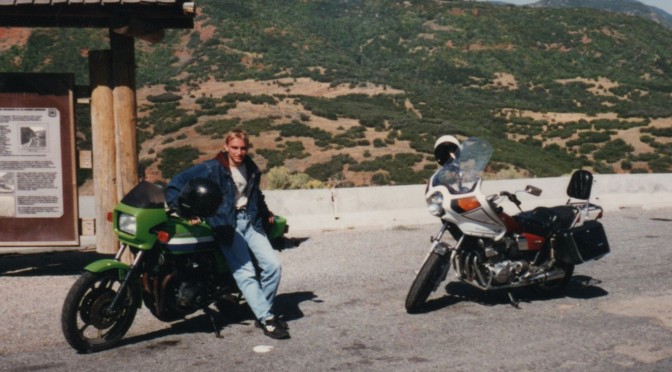
Storytelling – Museum Motorcycle
One of my kids’ favorite activities when we have new visitors over for dinner is to try and get me telling stories. I’ve told many of these stories so many times that the kids like to start to tell them on their own if I don’t comply with their requests. I imagine some of these stories are among the things they will take with them long after I am gone, but to ensure that they are correct (according to my flawed memory), I’ve decided to write several of the more popular ones down. These stories are true to the best of my ability to remember them. It’s possible that some of the memories have been contaminated or that my role in them has been exaggerated, but any of these types of artifacts are purely unintentional. Unfortunately, some of the names are gone from me forever, so if I leave one out, it’s either out of respect or simply because I can’t remember anymore.
My Museum Motorcycle
For as long as I can remember, I have loved anything that had an internal combustion engine. I don’t think I was quite ten when I brought home my first lawnmower engine that someone had left on the curb for the garbage man. Hoping to prevent my fascination from simply generating piles of junk motors and vehicles that didn’t run, my mom began checking out books on small engine repair from the library and leaving them somewhere I was sure to find them. As a result, I quickly became relatively adept at making old lawnmowers run. I guess I just liked the challenge of taking something broken and getting it up and running again. Besides, I was fascinated by the ability of a motor to turn something as volatile and gross as gas into power.
Around roughly this same time, my neighbor Mikey brought home a go-kart that needed lots of help. Mikey, my brother Tolon and I spent a few days working the motor over the best we knew how, and managed to get the thing up and running. All three of us loved the power that came with controlling a motorized vehicle, and we tore around the neighborhood at top-speed — somewhere around 15 miles an hour.
By the time I was twelve (it may have been ten or eleven, but I can’t really remember), I had bought an old Gemeni 80cc motorcycle from a friend and pushed it home. Against the preponderance of available evidence, I don’t think my mother believed I would get it running and consented to my buying it while hoping I would give up before I learned to ride it. She was wrong. With some help from my mom’s youngest brother Donald, I was tearing around the neighborhood on that bike within a few days. From then on, I didn’t bother with go-karts and lawnmowers unless they were broken and someone else wanted them fixed.
Over the next couple of years, I acquired a range of old, broken-down motorcycles; most of which were older than me and had been sitting in someone’s back yard for several years unmaintained. They also progressed in size and capability. The 80cc bike was successively replaced with a collection of 100cc, 125cc, 175cc, and a 360cc dirt bikes, and by the time I had a driver’s license, I think I owned somewhere around four or five of them. However, my newfound freedom to legally motor down the street spurred a desire to have a street bike. As with the dirt-bikes, one led to another, and by the time I was eighteen, mom had put a hard limit of no more than half a dozen motorcycles at any one time (I had to get rid of almost half of them).
My first street bike was a 1979 Kawasaki KZ400 (on the left). This picture was taken on a ride with my dad (his Yamaha 850 Special is on the right) through the Uintah mountains. There was one bike in all of that mix that I miss more than any of the others though. About the time I turned sixteen, my dad had a friend who was something of a modern gypsy. Mike Osbourne was an entrepreneur with a short attention span. At the time he met my dad, he was traveling from public venue to public venue selling beautifully printed and framed pages with people’s names and the origins of that name. His lack of focus, as it happened, also extended into his personal life, and he had collected a set of girlfriends across the country with whom he would shack-up when he came through town.
Somewhere back in the very early nineties or late eighties, Mike had wandered through Utah on a motorcycle he had bought new in 1983. For unknown reasons, he ended up leaving the state and leaving the bike in the care of the girlfriend who had been hosting him. However, Mike didn’t make it back to pick the bike up again for several years, during which time the girlfriend had met someone else and become engaged. Somewhere around 1992 Mike got a call from the girlfriend telling him he needed to get the motorcycle out of her garage or her fiancé would destroy it. I believe Mike was somewhere in Montana at the time, and couldn’t get there right away. He called my dad and asked if we could go get it for him. He also asked me to get it running again since it had been broken when he parked it. He promised to pay me for the work.
Dad had always gone out of the way to help any friend, and it wasn’t like we weren’t used to having motorcycles around, so we climbed in the van and took off for the ex-girlfriend’s house. What we found was a 1982 KZ100R painted up in the Team Kawasaki colors. It looked different… somewhere between a very muscular cruiser and a modern sport bike. I instantly liked it. We brought the bike home without incident, and a neighbor offered me space in his garage to park it while I got it running again. Over the next several months I worked it over little by little and got it up and running again, anticipating Mike’s return. The repaired bike sat in my back yard for the next two years.
Eventually, Mike came through town again. At this point, I was in violation of Mom’s motorcycle limit, and I needed to get rid of at least one of my inventory. I was also sore about the fact that I had spent a lot of time and money getting Mike’s bike running and didn’t get to enjoy any of the fruits of my labor. I gave him an ultimatum: Either he get the bike out of there and pay me for the work, sign the title over to me, or accept that I was going to place a mechanic’s lien against it and get the title anyway. At the time, he was living out of a large trailer he pulled with an old van, and didn’t have anywhere to put the bike. Seeing he had few alternatives, he ultimately agreed to just sign over the title.
Up to this point, I hadn’t done anything cosmetic to the bike. Just what needed to be done to get it running. However, once it was mine, I embarked on a two-year process of restoration that would include new paint, seat, and a totally rebuilt engine. At the end of it all, I had an almost new motorcycle (except for the scraped-up side engine cover I never got around to replacing). This bike had more horsepower than most small cars, was completely paid for, and was old enough that the insurance companies gave me a deep discount (the first modern bullet bike – the Honda Hurricane – entered production after this bike was built, and they didn’t recognize the model number as being a “fast” motorcycle). It was the best of all worlds.
The bike was amazing. It was faster than almost anything on the road. The sport bikes couldn’t match the low-end performance off the line, and the few times I caved in and agreed to race one, it wasn’t much of a competition. Because of it’s age, the speedometer stopped at 85mph, and I could hit that in about four seconds half-way up the tachometer in fourth gear. I suspected the collection of Honda CBR900s that were about hottest bike common in that area could catch me if we ever ended up on a long and straight enough section of road, but it never came down to that. The one time I really opened it up on a straight stretch was on I-80 headed west over the salt-flats.
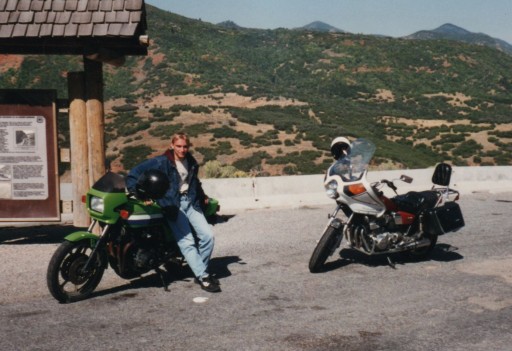
Me and my dad’s Yamaha 850 (that I mostly rode) stopping for a break on a ride with my dad down to Ephraim, Utah to visit his mostly crazy aunt. A friend and I were riding out to Wendover, and he wanted to see if he could keep up with me on a speed-run. He had a newer Kawasaki Ninja 650 and was confident his newer, lighter, performance tuned bike would out-perform me in the top-end. We pulled off a ranch exit and agreed to launch together from the on-ramp and see how long it would take for him to catch up. We took off on the agreed signal and I didn’t see him again until I pulled off the throttle and had coasted back down under the speed limit. According to him, he had pegged out at 140 and the gap between us was still widening. When I pulled back, there was still some throttle, tach, and power left. I never did find out how fast that thing would have gone if I’d really tried. It always did anything I asked it without the slightest hesitation or complaint.
All good things come to an end, though… I got busy, then married, then broke. By fall of 1999, I was on contract to the Air Force and couldn’t find anyone to hire me for the six months I had left in civilian life. My commission-based job fixing electronics wasn’t paying well either due to mismanagement driving away our major customers. To top it all off, I was relatively newly married. I was running out of money and options. To compensate, I had started teaching lab classes and grading papers at the university, substitute teaching for the local school district, and just about anything I could find to pay the bills, but things were still very tight. I wasn’t sure how we were going to make ends meet. That’s when I started getting post-cards.
One day, out of the blue, I got a card in the mail that said in essence “we want your motorcycle.” They had listed a few specific models of “vintage” bikes they were looking for, and mine was the first one on the list. I was in no mood to sell the bike, so I quickly disposed of the card before Liz saw it so I wouldn’t have to explain why I wasn’t going to sell a motorcycle to keep us out of the red. Unfortunately, whoever had sent that card was persistent, and Liz got the mail the day the next one arrived. I was greeted with a look that meant “you know what you have to do,” as she handed me the card.
I ended up calling the number on the card, and the man on the other end started reading off the VIN number to me to make sure I had the bike he was looking for. Without knowing anything about the condition of the bike he offered me $5000 for it. I was stunned, but I also didn’t want to sell the bike. I waffled and told him I had spent a lot of time and money fixing it up. He offered $6000. Liz was oblivious to what was going on over the phone, but I think the look on my face told the whole story. All I could manage was to tell him I didn’t really want to sell it, but that I would call him back in a couple of days.
After talking it over with Liz, I agreed the right thing to do was to sell it. I wasn’t even riding it at the time since I couldn’t afford the insurance and registration fees (which were actually minuscule). I called back the next day and he offered $6500 if I could have it to the shipper in two days. I agreed, but with heavy heart. The next day I pulled it out of the shed in my Mom’s backyard where I had been storing it, took it for one last ride, then drove it up to the shipping company where they were strapping it to a pallet and loading it into a truck as I signed over the title. From what I understand, it was bought by a private museum somewhere in Houston. I’ve contemplated finding that museum and seeing it again, but all that would do is make me want it again. I think I’ll let it stay as a memory instead.
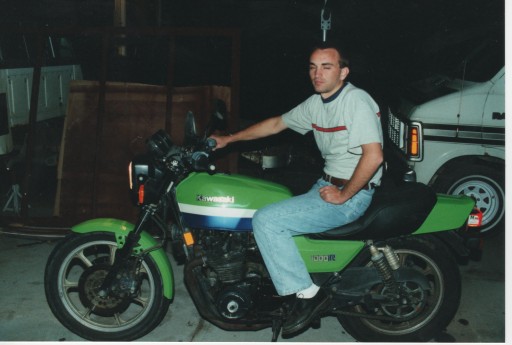
Just pulled it out of storage for the last ride. The next morning I took it to the shipper. The money paid the bills until I commissioned and went active duty, something I had been stressing over for a while at that point. In our family, we chalk this up to a case where faith and paying tithing results in miracles. I still miss that bike, but in the end, getting rid of it was the right thing to do. I probably would’ve killed myself on it if I’d kept it much longer anyway. I was too fearless, and it was too capable.
-
Mumble grumble
Mumble grumble gripe and rumble
Roiling waves of discontent
Leave me be and let me simmer
Since my patience now it's spent

Don't expect commiseration
Just because you love this stuff
What to some is pleasure simple
Can't be distanced far enough
-
What’s so wrong with not liking Christmas?
“Christmas a humbug, uncle!” said Scrooge’s nephew. “You don’t mean that, I am sure?”
“I do,” said Scrooge. “Merry Christmas! What right have you to be merry? What reason have you to be merry? You’re poor enough.”
“Come, then,” returned the nephew gaily. “What right have you to be dismal? What reason have you to be morose? You’re rich enough.”
Scrooge having no better answer ready on the spur of the moment, said, “Bah!” again; and followed it up with “Humbug.”
“Don’t be cross, uncle!” said the nephew.
“What else can I be,” returned the uncle, “when I live in such a world of fools as this? Merry Christmas! Out upon merry Christmas! What’s Christmas time to you but a time for paying bills without money; a time for finding yourself a year older, but not an hour richer; a time for balancing your books and having every item in ’em through a round dozen of months presented dead against you? If I could work my will,” said Scrooge indignantly, “every idiot who goes about with ‘Merry Christmas’ on his lips, should be boiled with his own pudding, and buried with a stake of holly through his heart. He should!”
– Charles Dickens, A Christmas CarolIt’s been said that I am somewhat of a Grinch or Scrooge about Christmas, and the sad part is that my accusers are probably right. In spite of repeated assurances and vociferous assertions to the contrary by my family, I really do struggle with the whole thing. Every day of the Christmas season tends to bring something that makes me want to either scream or retreat to my cave. However, the comparison is incomplete.
In the case of Scrooge, his dislike of Christmas stemmed from his miserly ways and the selfish desire to extract as much profit as possible from the populace. While I have a strong distaste for the fiscal liabilities and financial strain of the holiday, I flatly deny that my feelings are based in greed or selfish motivations. When I was younger, I assumed the stress and unhappiness that came at Christmas time stemmed from the somewhat constrained financial resources in my family growing up. My parents struggled to make ends meet from time to time, and the holidays were always an extra burden on an already tight budget. I watched them stress over how to satisfy the greedy demands of the season.
Worse than the strain on my parents, I began to recognize selfishness in myself. I began to compare the presents my friends got with what I was given. I saw others flaunting their ill-gotten gains and was jealous. I became unsatisfied. Recognizing those feelings in myself engendered a sense of self-loathing that still haunts me from time to time. Every year, as Christmas rolls around, I am reminded of what I felt and how I acted. They are shameful memories complicated by the fact that I see the same behaviors in people around me without the shame that should attend.
However, monetary scarcity is not at the heart of these frustrations. As time has worn on, I have progressively made more money until I’ve reached a point where I consider myself rather well to do. I distinctly remember looking at the pay tables many years ago and wondering what I would do with the kind of money I am making now. However, in spite of this change in situation, Christmas is still a financial pain. Contrary to popular belief, more pay doesn’t necessarily mean more unallocated money, and by the time Christmas comes around, we end up making financial trades in our house to try to accommodate the extra food for all the parties and other social gatherings (never my favorite thing), decorations, more parties, gifts, more parties, gas to get to the stupid parties, etc… Those trades spark some of the same selfish tendencies that taught me to hate the holiday many years ago. I have to admit to fundamentally hating the fact that I have to give up some simple pleasure (often a matter more of time than of money) so we can hang out with a bunch of people I don’t really want to be around from work or other associations. Recognizing this selfishness, in spite of years of working to suppress it, is depressing. Unlike Scrooge, I don’t hate Christmas because I’m selfish and want to keep what I have, I hate it because it exposes selfishness I wish to suppress.
Nor is the story of the Grinch a complete comparison. The Grinch’s feelings about Christmas weren’t too far off from mine, but that was simply a function of his misunderstanding. When the Grinch came to understand the real meaning behind the holiday, he had a change of heart and embraced the season. Unfortunately, I have a crystal clear understanding of why Christmas is celebrated. I absolutely agree that the subject of Christmas is a reason for great joy and rejoicing. Angels heralded the birth of Jesus, and we too should remember that event with joy and rejoicing. The problem I run into is that I don’t celebrate things the way the world would have me do.
The ways the world celebrates don’t focus my attention, thoughts, prayers, or actions on Christ. They don’t help me remember the incomprehensible miracle that was His birth. In fact, they tend to distract and depress me. I tend to celebrate in very private and personal ways, and demanding that I participate in public displays of any sort is almost a sure-fire way to cause me to rebel against whatever it is you desire me to do. This rebellion sets up a vicious cycle of me being unhappy, someone else (usually Liz) being unhappy because I’m unhappy, which makes me even more unhappy.
Unfortunately, nobody seems content to let me alone to celebrate in my own time and manner. I guess I don’t understand why it’s so wrong to feel as Scrooge did when he said “Nephew! Keep Christmas in your own way, and let me keep it in mine.”
-
Book Burning
For most of the world, there is little thought that goes into disposing of something. You simply put it in the trash bin, set that bin on the curb roughly once a week, and it magically disappears. When you live where we do, though, there is more to it than that. For those in our “neighborhood” who elect to pay for regular trash service, they pay roughly ten times what it costs in the city for the privilege. As an alternative, we have the option of bagging our trash and hauling it off to the local dumpster once a week for a set price per bag. Many of us, on the other hand, find alternative ways to deal with unwanted stuff.
There is a well-defined and graduated scale of sophistication in back-woods trash disposal. Lowest on the totem-pole are the jerks who look for some unattended place to simply dump their crap and make it someone else’s problem. These are scumbags who don’t think twice about throwing a half-empty 20oz beer can out of the truck window and into your yard. May they get warts and boils on their intimate parts.
Next up the ladder of sophistication are the old-school farmers who never get rid of anything, opting instead to throw it on the pile that’s been building in the back lot since grandpa discarded an old plow or other piece of worn-out farm equipment, saving it “just in case.” This crowd doesn’t really care much about what others think, but scoff at making their junk someone else’s problem. They respect others property rights, and expect you to respect theirs by not complaining when their front yard looks like a scrap-heap. The only time this group becomes a problem is when they die or move, necessitating a major cleanup effort. They do have a bad habit of dumping fairly toxic stuff rather than incinerating or otherwise dealing with it.
Next there are those who believe in having their own personal landfill and dig a big hole somewhere on their property to push everything into, thereby dealing with the cosmetic issues the first kind of “freestyle landscaping” causes by burying it. Unfortunately, this group isn’t very particular about what goes into the holes, tossing used motor oil, unused agricultural chemicals, furniture, plastics, and anything else they happen to accumulate into the pit to contaminate the groundwater. Recognizing the limit on space, they often have a habit of separating at least the large items with metal in them for eventual recycling (usually when they move or die).
Next in sophistication are those who get tired of digging new holes, so they burn the pile in the hole on a regular basis and only cap it off when the ash builds up. This tends to minimize the space used and consume many of the more nasty chemicals and plastics that would otherwise pollute or clog landfills. The ash it produces, however, is toxic in itself.
Finally, there are guys like me. In our house, we separate our waste into a few simple categories. First, there is food waste. There is no point in wasting what would otherwise be effective fertilizer, so 100% of it is either fed to the chickens or composted. Second, there is the organic matter that isn’t easily composted or edible like paper, cardboard and wood. This we burn in our fire-pit, collecting the ashes and scattering them in the field to return the minerals that remain to the soil. Third is anyting metal. Metal doesn’t burn, and I don’t like the idea of burying a bunch of it on my property, even if it isn’t likely to be toxic, so it gets collected until there is a sufficient pile of it and I turn it in for scrap. Finally there are glass, plastic, and contaminated paper products. Glass and plastic aren’t worth recycling here, so it isn’t separated from the other things I can’t recycle. All of this is burned in a ventilated burn-barrel. When the barrel fills with ashes broken glass, and anything else that didn’t burn up, the ashes are triple-bagged and hauled off to the dump-station where they are taken to a lined landfill.
Between being conscientious about the kinds of stuff we buy and making the most of the system I described above, we’ve reduced our contributions to the landfill to about two to three moderately large trash bags every six months while only spending about $20 in that same time-frame. I don’t want to hear any griping about air pollution or carbon dioxide emissions. I’ve considered the alternatives, and this has the least overall impact on the environment without going to uneconomical extremes. The only real down-side is the work that goes into burning.
So, what is the point of this long dissertation on how country rednecks get rid of trash? Recently, Liz and I went through our extensive collection of books and down-sized the library. One consequence of this was a decision to rely on electronic means for many materials that are readily available for free via the Internet, and the library for books that aren’t likely to be referenced frequently. Many of the books we identified as excess are worth selling, others were worth donating to the local second-hand stores. However, we had a large number (mostly religious and available for free on-line) that were not likely to be marketable even at a thrift store.
Given that we have to pay for every bag of trash we throw away, and that you can only reasonably put so many books into one bag without it tearing through, I didn’t want to just throw them out. Not only that, but the ash content of the paper is rich in trace minerals that can fortify soil, and most of the inks used in modern printing are vegetable based so I wasn’t worried about any concentration of toxic crap in the ash. The books simply had to be burned.
Burning books is not something that feels intellectually good. Generally speaking, book burning brings up imagery like the Nazis prior to WWII or the firemen from Ray Bradbury’s Farenheit 451. I treasure books, information, and the free-exchange of ideas (even when I disagree with them). The idea of doing something supported by fascists to stamp out or bury information causes cognitive dissonance. However, I’ve a long track record of overcoming hesitation when something needs to be done.
Last night, Isaac, Michael, and I spent the evening burning the pile of junk books. Something I’ve learned over the couple of years we’ve lived here is that you can’t just throw a book in the fire and expect it to reduce to a small heap of ashes. In fact, there are few things that are ultimately flammable which are harder to burn. If you want a book to burn, you have to separate the leaves of paper to allow the air to circulate, otherwise the ash from the outside pages smothers the pages within and results in a book with scorched edges that is generally intact. The three of us spent most of the night tearing out pages, crumpling them, and adding them to the fire slowly enough to prevent suffocating it.
Burning books is a slow, hot, smelly, smoky, painful, tiring process. While I was stirring the pile of burning paper with a shovel last night to make sure everything burned down completely, I reflected on how much malice there must have been in the hearts of people who participated in burning “unwanted” documents in Nazi Germany. While I don’t understand how you could get to a point where it would be appropriate to eradicate and criminalize dissenting opinions, I now have some minor insight into how committed those who got to that point were. They must have really been committed to spend that kind of energy. As for me, I’ll be happy if I never have to burn another book again.
-
What Do We Hunger For?
Today I was listening to a talk (or sermon depending on your faith tradition) and was granted a new insight into a scripture story I’ve read and contemplated many times before. The speaker brought up the miracle of the loaves and fishes, where Jesus miraculously fed the multitudes. Often this miracle is the focal point of the message. As the speaker continued with the story, I was struck by what followed.
In John chapter 6, we read about Christ feeding the masses with five loaves and two fishes. In addition to the marvelous teachings they heard, all who were there witnessed a miracle that resulted in tangible results: they had full bellies when they otherwise would have gone hungry. Many who were there followed Christ, and I’d like to think that I would have been among them had I been there.
Unfortunately, many were only converted to the physical rewards of discipleship. They had hungered and were fed. This miracle was what they sought. Christ knew this and decided to use it as a teaching moment to help the crowds understand a much deeper lesson about the atonement and His mission. When the food from the previous miracle wore off, the crowds were again hungry. Christ could have easily broken bread again sufficient to feed the crowd, but he opted not to in order to do something much more important. He knew that no amount of miracle bread and meat would convert the hard-hearted, so he used it as an opportunity to test the righteous and teach them about eternal life.
All of this should sound familiar to anyone who has studied the New Testament. Nothing I’ve written so far could be construed as a new insight. The insight for me comes from elsewhere in the scripture. After Christ finished teaching the lesson he had for the masses, many who had followed him left. They had come hoping for a tangible and temporal miracle, and were unwilling or unable to accept the miracle of wisdom that was offered in its place. Not receiving what they had desired or expected, they fell away.
This interaction reminded me of an experience a friend of mine has had. He was an active follower of Christ, and appeared to be strong in the faith. However, some time after we parted ways (he to one state, and me to several others) he began to experience some serious health issues that interfered with several things that were very important to him. He sought for a temporal blessing, and was hurt when it wasn’t granted. At least in part due to this experience, he went through what he describes as a “faith transition,” eventually convincing himself that there was no God. Because he didn’t get the miracle he sought, he, like the people in the scripture story, no longer followed Christ.
What higher blessing could have been available to my friend had he maintained faith and continued on the path of discipleship nobody will ever know but the Lord himself. However, what is certain is that he gave up a great deal. Unfortunately, this case study is far from unique. I’ve known far too many who have grown resentful at God because they were not blessed in the way they desired and expected. I believe it is likely all of us experience this to some degree or another. For one, it is a failure to be healed of some physical malady. For others it is a blessing sought for family or other loved-ones. There are innumerable ways we can feel like we are being denied a blessing or miracle we righteously seek. Unfortunately, our perspective is terrible. Sometimes the worst thing that can happen is for us to be given exactly what we ask for.
The key, I think, is to keep in mind Peter’s response when Christ asked him if he too would go away:
“Then Simon Peter answered him, Lord, to whom shall we go? thou hast the words of eternal life.”
Where else could we go that would better prepare ourselves for the trials that surely lie ahead? Who else could we turn to when the burdens of this life feel overwhelming? What other source could we turn to in order to find happiness in this life and the next? The answer to all of these questions is simple. There is no other way to enjoy the fullness of this life and the potential of the next than through faith in Jesus Christ, and that includes the faith to forgo a blessing we feel we need and trust that the Lord knows what he’s doing.
-

Bag of Rocks
Many years ago, two intrepid scout masters took the young men from my church youth group on a week-long backpacking trip into an offshoot of the Rocky Mountains. One of the guys in our group was physically smaller than the rest of us and had a chip on his shoulder to compensate. As a result, and as matter of record, I didn’t have a lot of love for him. In fact, he had spent most of the last two years pestering and tormenting me — his apparent goal being to start a fight with me (beat me up) to prove he was big and strong. Earlier in the summer of this trip he succeeded in pushing me over the line while we were working a fund-raiser. I finally got fed up with him, pinned him against a concrete-block wall, and proceeded to pummel him with all the malice I could generate. Had his larger “cool-crowd” friends not intervened I probably would have hospitalized him.
Given this description of my feelings towards the kid, it might be surprising that this trip found me largely pitying him by the fourth day. On the first day, all of us took off from the trail-head slightly overloaded with food and other necessaries. Fresh legs and the excitement of what lay ahead of us compensated for the weight, and we reached our first stop tired but in good spirits. Courtesy of the constant feedback gravity had provided over the course of the day, we all lightened our packs considerably by gorging on at least two days worth of food and praying we would be able to catch enough fish along the way to make up the difference.
As we progressed through the trip our legs got tired but our packs got lighter. The two seemed to compensate each other since we managed to get to the end of our day without feeling any more or less tired than the day before… all of us except for the twerp. Every day he seemed to get more and more tired and lag more and more behind the rest of the group. This puzzled me, but seemed to be a source of endless mirth to his “friends” (incidentally the same ones that egged him on to the fight that they subsequently broke up). By the morning of the fourth day he was exhausted, so we stopped earlier than planned for a break. That’s when he discovered the rocks.
His “friends” had been sneaking small rocks into a large but formerly unused pocket in his pack. They had added one here, one there, sneaking them in any time he wasn’t looking. The end result was that his pack grew heaver and heavier as time wore on. By the time he figured out what was going on there were probably 20 lbs of rocks in his bag. For a 110 lb kid, that’s a substantial portion of the workable load. Eventually, the extra weight and fatigue of hiking became too much for him to bear and he had to stop. Luckily for him, he found the problem, corrected it, and managed to do quite well for the rest of the trip in spite of some choice words with his “friends.”
I was significantly larger than this kid, was carrying about the same basic load, and felt pretty tired by this point. Watching him struggle was uncomfortable, and when it became clear that the difficulty was the result of mean-spirited actions by people he liked and trusted I pitied him. The load of rocks he had gradually “picked up” along the trail had built up to the point where he couldn’t take the load any more. Individually, the rocks were small and wouldn’t be considered a burden unless it had been wedged under your foot to irritate at every step. Each rock that was added made only a small incremental addition to the weight, hiding the total contribution in the larger mass of the pack.
Now, why would I choose to reflect and write about this experience? Sometimes I feel like I am hiking with a bag of rocks on my back. As I trundle down the trail that is my life, I am constantly bumping up against little annoyances, inconveniences, issues, problems, frustrations, or demands on my time and talents – rocks. At each juncture I am often faced with choosing one of a few possibilities: I can bypass the rock and leave it for someone else to stumble on and deal with, I can react badly and make the problem someone else’s, or I can take care of the problem and clear the path for the next traveler. Most of the time, I decide it’s a small thing, bend down, pick up the rock, and throw it in the bag. The small service I render to those behind me on the trail makes it well worth the almost imperceptible extra weight I now carry. I don’t grumble or use it as an excuse to further burden someone else. My strength quickly adapts to the slightly heavier load, and I carry on.
Other times, there is no choice. The rock simply must be added to my load either by force of others, the nature of the situation, or by my own (sometimes unwilling) conscience. These are the most difficult rocks because they don’t necessarily bring with them the sense that I am sacrificing for someone else’s good. They are simply an ugly addition to the weight I already carry. Additionally, these rocks aren’t constrained to be relatively small. They can be quite heavy. However, I recognize that the only way to build strength is to take on progressively heavier loads so the muscles, bones, and connective tissues can react and rebuild stronger. In this light, the burdens are lightened and I can generally pick them up with magnanimity and press on.
The difficulty comes when the rate at which I add to my load begins to exceed my ability to marshal and develop strength to carry it. Sometimes the load becomes so heavy that even an additional grain of sand can be a soul-crushing weight. My default reaction when the load becomes overwhelming is to want to dump it, and were I on a real trail, I’d simply step off of it a few feet and create a neat little pile of my accumulated rocks. Unfortunately, life’s burdens aren’t so easily discarded. Each one is tied to someone or something that would suffer if I were to let that rock drop back to the ground. Many of the heaviest burdens would have eternal consequences should I fail to carry the load they represent. This situation makes it nearly impossible to lighten the load in any tangible way. I can complain and leverage my burden to add to someone else’s load, but this gives no real relief and I am left with no viable choice but to continue on; hoping I can find the strength to continue, and praying I won’t be asked to pick up any more rocks.
One of the more irritating aspects of having this load that I can’t drop is the fact that I have a tendency to become resentful and selfish when someone tries to add anything to the pile. People seem to assume that because you are currently carrying a heavy load that you are strong enough to further add to it. They want to give you their burdens, not realizing that the only way they can build strength is to continue carrying their own load. They don’t, or can’t, see that while your strength is great, it is matched to your load and doesn’t leave much of a margin for additions.
Where I generally feel happy in lifting someone else’s load or clearing the path for those behind, a heavy burden poisons the joy that would otherwise have helped steel me for the task. I no longer want to help. I want to protect what strength I have left for myself. I want to pass by the things that could trip up others and make it their problem. I want to pass off my load to someone else rather than reach out and steady or lift someone else’s. I want things that I know I shouldn’t want. That knowledge on its own is a burden.
So what do you do when you feel the crushing weight of responsibility sucking the life out of your soul? Where do you turn when there is no clear path of escape? How do you get help lifting a load you are unable to share? How do you help people understand that while each small thing is individually easy to carry, there is a wellspring of others, both seen and unseen, that combine to make the load much worse than would be expected based on external appearances? How do you carry on when the one Being capable of seeing things in their entirety seems distant and unconcerned? How do you even admit to feeling that way when you know it isn’t true?
Mortal onlookers are always quick to suggest quick solutions or trivialize the burdens they are able to comprehend and fixate on. I would they could see and feel from inside, but sharing glimpses through the means available tends to simply give them only a small piece of the puzzle they latch onto and use to try and explain the whole without sorting through the pile and taking time to put all the pieces together. Even if they had that desire, it would be impossible, since some of the pieces are hidden even to me.
Were I not who I am, I think I might do as the twerp did when his pack became too heavy… Simply stop in the trail, dump the load, and refuse to go on until I have strength to continue That won’t work however, since the burden of the failure represented by those dropped rocks would far outweigh the load I now carry. There is one, and only one, real solution to this dilemma, only one source for relief, and it doesn’t involve removing any of the weight.
We have been promised by the Lord that we will not be burdened with more than we can bear, tested beyond our strength, or asked to do something we cannot do. These promises should give us hope and comfort, and will… if we allow them to. The loads we carry are not unnoticed by our Father in Heaven and our Lord Jesus Christ. Nor are they without purpose. They are adjusted to our capacity, calibrated to strengthen us, designed to meet the Lord’s purposes, and necessary for our own eternal progression and salvation. Should the load begin to actually be too heavy, the hand of the Lord will lend us strength until the burden lifts or our strength is sufficient.
While it won’t sell many self-help books, make an interesting movie, or lend itself to a new system for self-actualization, the solution boils down to something pretty basic: We must trust the Lord, simply continue on at the best pace we can manage, and try not to be so grouchy, judgmental, and selfish when someone asks us to help them pick up and carry another rock.
-
Unwanted
Life can be funny sometimes. Things we often tend to view in absolutes can become quite fuzzy or even inverted when the context is right. One example I’ve experienced very recently is an inversion of the concept that it’s bad to be unwanted.
Most of us spend a good portion of our lives trying to be something or someone who is wanted. We develop skills that are wanted by employers. We seek to be wanted by friends and love interests. We often find ourselves trying to acquire stuff and abilities that place us in a position to be envied. I think it is a part of human nature to want to be something admired or desired by almost everyone we meet.
When I was a kid, I was a klutz who was usually among the last to be chosen when it came time to pick teams for any kind of sport (a situation, incidentally, that hasn’t really changed). I hated feeling unwanted, and as a result I pretty much quit trying to play sports in the first place. As a young man, I didn’t fit in with the “in crowd” (who incidentally have for the most part had fairly miserable adult lives if reports are to be believed) and was an unwanted strap-hanger or outsider. I hated it enough that I quit going to youth activities at church to avoid feeling unwanted. I wanted to be wanted.
Fast forward many years, and I am now waiting to find out where the Air Force is going to send us for the next four years. For some unknown reason, the personnel gods decided to completely ignore my preferences and the recommendations of my senior leadership and opted to recommend me to the “cables” office at the office of the Secretary of Defense (SECDEF). This office is basically a glorified 24-hour a day, 365 day a year answering and generalized executive services staff for the SECDEF. It’s not the kind of thing I’ve spent years and years in school only to spend the last years of my military service on. In fact, one of my friends from a previous assignment had worked in that office before, and the first thing he said when I called him was: “You’ll HATE it!” Based on his subsequent descriptions, I’m certain he was right.
The way I found out about the personnel system’s intentions was a call from the chief of the cables office, a Navy Captain (Colonel equivalent). He was concerned that I didn’t have enough “operational experience” in my background. He expressed hesitation and reservation in hiring me, and made it sound like the job was something to be coveted. He seemed to suffer from the same delusion many Air Force fighter pilots are under that being an “operator” qualifies you for everything, and that anyone who hasn’t done what they’ve done couldn’t possibly be as good at anything as they are. I’m not sure what planning and executing operations has to do with answering the phone and filing emails, but I answered his questions and sent him a more detailed resume anyway. Along the way, I think I might have mentioned the fact that I hadn’t exactly volunteered for the position (didn’t intend to submarine the job, but sometimes Freudian slips are hard to avoid).
I didn’t hear anything back from them for a week, waiting the whole time for the dreaded notification that my assignment had been finalized. By Thursday (one week since sending my resume), I sent a short note to the Captain asking if he needed any additional information and if they had made a decision yet. He informed me that they were still deliberating and had received another nomination from the personnel center. The only way they would have gotten another nomination would have been if they asked for one. The message, intended or not, was that they weren’t happy with my background. Yesterday this was confirmed when they sent me a message telling me I was not selected for the position. I guess answering phones is too tough for someone as unexperienced and uneducated as I am. It’s never felt so good to be unwanted. I cried all day… tears of joy that is.
The only down-side to this tale, however, is that while the cables office was waffling and “deliberating,” people were being matched against all the other less than awful jobs on the must-fill list. The entire job-matching process is supposed to be complete tomorrow, and the personnel system didn’t get the message I wasn’t accepted until yesterday. They are probably going to plug me against one of the must-fill jobs that nobody volunteered for, since almost all the rest will have already been filled by now, and they don’t have a lot of time to do anything different. Man… I can’t wait to find out what other hell-hole of a job they think my PhD and varied experience qualifies me for.
UPDATE
It would appear we are off to Albuquerque where I will for the first time be in a position that actually has the potential to utilize all that over-hyped and high-priced education the military paid for. Michael has trouble pronouncing it, instead using a word that is more of a cross between an albatross and a turkey (albaturkey). The other kids just have trouble spelling it.