Category: Peter’s Writings

Things Peter writes for his own benefit, not necessarily intended for or made available to the general public.

  • The Modern Moral Compass

    While our country remains untainted with the principles and manners which are now producing desolation in so many parts of the world; while she continues sincere, and incapable of insidious and impious policy, we shall have the strongest reason to rejoice in the local destination assigned us by Providence. But should the people of America once become capable of that deep simulation towards one another, and towards foreign nations, which assumes the language of justice and moderation while it is practising iniquity and extravagance, and displays in the most captivating manner the charming pictures of candor, frankness, and sincerity, while it is rioting in rapine and insolence, this country will be the most miserable habitation in the world; because we have no government armed with power capable of contending with human passions unbridled by morality and religion. Avarice, ambition, revenge, or gallantry, would break the strongest cords of our Constitution as a whale goes through a net. Our Constitution was made only for a moral and religious people. It is wholly inadequate to the government of any other.
    – John Adams, Address to the Officers of the Massachusetts Militia

    When John Adams gave this speech to the officers of the Massachusetts militia, the French revolution had already produced the “reign of terror” and victimized the French people for almost nine years.  The atheistic fraternal principles upon which the revolution was based were a point of concern for then President Adams, and he had predicted its ultimate failure.  In his view, a functioning democracy required a people bound by religiously founded principles and guided by an undeviating moral compass.   I believe he understood that any government “by the people” would ultimately unravel if “the people” were unworthy of it.  I doubt he could have foreseen our day, but I also doubt he would be surprised at what we have done to our government given the decrepit moral condition of  society.

    Some of the incessant hyperbolic and hyperventilating news coverage  has given me pause to ponder the general state of our nation.  Recently, a deranged bigot shot up a historically black church and ruthlessly murdered nine people attending a prayer meeting.  As a result, we are supposed to believe this horrible action is an inevitable and exclusive outcome of historic anti-black racism and that banning flags, erasing history, and publicly castigating anyone who happens to disagree is the cure.  We must spend hours and hours discussing at length the white-man’s shame and find every creepy looking picture of the perpetrator ever taken so it can be plastered on everyone’s screens in an effort to demonize him.  Nobody seems interested in dealing with the fact that the mentally ill have always been with us, and that violence of this sort is rare, not new, and only preventable by deeply infringing on multiple fundamental liberties.  As long as we are unwilling to arbitrarily and forcibly institutionalize anyone who shows signs of mental instability (never mind the very contentious discussion about what constitutes instability and who gets to decide),  we must accept the risk that these types of events represent.   Yet we don’t talk about the real issues, and we are unwilling to cope with the inevitability of risk.

    With similar breathlessness, media outlets spread hate, hysteria, distrust, discontent, and sometimes outright disinformation when someone dies at the hands of law enforcement if the incident happens to support the narrative of powerful people.  Meanwhile, we are unwilling to discuss the realities and risks that contribute to the distrust and dangerous tension that exists between police and their constituents.  We aren’t allowed to ask why it is that police have shifted away from “community” policing, are armed better than most third-world armies, and escalate to lethal force when they feel threatened.  We cannot question the conditions and undercurrents of society that have engendered a feeling of mutual dislike between police and the public they serve.  We certainly can’t have an open and honest debate about why a police officer might feel more likely to be threatened by a young black male than any other demographic due to the foregone conclusion that this stems from Jim-Crow era racism.   Any attempt to deviate from this party line is instantly dismissed and often results in a reprimand, marginalization, and/or mandatory white privilege training.  Informed, frank, and open-minded discussion or debate has been completely replaced by volleys of shouting and thirty-second slogans hurled from one side of the debate to the other.

    While talking heads with little real interest other than self-aggrandizement foment unrest and further violence, another string of victims (mostly minorities) and perpetrators (also mostly minorities) is constantly being  produced without substantial news coverage.  The mass outrage that should be appropriate given the large numbers of lives being destroyed by this politically inconvenient violence is silent or suppressed.  This violence is ignored, not because of racism, but because it doesn’t support the narrative.  Apparently it’s racist to want to talk about some of the most common perpetrators, victims and most importantly the causes of violence against and by minorities.  Even more fundamentally than that, we as a people don’t seem interested in the root causes of violence writ-large – the combination of policy, history, economics, collusion, greed, real racism or other forms of prejudice,  and cultural corruption that is corroding the very foundations of our society.

    A look at the “privileged” classes doesn’t bring much more hope.  My personal experience is ripe with young men of any race with little ambition, useless education, and a deep-rooted sense of entitlement.  Rather than put on a pair of over-alls and pick up a shovel or crawl under a car, they squeeze themselves into clothing designed to make women look stupid and make men look like effeminate she-males.  They spend their energy and time lost in virtual worlds incapable of providing any real rewards, and cringe at the thought of responsibility that comes with being a contributing adult member of society.  Sex for them is simply a pass-time that provides selfish pleasures most often experienced through pornography, and real intimacy is forfeit to on-line or casual relationships.   Marriage and family are arrangements of convenience, assuming they happen to find it convenient long enough to enter into that all-to-temporary social and tax-advantaged arrangement.  Children, when even in the picture, are often an afterthought, selfish desire, accident, or inconvenient obligation.  I see a generation largely adrift and sitting precariously under the sword of Damocles while they stoke a fire hot enough to singe the string that keeps it suspended.

    As if watching an entire generation implode weren’t bad enough, we are asked and expected as a society to celebrate when a fading celebrity who is uncomfortable with the body God gave him undergoes extensive surgery to look like something he is not.  What’s more, an apparently large and highly visible swath of society does celebrate.  Pictures of this “transformation” are plastered all over public spaces and (s)he is heralded for inherent “bravery” while collecting large paychecks for sharing the journey with an eagerly voyeuristic public.  We collectively seem to have accepted the narrative that gender is not a biological trait, but that it also must not be viewed as a choice – the vast majority oblivious to the internal inconsistency of this view.  Parents and medical professionals now consider and initiate hormone therapy to delay or disrupt normal sexual development so the child can “decide” if it wants to be female or male.

    We celebrate publicly when the Supreme Court overturns millennia of cultural wisdom and tradition to redefine the fundamental unit of society.  The very fact that we feel a need for the state to sanction and subsidize relationships that are incapable of propagating society doesn’t seem odd.  Instead, those who “cling” to traditional beliefs are castigated as “intolerant” and bigoted as opposed to the “enlightened” members of society who seem quite intolerant of dissenting opinions on the subject.

    These examples are simply a small taste of the variety of stories, anecdotes, and current events that call into question the long-term viability of our culture as it currently stands.  We are in a time and place where we are being taught and seem to believe that family relationships are optional and are for the fulfillment of individual “needs,” that children are a burden, that mothers who raise their own children instead of “contributing to society” by working outside the home are selfish, that self worth comes from external sources, that exercising judgment is the same as being judgmental, that  terminating a viable pregnancy (killing an unborn child to use politically incorrect speech) is a desirable alternative to the inconvenience and responsibility of an unplanned pregnancy, that success and failure are the product and result of other people’s influence on our lives, that there is no primal role for personal responsibility and individual effort, that rapid and unrestrained personal gratification is the height of achievement, that life has little value, that work is an inconvenient necessity rather than a blessing, that humans are evil beings who are destroying the global environment, and that right and wrong are flexible concepts.   If they believe in God, many have fashioned a God in their own mind who is the deified equivalent of a parent who refuses to tell their children no, introduces them to the joys of being high on methamphetamine, and takes their son to see a prostitute for his sixteenth birthday.

    Our moral compass seems to have been degaussed, or worse yet, had its polarity reversed.  The terms John Adams used to describe a dysfunctional and dangerous society “which assumes the language of justice and moderation while it is practising iniquity and extravagance, and displays in the most captivating manner the charming pictures of candor, frankness, and sincerity, while it is rioting in rapine and insolence,”
    are fully applicable today.  We, as a society that was originally based on classical liberal ideals and traditions cannot enjoy the benefits of a government built around those ideals if we abandon the very foundation on which that government was built.  We will only get the government we deserve, and at present we don’t deserve much that is virtuous or praiseworthy.

    Because of our vanity and greed we have put ourselves in a position where we no longer have the right to complain about the onerous burdens placed on us by the societal masters.  We have proven incapable of governing ourselves, and as such should not be surprised when a subset of ambitious and corrupt individuals take that task on themselves.  Unfortunately, or perhaps fortunately, few seem to see through the tissue-paper thin veneer of self governance and liberty to understand the true nature of the ties that bind us.  Our ignorance, insolence, and self-absorption have allowed avaricious men to gradually wrap thin flaxen cords around us for so long that we are now bound fast and subject to their whims and pleasures without realizing how it happened.  In some cases we fail completely to understand that we are even bound.

    Our government, once at least outwardly based on the concepts of individual liberty and god-given rights, is gone.  It has become a nanny-state oligarchy where “citizens” are artfully manipulated and exploited by the powerful to extract wealth and power while a few elite (and not necessarily those who sit formally in judgment) decide which “rights” are fundamental and which are inconvenient.


    Benjamin Franklin’s assessment of the outcome of the constitutional convention seems prescient when viewed through the lens of current events.  When asked “What have we got, a republic or a monarchy?” Dr. Franklin reportedly replied “A republic if you can keep it.”    It doesn’t appear we have been able to keep it.
    There does seem to be one silver lining to this cloudy picture though.  Darwin at his best described adaptation of species through essentially a die-off of the unfit and preferential (or selective) breeding reinforcing positive genetic characteristics.  Perhaps since the loafers and deadbeats don’t seem to be interested in peopling the earth, maybe they’ll breed themselves out of relevancy and a few more sane, rational, independent, and thoughtful people will fill the void with children brought up outside the nonsense of the main-stream.  Who knows, maybe in a generation or two they’ll be able to look back on our time with the same disdain with which we ponder the inquisition or other shameful periods in history.
  • Quote of the Day

    While scanning a news site I ran across an article talking about a collection of letters Albert Einstein had written.   One of the topics reportedly addressed in the letters frequently was Einstein’s thoughts on God.  One section quoted struck me:

    I prefer an attitude of humility corresponding to the weakness of our intellectual understanding of nature and of our own being.
    -Albert Einstein

    While I don’t agree with Einsteins thoughts on the childishness of believing in a personal God (contained in a section of the quote I omitted here), I think his reasoning is something the rest of the world could use more of.  We as a society have somehow come to the extraordinarily arrogant conclusion that we have a near complete understanding of how things really are.  We believe that because we can apply logic, reason, and the scientific method to predict and observe various phenomenon we know how things actually work.   Furthermore, we seem to believe that because we think we understand how things are, we can control them as well.

    If Albert Einstein suffered from intellectual frailty, we all must admit to the same faults.  I believe a big dose of humility and introspection about the frailty and fallibility of men and our incomplete ability to even comprehend simple things would go a long way towards solving some of the uglier societal problems facing us now.

  • Failure – The Forcing Function

    Failure – The Forcing Function

    ‘Some conjurers say that number three is the magic number, and some say number seven. It’s neither, my friend, neither. It’s number one…  Only to show you my meaning clearly,’ said the Jew, raising his eyebrows. ‘To [secure your own prosperity], you depend upon me. To keep my little business all snug, I depend upon you. The first is your number one, the second my number one. The more you value your number one, the more careful you must be of mine; so we come at last to what I told you at first—that a regard for number one holds us all together, and must do so, unless we would all go to pieces in company.’
    – Fagin in Charles Dickens’ Oliver Twist

    This passage from Oliver Twist has often wound its way through my thoughts over the years since I first encountered it, and it has grown to have substantial meaning for me.  While the complete and original context the message was one of mutual dependence based on shared knowledge of misdeeds and certain doom if caught, I have come to believe the general principle Fagin was attempting to describe is more universally applicable.  If you truly understand the nature of your priorities it becomes clear that you cannot simply focus on the “number one” without jeopardizing other priorities that are critical to sustain “number one.”  In fact, the more you understand the nature of the truly important things in your life, the more inseparable they become.  The concept that there are discrete and independent “number one” priorities in life seems to me a fundamental fallacy of modern creation that has led to untold frustration, failure, and heartache.

    This belief of mine, however well founded, is sure to exclude me from the club of motivational speakers, guidance counselors, and self-help authors who hawk a brand of snake-oil based on the promise that simply putting “first things first” will ensure success and happiness.  They promise eagerly gaping audiences (who incidentally have heard the message before) that if they only take an inventory of their lives and selves and articulate what they find in a rank-ordered list of priorities the path forward will become clear and achievable without giving up things that are substantially important.   The truth, as I see it, is far too complex to simplify into a bumper-sticker reduction of much more intricate concepts and realities.

    Take for example a perhaps typical top five breakdown that any superficial inventory may produce:

    1. God
    2. Family
    3. Physical and Financial Security
    4. Serving Others
    5. Professional Obligations

    I challenge anyone with even a superficial understanding of the true nature of any of these five items to describe to me how it is that any one, two, three, or even four of these priorities can be satisfied at the expense of the others.  For example, families were instituted by God for the benefit of man as part of His work and glory.  Failure in the family equates to failing God in a very real way.  Attempting to divorce serving God from meeting family obligations is a guaranteed way to break both.  God cannot be pleased with us unless we are striving with our fullest strength to meet our family obligations, and we won’t meet our family obligations in real terms unless we serve and seek to please God with similar intensity.

    Perhaps tying the top two priorities together is a poor example since they are so intimately related at a fundamental level.  As an alternative, consider the final of the five indicated priorities – Professional Obligations.    We have a duty to produce a fair amount of work for the wages we receive.  To do otherwise is a rotten mixture of dishonesty (breaking faith with the contract employment represents) and theft, pure and simple.  I know of no main-stream faith tradition where dishonesty and theft are acceptable to God, and consequently failing in professional obligations is failing God.  I cannot satisfy “number one” unless I satisfy number five.   Furthermore, I cannot fulfill my family responsibilities without the work and associated income tied to my professional obligations.  Number two depends on number five.  And, to bring us full circle, I won’t be capable of fully meeting my professional obligations if my family or faith are in crisis.  Five depends on one and two.  Once enlightened to this mode of analysis, it becomes easy to show that none of these five priorities can possibly be satisfied in isolation.  However, because I don’t feel like spelling it out at the moment, I’ll pull the same cop-out authors of my old math textbooks would use… “the proof is left to the reader as an exercise.”

    I suppose the counter argument would be along the lines that by taking care of the high-priority items, such as the five listed above, you will have the clarity to eliminate “chaff,” ample time to accomplish all that is needful, and have time, resources, and energy to spend on the lower-priority things that are worth doing.   The funny thing about assertions of fact like this one is that it only takes one counter-example to disprove it.  Without going into detail and revealing information that either isn’t mine or not for public consumption, I state unequivocally that I have irrefutable counter-examples.  I assert that it is not only possible, but extremely frequent that any given subset of “number ones” intertwine to form a web that binds as impossibly tight as any chain that blacksmith ever forged.  Once bound by this web of entanglements, ones ability to manage schedule, priority, resources, and desires without failing in some aspect is debilitated just as surely and completely as the body of one who is incarcerated in a maximum security prison.

    Reflecting on this reality, it is easy to become disheartened or depressed.  Every one of us are in a position where we simply can’t win; and failure, we are often told, is not a option.  Personal limitations and resulting shortcomings or failures are tied intimately with some of the most bitter memories and moments in my life.  Coming to terms with the inexorable reality that there is noting I can do to avoid some level of failure is not something I can simply accept as inevitable without substantial cognitive dissonance and internal anguish.   Unfortunately, I am periodically forced to do just that.  Cognitive dissonance and anguish are close friends of mine, as I have repeatedly been put in a position where I cannot meet the demands placed upon me, have attempted to muscle my way through while juggling a dozen or so flaming spears of responsibility, and have been burned or crushed when a miscalculation or external influence caused me to skip a beat.  The delicate balance and rhythms that had kept everything in motion don’t handle disruption well, which brings the side-show to an abrupt and spectacularly disappointing end as I try to rescue at least a few of the things I was juggling while gravity regains its foot-hold and pulls them to the floor with a crash.

    Given the inevitability of failure, the next logical conclusion may be that we simply must accept failure for what it is and give up trying.  This, however, is a terrible fallacy.  Failure is a critical aspect of growth, and this life is a time for continual growth and learning.  We must accept failure as inevitable, but must not accept it as the standard for performance.  Failure is the feedback mechanism that stimulates growth and identifies weak spots that need strengthening or reinforcement.  Had we always been unwilling to fail (only do things we are good at), we would all still be helpless fleshy slugs nursing on our mothers teats, and I can’t imagine that as a desirable state of being much beyond the first few short months of life.

    I remember being somewhat risk-averse as a kid, but also remember attempting things I was completely unprepared for only to fall flat on my face (sometimes literally as my mother can attest).  While the often painful feedback had consequences that were unpleasant and sometimes lasting, in the end it didn’t stop me from doing and getting better at many things.  Take for example learning to ride a bicycle… I don’t know of anyone who learned to ride a bike as a kid who didn’t crash and burn several times in the initial stages.  Even then, most of us still managed to crash along the way as we began pushing limits and exploring the edges of the envelope.  In my case, I have a very vivid memory of being thrilled to have finally gotten vertical and in motion on a neighbors bike (which incidentally didn’t have breaks and was in motion well before the era of bike helmets).  Unfortunately, I was incapable of balancing the demands of riding a bike at the time, lost focus, and crashed into the grille of the Avon Lady’s car.  It hurt in ways I won’t describe beyond telling you the cross-bar on the bike was taller than my legs could comfortably straddle.   In every respect, my initial foray into riding a bike was a spectacular failure.  Had I then the kind of timidity that comes with age, I doubt there would have been a second attempt without some form of coercion.  However, I had the fearlessness of youth and became quite adept at operating two-wheeled, self-propelled transportation in spite of several subsequent failures that included knocked out teeth, stitches, and other unpleasant consequences.  In fact, I came to love bikes and spent lots of time and miles pedaling through all kinds of urban and wild terrain including rather difficult and technical rides that should have given me pause.  The energy and hopefulness of youth was able to experience failure, learn from it, and move on without debilitating hesitation.

    Maybe this is part of what Christ meant when he directed us to be like little children.  Children are willing to take risks and accept failure as part of the learning process.  When they encounter failure, they may cry, complain, whine, or otherwise flounder for a while, but in general they are willing to try again because they understand it is part of the price of learning.  Each and every one of us on this earth have great potential and fail to meet it to some degree because we aren’t willing to risk much.  We need to accept that we will fail, at least for a season or in some respect.  We may fail even at important things like whatever it is we label as “number one.”  However, in doing so we need to avoid throwing our arms in the air and giving up.  The key to failure is to acknowledge it, see if there is something we can change to avoid it in the future, accept it if we can’t, and “pick yourself up, dust yourself off, and start all over again” as one of my wife’s favorite children’s songs advises.   Failure is a fact.  There is no way to avoid it, but there are ways to turn it to our benefit if we accept it for what it is: the the moderating force that balances risk and a forcing function for learning.

  • Worthless Sleep

    Most people are familiar with restless sleep where the night is constantly interrupted by one thing, another, or nothing in particular.  Short periods of unconsciousness are only randomly interspersed throughout the night and insufficient to guarantee a reasonably wakeful and rested morning.  Over the years I’ve dealt with the effects and side-effects of this kind of sleep deprivation.  It would creep up on me frequently during periods of high stress such as points in my graduate studies when my mind would refuse to wind-down for the night and keep me up until I got out of bed and worked through whatever problem it was I was mulling over (a real issue when problems could take weeks to work through).

    Lately I’ve been experiencing a different kind of disturbed sleep, something I’ve decided is best described as worthless sleep.  It’s the kind of sleep where you fall asleep almost instantly, are utterly unconscious of anything around you or any disturbance to your peaceful slumber, and yet you wake up tired, grumpy, with a raging headache, and even feeling kind of sick or weak at times.  This is the sleep of someone suffering from “sleep disordered breathing,” or in my case more specifically “obstructive sleep apnea.”  Each night I am forced to sleep without treatment (a.k.a. the Darth Vader Device or DVD) I stop breathing a couple of times each minute that I’m in deep sleep.  This pause lasts until my blood oxygen saturation dips low enough to temporarily wake me from deep sleep enough for me to start breathing again.  I am unconscious of these periods, but they devastate the most critical phases of sleep.  As a result, I’m never in the deep phases of sleep long enough for my body to rebuild and for me to feel rested.

    For the last two and a half years I’ve had the misfortune and pleasure of plugging myself into a machine that blows pressurized air into my nose to keep the airway open.  This prevents my throat from closing off and allows me to spend sufficient time in deep sleep to rest and restore in the course of a night.  It has been quite effective for me in spite of the discomfort and the difficulties Liz has associated with trying to share a bed with a machine that blows air in her face and makes funny noises when the seal is slightly off; not to mention the difficulty of cuddling with someone who has what looks like a medieval torture device attached to their face.  Recognizing how rough things were before I got treated, I have been willing to put up with the side-effects and have always been what the doctors call “compliant” — a term not generally used by the medical community to describe my behavior.

    Recently, I’ve had the reality of my handicap and dependence on treatment reinforced in a very visceral way.  On a recent trip overseas, I took the DVD as carry-on to avert the likely event that my bags got lost or delayed.  By the time I landed in Washington D.C., I was so sleep deprived due to jet-lag and the long day of sitting in extremely uncomfortable seats (both on the plane and at the airport) that I forgot to grab my stuff out of the overhead bin until after I had cleared through customs and couldn’t turn back.  The unsuccessful attempt to locate the DVD through the airline, the delay getting insurance approval for a replacement, and now the delays associated with the asinine requirement that a respiratory therapist schedule a time to teach me how to properly use something I’ve been using for the last several years have culminated in almost two weeks since I’ve had a good nights rest.   Think of it as being about three to four beers into an all-night bender as far as cognitive impairment goes (or maybe five or six…  judging your own impairment while you are impaired is a highly inexact science), simultaneously like being really hung-over after that all night bender as far as physical condition goes, and overall about as patient and kind as Charles Manson when it comes to emotional stability.

    For the life of me, I can’t figure out why it is lower risk for the supplier to mandate an appointment and the associated delay in treatment when the delay is akin to telling me to continue driving drunk while being emotionally unstable (mostly just very angry and easily provoked).  Unfortunately, this episode has forced me to concede that I am in fact limited by my condition.  I am beholden to modern medicine.  Had I been born a hundred years ago, I’d probably be labeled a loafer because I would fall asleep all the time or be the scary angry man down the street that nobody dares talk to  for fear of losing a valuable bodily appendage.  I’d also probably die of a heart attack by the time I was in my early fifties.

    While I’ve accepted the fact of my dependence, I still can’t come to terms with why it is the case.  It seems nearly everyone I am around is coping with the same or similar conditions.  For millennia, the human race has  gotten along generally fine without having to force pressurized air down their throats all night, every night.   Until recently (that is until my and to some extent my father’s generation began being diagnosed with the disease) everyone I knew who had substantial problems with apnea had other complicating factors that could easily explain it like being obese, airway deformities, or having a very large neck.  However, in my office at work there are five people: all active duty military, all relatively fit, none substantially over weight and only one with anatomical issues.  Three of us have confirmed obstructive sleep apnea and one of the remaining two is being evaluated for it as I write.  Granted, it is a small sample size, but it is somewhat representative of the larger population of acquaintances and associates I have.

    There could be an argument that the reason there are so many people being treated now is because we are more aware of the problem.  However, this recent experience confirmed for me that this argument could not be true.  I am functionally disabled without treatment.  There is no way what I am experiencing would have gone undetected any time in the last fifty years and that I only know about it because we as a society are more aware of it.  I am a danger to myself and those around me without treatment, and it is visible enough that those around me are as anxious as I am to get me back on treatment. So the question I cannot answer is “what has changed in the last 50 or so years to make this condition so much more prevalent?”   (to be fair, I have a few theories, but they are generally unsubstantiated and won’t be addressed here)

    Being unable to answer my question, I am left to anxiously await that all-important appointment with the “respiratory therapist” who’s only function is to hand me the damn machine and show me how to turn it on (hmmm… let me see… maybe the big, round button with the power symbol on it?!?!).  The challenge will be to not bite his/her head off and make it out of the room with the machine and without a police escort.

  • Poetry is for sissies and the lost DVD

    It’s been a while since I wrote anything about the family…  It seems I’ve been on a poetry bender for the last several months, and have left the more weighty matters to moulder.  I can’t for the life of me understand why it is that I feel inclined to make up silly rhymes to go with stupid pictures, but I guess I find it somewhat therapeutic to pull myself away from the world of analytical and sterile language that dominates my days at work.  Unfortunately, that probably means that the three or so family members who have ever read this blog, and did so for the sole intent of looking at pictures of grand-children and hearing stories about them, have probably given up on reading it.

    By hook, crook, or miracle we have managed to hit a relatively stable stretch on the road of life.  The kids continue to learn and grow in regular form and fashion.  The animals are doing what animals do.  I go to work every day wishing I could find a way to make being a hobby farmer profitable enough to quit my day job and knowing that wouldn’t really be any better if I managed to do it.  Liz works amazingly hard to make sure the kids have access to an outstanding education.  It feels like I’m tempting fate when I write (or even think) it, but I don’t have good materials to work with when it comes to spinning yarns.  In reality, I am sure life is as interesting as it has ever been, but the creative juices aren’t flowing at the moment.  It’s likely a consequence of sleep deprivation.

    A little over a week ago, I was on a flight from Munich (Germany) to Washington D.C..  By the time we landed in D.C.,  I had been up for nearly 24 hours and wasn’t thinking clearly.  I grabbed my backpack from under the seat in front of me (the only carry-on bag I generally have) and headed off the plane towards customs.   About 20 minutes later as I grabbed my checked bag I realized I didn’t have my stupid Darth Vader Device (DVD) – also known as a CPAP.  In fear of having to go without it in the moderately likely event that my bag got lost I had opted to carry the DVD as a second carry-on bag and stuck it in the overhead bin.  That was five days ago…  The dumb thing still hasn’t surfaced.

    As a result of my absent-mindedness, not only did I have to deal with the jet-lag associated with jumping seven time zones without being able to sleep on the plane, but now I’ve reverted to the half-zombie state I dealt with for several years before I was diagnosed and treated for sleep apnea.  It’s hard to believe I managed to function at all back then.  I’m pretty sure I was only half-conscious for several years.  It’s really rough going back to that state of being.

    I’ve given up on the airline finding the DVD and have had the medical folks order me a new one.  Hopefully the insurance will cover it, but if not I don’t really have much of a choice at this point.  I can’t function like this much longer.  Falling asleep in meetings with high-profile visitors is bad enough (something I narrowly avoided twice in the last two days).  Falling asleep in traffic is an outcome I really want to avoid.

  • Rain

    Rain

    A graying sky comes pressing on
    It's twilight at noon day
    Air's heavy since the early dawn
    Seems a storm is on it's way.
    
    A distant rumble passes by
    The horses snort and stomp
    A sudden flash lights up the sky
    My outside work must stop.
    
    In the barn a drum beat starts
    Quick tapping on tin roof
    A yearling kid now jumps and darts
    Beats dirt under her hoof.
    
    The tapping turns into a roar
    Explosions shake the walls
    Howling winds pound on the door
    The roof makes water falls.
    
    A thirsty earth gapes wide the mouth
    To drink and then to drain
    While all around from north to south
    We celebrate the rain.
  • Pray for Rain

    Pray for Rain

    'Mid searing heat we pray for rain
    And hope for cloudy skies
    To wet the earth and cool the air
    Make shade for squinting eyes
    
    Withered plants cry out for damp
    And wilt in summer's heat
    On cracking earth with fissures wide 
    Growth turned in fast retreat
    
    Dust and sun and baking winds
    Blow grit in eye and ear
    Peeling skin and cracking hands
    Pray that rain is near
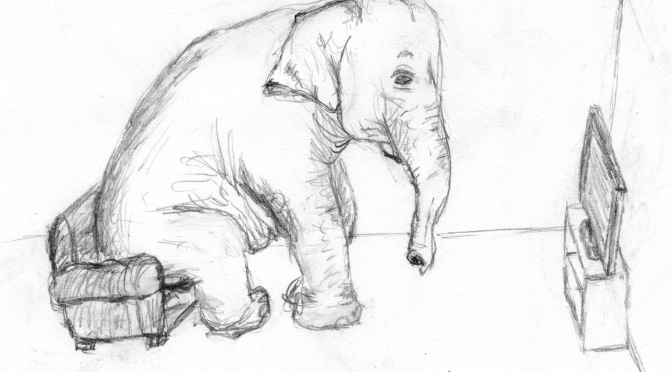
  • The Elephant

    The Elephant

    Acknowledged but unspoken,
    Sitting heavy in this space,
    A weight on every shoulder,
    Tensile strain in every face.
    
    It's name must not be sounded,
    Nor its presence e'en confirmed,
    It's substance flat discounted,
    It's existence not affirmed.
    
    If aired, the thoughts and feelings,
    Formed about the ugly beast,
    Would stir it from a slumber,
    Then it on my peace would feast.
    
    So better to ignore it now,
    accept the stagnant stink,
    Give up what was my breathing room,
    Turn off my will to think.
    
    Confine myself to smaller space,
    Be glad I have some left,
    Then hope it won't demand yet more,
    And leave me flat bereft.
  • Dawdling

    Dawdling

    How is it that they cannot walk,
    When slower speed is wanted,
    Can play all day and jump and climb,
    On into night undaunted. 
    
    Bounding to and fro with mirth,
    While chasing wind and rain,
    Grubbing, digging, wrestling too,
    Impervious to pain.
    
    But task them with some simple thing,
    Then comes a sudden crash,
    Aching backs and swollen tongues,
    With joint-pain and a rash.
    
    Bathroom breaks that take an hour,
    Drinks that last all day,
    Just anything to slow the pace, 
    Because it isn't play.
  • Grinding

    Grinding

    There is a kind of tired,
    That resting can't assuage,
    Not caused by sweat and labor,
    Nor a product of great age.
    
    Oft it creeps in slowly,
    Caused by labors of the mind,
    When truths compete as valid,
    But no resolution find.
    
    They grind against each other,
    Then life adds in some grit,
    Of reason, hope and longing,
    That block and warp the fit;
    
    Which erstwhile might be forming,
    Were the process left alone,
    To smooth the roughened edges,
    Like a knife against the hone.
    
    And form a polished surface,
    Where the two can both reside,
    Supporting one another, 
    Standing stronger side by side.
    
    But friction over zealous calls,
    For effort hard and long,
    To overcome the sticking points,
    A glue that's thick and strong.
    
    Competing hopes and hardened facts,
    Pull and push and block,
    Each in it's own direction,
    'Till it stops, an unwound clock.
    
    With such grit to clog the gears,
    The truths are ground to dust,
    And leave back no remainder, 
    In which to hope or trust.