Category: Peter’s Writings

Things Peter writes for his own benefit, not necessarily intended for or made available to the general public.

  • Satan’s laugh

    Satan’s laugh

    Hateful things in human thought
    Twisted minds this sin have brought
    Barking dogs pull at the chain
    Howling shrieks and moans of pain
    Mothers weep and infants cry
    Above the gate - ARBEIT MACHT FREI
    Shuffling feet of broken hearts
    Pause for families torn apart
    Wives and children stripped away
    Screams and cries that cannot sway
    
    One by one sent there and here
    For some the end is very near
    While others hear the orders barked
    For brutal labor they were marked
    The crack of whips and thud of fist
    The whimpered hope you're on the list
    Yet labor's toil halts not the end
    It just delays the captive's friend
    Released as smoke to float away
    To rest in peace 'till judgement day
    
    The aircraft's roar makes rain of steel
    The rumbling tank with squeaking wheel
    The cannon's bark and tongue of flame
    Cackling guns no man can tame
    Hateful shouts dehumanize
    All morals lost to human eyes
    Torture, torment, words of hate
    Pain designed to grind and grate
    
    Little children weaponized
    With vacant stares and hollow eyes
    Mothers, fathers, infants, kids
    Thrashed and killed as leader bids
    Allah's name they shout aloud
    And purify by purge the town
    They claim to be his army true
    Do horrid things no saint could do
    
    Hate and malice, selfishness
    Idols finely shaped and dressed
    Lure distract and lead away
    Those who stumble on their way
    To wanton riot, heinous deeds
    Anything to feed their greed
    Shattered lives and broken dreams
    Whimpered cries and shouted screams
    Calls for vengeance swift and sure
    Find neither answer nor the cure
    
    These horrid sounds assault the ears
    Tender hearts sprout monstrous tears
    But hardened souls cannot be moved
    Though hell itself their deeds reprove
    Rumbling, thundering waves of sound
    O'er the earth reverb, rebound
    Satan's laugh with mortal voice
    Cackling glee at human's choice
    Oh what fools these mortal souls 
    who let me in to take control


  • A Rant on Modern Science

    When I was a kid, my best friend Zeke (not his real name) was what we all considered “fat.” In addition to being heavier than the rest of us, he had a complexion that would have been described as sallow, had a tendency for profuse sweating, bad teeth, and delayed mental development. He was different, and that made him a target. Aside from Zeke and one or two other kids in my elementary school, I can’t remember a single kid who would be labeled overweight by today’s standards. Fast-forward thirty years, and my experience would infer that Zeke would be quite normal in a modern school.

    There appears to be near universal alarm, hysteria, and media hype about an “epidemic” of obesity; childhood obesity in particular. Everyone from the First Lady to self-help authors are on the bandwagon, shouting to the hills about the evil of one perceived cause or another and schilling for their particular remedy. Assuming you believe the publicly circulated reports, obesity is responsible for or contributes to more untimely deaths than smoking, and the rate of occurrence is reportedly on the rise. Based on my personal experiences observing and interacting with every-day people, I would have to agree that something has gone seriously wrong in the thirty or so years between my generation and the current one. The real question, and one that I don’t believe has been adequately answered, is what?

    Given the wide acknowledgement of a problem and poor public understanding of the causes and cures, industry writ-large is exploiting the vacuum to bleed the public. The diet and supplement industries are playing to this tune and stripping billions from the pocketbooks of people who have fallen victim to this plague. It seems every day there is a new “miracle” diet that completely contradicts yesterday’s diet d’jour and will cure you of your ills for a price. I’ve lost count of the number of miracle supplements and “natural” products (all of them expensive) that were supposed to make weight loss easy only to see them pulled from the shelves as unsafe or fade away into oblivion as the public gained experience and found the results to be wanting.

    The pharmaceutical industry too has stepped up to the plate by introducing new miracle drugs that promise to end heart-disease by lowering cholesterol, cure obesity by interfering with our ability to digest fat, and in general make us healthier and happier through chemistry – for a price. It almost seems to be a point of pride for some (some quite close to me) how many different drugs they are taking. The food industry has also responded by introducing an endless stream of new “healthier” alternatives to traditional foods. Diet sodas, low-fat snacks, processed whole-grain cereals, cholesterol free refined vegetable oils, and so on and so on. In addition to providing “healthier” ingredients, the industry is saving us the trouble of having to think about what goes into the food we eat by providing these items to us in a processed form that is ready for consumption, complete with labeling to reassure us that science is on their side. Looking around me, it is clear that science has failed us in many respects. “Science” has been promising painless progress and perfect cures for this health epidemic and it’s close cousins since before I was born, but the overall trajectory in many ways has been increasingly downward.

    One thing I’ve not seen, though, is a willingness to reexamine the fundamental premises of the current hysteria. Historically, obesity was an affliction of the affluent. The kinds of heart disease and other chronic illnesses that make life miserable or short for a great many people today were reportedly almost unknown in preindustrialized societies. As recently as the 1930s, Weston Price was able to find societies who hadn’t adopted modern lifestyles and eating habits, and where rotten teeth and heart disease were virtually unknown. None of these people followed the advice of modern science for caring for their cardiovascular system or teeth. They ate diets that for the most part would be condemned by modern science as an irrefutable recipe for an early heart attack. Science has been unwilling to question how and why this is the case, and either writes these cases off as aberrations or statistical anomalies, or looks for other factors that they can use to make the data fit their existing hypothesis. The science of heart disease and tooth decay is “settled,” and the debate is over. Never mind the fact that nearly 40 years of low-fat, low-cholesterol hysteria has done nothing to reduce the actual prevalence of the condition it was supposed to fix. One of the truest tests for the utility of any scientific theory is it’s ability to make predictions that match observations. In this case, the predictions have been abysmal – enough so, I believe, that the theory should be scrapped. Yet we are unwilling to go back to the beginning and re-examine the underlying assumptions. We seem unable to give up on something new and go back to reevaluate the wisdom of the past.

    I think it is a part of the American psyche that we tend to want to look forward, to “progress.” There is an implicit trust in anything labeled as science and deriving from experts, and a serious prejudice against the preferences and traditions of prior generations. This mindset has been at the heart of some of the greatest inventions the world has ever known, but it can also lead to devastating consequences if our trust is misplaced. In the past it has resulted in products such as methamphetamine being openly marketed as a cure for fatigue and a miracle diet pill. It brought in kudzu to the American south for erosion control. It brought African honey bees (killer bees) into South America. We have a habit of arrogance that can be astounding, and a willingness to remain blind to our own limitations and limited understanding.

    It is a fundamental characteristic that the capacity for evil inherent in any given object, capability, or idea is almost directly proportional to the capacity of the same thing for good, and it requires great diligence, thought, and analysis to distinguish between the two when the messages are controlled or shaped by those with an interest in the outcome. What’s more, we are truly adept at ignoring those things that are somewhat inconvenient or that would require us to move away from the preformed ideas we hold. In my mind, there is at the core of much modern debate a fundamental inconsistency – one that we tend to ignore just like other the inherent flaws and contradictions in our attempts to “fix” the human condition through “science.” This inconsistency, if truly examined and acted upon, would radically change the way we look at the world around us; and it is this kind of change of perspective that I am seeking for myself.

    Foundations

    “He is like a man which built an house, and digged deep, and laid the foundation on a rock: and when the flood arose, the stream beat vehemently upon that house, and could not shake it: for it was founded upon a rock.” – Luke 6:48

    Not too long ago my wife and I purchased land and contracted to have a home built on it. Before any other work was done, the contractor dug a hole in the ground near where the house was planned in order for a specialized engineer to evaluate the soils and design a foundation that would be strong enough and anchored deep enough to prevent it from shifting, heaving, cracking, and generally undermining the construction. After evaluating the soil, the engineer retired to his firm to do the required analysis and design. His results indicated that the standard foundation construction for which we had budgeted and scheduled would be inadequate. We would have to spend significantly more money and allow extra time.

    This was a significant challenge for our family. We had already delayed construction several months due to difficulties closing on the land and construction loan, and were facing a period of homelessness between our extant lease expiring and our house being ready for occupancy. Unexpected costs at closing had sapped much of the reserve we had allocated for cost overruns. The additional costs and delays required to evaluate and design the foundations were a significant inconvenience. However, there was never any doubt about the path we needed to take. Weakness in the foundation would undermine the entire house and jeopardize everything we had put into it.

    What does this have to do with the topic at hand? The answer lies in the foundations for many of the positions and arguments made today. I believe we have built many of our exquisite explanations and justifications on the weakest of foundations. Foundations that were cracked even as the first bricks were laid for the enormous house of cards that we have built. However, because we are deeply invested in what we have built up we continue to patch, re-level, brace, and generally bandage the teetering tower of sophisms rather than look at the root cause of the repeated need to patch.

    In order to get a clearer understanding of the problems we face, and find any hope that we can begin to correct them, we need to start by acknowledging the failure of current foundations, then identify the requirements for a solid foundation on which we can build a durable and strong structure capable of enabling clear understanding.

    What then is the foundation upon which modern thinking is based? In short, my view is that our cultural and intellectual foundation is grounded on the belief that man has evolved or progressed miraculously in the last 100 years or so, overtaking and overcoming all the wisdom of the ages with irrefutable and indisputable science. We seem to believe that we are fundamentally different from our ancestors, and that anything produced before our living memory is as crude and barbaric as bleeding a sick patient in order to “re-balance the humors.” We believe we can accurately explain anything, and are quite adept at developing explanations and theories that fit conveniently with and support our biases, prejudices, and preferences. We also believe that we actually understand the intricacies of the universe we live in and the relationships between the numberless components and influences. We also tend to reject or write-off data or theories that don’t fit with our pre-conceived notions or current understanding.

    I claim this foundation is perhaps as shaky as any ever built. Each aspect I evaluate seems as solid as a cloud, glued to the rest by little more than air. To begin with, consider the basic premise that science has answered or will answered our questions irrefutably and that using scientific methods, we have proven theory beyond any shadow of a doubt. I personally find this belief preposterous for a very simple reason. We are inside, affected by, and affecting in the course of observation or even existence the system we are attempting to describe. Our ability to objectively and fully observe any phenomenon is fundamentally limited. At best, we can view or account for only a small subset of the conditions, variables, forces, and other interactions that make up even the smallest and most controlled of physical experiments.

    Humility

    “Oh what fools these mortals be.” – Shakespeare

    As an illuminating example of how insignificant our capacity and understanding are, consider the anecdote of the butterfly flapping his wings in one hemisphere tipping the scales and initiating a hurricane in the other. Every aspect of the atmosphere is interconnected. On a very small scale, we have written equations and theories for how the major constituents of the atmosphere react to pressure, temperature, motion, etc… and have shown that these equations accurately predict observable changes in controlled environments. Analyzing the theory has resulted in insights and additional predictions that became the basis for great discoveries and inventions such as the jet engine and common refrigerator. These developments have been practical and important, and were based on principles derived from the same fundamental theories that should govern butterfly wing turbulence and hurricanes. The problem with applying these theories to the global-scale is that complexity makes the problem intractable (a scientist’s or mathematician’s way of saying impossibly complicated and unsolvable).

    Things in the real world are impossibly interconnected and involve an almost infinitely dense set of relationships. This fact makes definitive theory useless for application on that kind of scale. In the case of the butterfly flapping it’s wings, we would need to know the texture of the wing in exquisite detail, the precise motion of the wings, the location and physical shape of the butterfly and every object in the vicinity that would impact the induced air currents, the terrain and all other physical features of the global environment that would affect the movement of air. Each of these factors are potentially related, with one affecting the other, requiring specification of the first-order (how one thing affects it’s neighbor) and higher-order (how multiple things combine to affect other things) relationships between them.

    As an example of how ridiculously complicated this becomes, consider one method for modeling where we cut up the space into small cubical “blocks” of air that are next to each other. This division into discrete blocks is not reality, but is a simplifying approximation required to even begin framing the problem. Each block interacts with at least the six other blocks which border it (top, bottom, left, right, front and back). At a minimum, all six of these interactions must be described by at least one relationship (equation with at least one variable) and initial conditions (starting points) for each variable. For the approximation of the “block” of air to be moderately accurate, the block must be small enough that the stuff inside it is easy to fully account for and everything inside the block is uniform… Nothing inside the box is affected by anything outside it, and there is nothing inside the box to perturb the internal conditions. The entire box of air reacts together to the influences of the boxes surrounding it.

    Now, rather than tackle the entire globe at once, consider a 2000 square-foot house with eight-foot ceilings. For simplicity and illustrative purposes, assume that we can adequately describe the atmosphere by chopping it up into one cubic foot blocks (about the volume inside a mid-size microwave oven). Also for simplicity, assume there is a single, one-term, relationship between each face of the block and the block next to it. Assuming the house is a pure cube with no walls, ceiling, heat sources, furniture, or other factors that could influence our butterfly turbulence, there are 16,000 “cubes” of air, resulting in at least 96,000 starting data points and first-order/nearest neighbor relationships.

    This sounds pretty difficult already, but with modern computers systems of even millions of interrelated equations are easily solved. I personally have written programs to grind through extremely large problems, and am enamored of the computing capacity we have developed. Our 96,000 element problem is simple once the relationships and starting conditions are defined. However, one cubic foot is HUGE compared to our butterfly. If we break up the atmosphere into one-foot cubes we will loose the butterfly to the assumption that the air inside the box is uniform. In order to preserve any of the effects of the butterfly, we’d have to break the box up into pieces less than about 1/10th the size of the smallest feature in the system. For the sake of this example, think of something on the order of one cubic millimeter (roughly a grain of kosher salt) or even smaller. In this case, our 96,000 relationships for the 2000 sq-ft house become more than 2.7×10^12 (2.7 Billion) relationships and starting conditions. Add to that the need to describe every square millimeter of air contacting non-air (walls, floor, furniture, etc…) in 3-dimensional space, and an expression that adequately captures the way the air interacts with it (for example, foam would be substantially different from steel), and it would take well over 20 terabytes to digitally store just one double-precision value for each cube.

    In addition to cutting up space in to blocks, time must be discretized in order to compute the effects of our butterfly. Think of it like watching a movie… Each picture in the movie is a single snapshot of what things look like at that time. If we are only working to the fidelity of the human eye, we only need to cut time into segments of about 1/24th of a second each (24 frames per second) since the eye can’t really respond faster than that. However, if you use this frame-rate to record something that happens very quickly, all you see is a blur that washes out the very thing you were trying to record. This is why National Geographic and other documentarians love extreme slow-motion cameras for filming amazing things like a great white shark attacking a seal, a humming bird flying, or a chameleon catching a fly. These scenes are created by breaking time up into much smaller chunks. In a similar fashion, to model the effect of the butterfly’s wings, we need to break time up into chunks small enough that the “wave” of turbulence generated by the butterfly doesn’t travel across any of the blocks of air between time slots. What this means, is that the entire gargantuan system of equations we’ve developed to model the system has to be solved over and over again for each tiny time slot until the effect has reached the time we are interested in. Assuming access to a supercomputer large enough to store and process data on this scale, the time required to process a single slice of time would be substantial. Continuing the computation to describe the immediate effect just across the room (not to mention the late-term and second-order effects) would be phenomenal.

    Solving this system might be conceivable in the future if Moore’s law continues to hold (roughly stated – computing power doubles every 18 months). However, the complexity doesn’t stop there. We could continue to refine the problem (and make it more realistic) by adding second and third-order effects, further breaking down the discretization (blocks) into smaller blocks, and including an almost infinite list of external influences ranging from the effects of gravity on the density of the air as a function of altitude to the temporal and spatial variations in solar heating caused by variable absorption in the atmosphere and so on, and so on… Our ability to even comprehend all the factors that may influence even a highly artificial and controlled situation is fundamentally limited. At some point, we become part of the data set ourselves (our breathing and movement for example), and in the act of setting up our measurements we perturb the experiment and invalidate the results to some degree.

    Finally, perform this mental experiment: Look up your house on your favorite mapping software that includes satellite imagery. Think how complex the problem of scientifically describing your house is, then slowly zoom out until you have an appreciation for how small your postage-stamp on planet earth is in the grand scheme of things. That zoomed out picture contains a great many houses of similar complexity with additional “stuff” between them that must be similarly described. Continue the exercise by mentally backing out further until the earth is a speck in the solar system, the sun a dot in the galaxy, the galaxy a small speck in the universe, and so on… The closer we look, the smaller we are, and the more we understand how little we actually KNOW.

    There are good reasons why weather guessers have a hard time predicting the weather more than just a few hours in advance. Even equipped with the best models, super computers, and science to back them up, their computations are necessarily based on simplifying assumptions and approximations. The best they can hope to do is run a whole bunch of simplified simulations with varying amounts of randomness added in to simulate the unknown contributions of the real world to their idealized model and hope the average comes out somewhere near the truth. This isn’t unique to weather. All of human endeavor is clouded by the limitations of finite understanding, precision, and capacity. Sometimes the effect is obvious (like the weather), and sometimes it is hidden or small enough that we ignore it either willfully, deliberately or through ignorance of its existence.

    Even if by some miracle we were to completely observe, describe, and incorporate all influences within a system into a universal theory that worked all the time, there is no real way to prove the theory is in fact the way things actually are. We can demonstrate the adequacy of the theory for describing and predicting observations. We can similarly disprove a bad theory by showing counter-examples. And, once certain underlying conditions have been set down we can “prove” a theory in some sense provided our underlying “facts” are in fact correct. However, all proofs begin with a statement of the given facts, and as much as we would like to dis-believe it, facts in an absolute first-principles sense are difficult to come by. The best we can hope for is confirmation that the theory is capable of predicting the behavior of the system for which it was created.

    As an example, consider one of the fundamental “givens” in physics: opposite charges attract in quantifiable terms, and like charges repel in a similar fashion. We can demonstrate easily that objects imparted a “charge” of “like” or “opposite” character will attract or repel each other in a well behaved and well defined manner. If we add to this the concept of magnetism and describe the observed effects in equations laid down based on scientific observations by Gauss, Maxwell, and others many moons ago, we can take those relationships (equations) and use them to predict certain observable behaviors that explain things like stereo speakers, power generators, radio waves, light, and so on… Using the core concept of charge and magnetism, we have been phenomenally successful at identifying means to leverage and manipulate the world around us for our own convenience. This is the true utility of science. It allows us to describe interactions in a way that enables comprehension and understanding sufficient for predicting the outcome. However, being able to describe something in useful terms and being able to give the definitive specification for what something actually is are not necessarily the same.

    As an example, the concepts of “charge” and “magnetism” have proven very useful; expanding from the extremely small-scale universe of quantum mechanics through to grand-scale cosmology, and have stretched into the even more esoteric realms beyond. I don’t believe there has been a single data point or theoretical instance that casts doubt on the utility of these concepts. However, we don’t often stop to think and ask ourselves – what is a charge? I contend we don’t actually know, and fundamentally cannot know. All we can hope to do is describe it’s effects. We can’t inspect it directly. We can’t see it. And even if we could, we would be limited by the fact that we are part of the system within which the concepts exist, and therefore not in a position to step back and pass absolute, impartial, and correct judgment. It would be a bit like asking a blind salamander who had spent his entire life in a dark cave to describe the universe based on the minerals dissolved in the water he drinks and the detritus he cannot see that makes its way into the darkness of his cave.

    Unlike the blind salamander though, we have been amazingly adept at using our limited capacity to comprehend the universe to build theories and explanations that conform with observation. As we have gained experience with these theories, we have historically become more and more confident in their correctness, to the extent that we become blinded to our own nothingness. Prior to the 1920s, physicists believed they were just about “done.” They had built up a theory of how the world works that could describe almost every observable phenomenon when viewed in isolation. There were just a few inconvenient aberrations like why a heated incandescent light-bulb filament is the color it is and why different materials retained heat better than others. Many physicists were convinced these trivialities would surely be fixed in due time and the theory of how the universe works would be complete.

    Scientists can be a rather arrogant lot. When we think we know the answer, we tend to push back at anything that seems “counter-factual” or inconsistent with our understanding. We look for plausible explanations for “outliers.” We get comfortable with a theory and forget the limitations and uncertainty upon which it is built. We begin to confuse belief and knowledge, model and object, master and servant. This behavior is not unique to the big-brained academics. We all tend to assume we “know” things that at their heart are fundamentally unknowable, and to discount anything that is counter to our predetermined outcome. In the case of the initial forays into quantum mechanics, the professors of classical mechanics didn’t react well to the radical new theories that fundamentally undermined their understanding of the world.

    Unfortunately for Sir Isaac Newton and those who followed in his footsteps, the inconvenient aberrations or oddities early 20th century physicists explored shook the very foundations of science in ways nobody could have predicted. The resulting innovations in thought and theory resulted in new ways of describing the world that opened the doors to an amazingly wide range of modern innovation ranging from the amazing contributions of chemical engineering to the world of digital electronics that surrounds us now. In the course of exploring the oddball “boutique” problems, brilliant minds would introduce the theory of quantum mechanics and turn the scientific world on it’s head, all while demonstrating the absolute inadequacy of what had been all too recently declared as essentially “done.”

    This up-ending of understanding is not unique, and won’t stop with the current generation of experts. However, there are limits to what we can observe, and therefore limits on how much we can usefully predict and begin to understand. In every generation, there have been those who argued vehemently against any form of theory or thought that went against conventional wisdom. In every case I’m aware of, every single professor of wisdom who declared the argument over and science settled has, in the end, ended up on the trash-heap of history. I find it an amazing mark of arrogance and stupidity when I look around me and find an entire generation who have bought off on the message that science has “proven” this, that, or the other, and that the debate is over. To think that we are capable of completely comprehending, understanding and accounting for all of the influences and interactions that make up this amazing universe of ours is indeed one of the most stupid things I can come up with.

    If we as a people are to have any hope for increasing our understanding and improving our situations, we need to be honest about our own inadequacy. When we are arrogant or self-certain, we close the door on learning. There is no student more difficult to teach than one who believes they already know the answer, and the most unfortunate part is that the answer itself is rarely the point of the learning. We must be humble to be teachable. We must comprehend our limitations and be willing to acknowledge that even our most exquisite and best developed theories are no more than that… theories that are useful within the context for which they were developed.

    Down With Intellectual Laziness

    “For even when we were with you, this we commanded you, that if any would not work, neither should he eat” – 2 Thessalonians 3:10

    One of the most important lessons life has taught me is to question everything with an open mind. I believe we as a society have become too mentally lazy to do the real work required to thoroughly analyze a problem, research answers, organize and arrange the results and come to a conclusion based on rational and defensible conclusions. The human desire for simplicity and ease is natural, and is to a great degree responsible for many of the improvements in our lives. The desire to get more out of the limited resources we have is the driving force behind innovation but also lies at the heart of laziness. Very few people, indeed you could argue that no one, will sacrifice short-term gains unless they perceive a long-term payoff that makes the sacrifice worthwhile. The distinguishing factor behind laziness is the inability or unwillingness to look forward into the future to identify areas where sacrifice or hard work will pay off.

    The American public has become intellectually Lazy. It is much easier for us to accept a party line, polished explanation, or the confident explanations of experts than to spend the time and effort to truly evaluate the substance of the messages we hear. More often than not, positions are taken based on popular appeal, fair speaking, hollow promises, uncritically examined ideologies, or blind acceptance of the status-quo. This mental flabbiness seems to extend to all aspects of modern life. We have reached a stage of society where the 6-second news clip can incite riots, the most repeated opinions are taken as truth, and true debate and discussion are displaced by unthinking partisan bickering, intellectual dishonesty, and unreasoned and inflexible dogma.

    In my personal efforts to overcome this mental laziness, I have read and considered some of what would have passed for mass media early in our country’s history. A case in point that illustrates how far we have wandered from our roots as a thinking society are the Federalist and Anti-Federalist Papers. These papers were originally written as series of newspaper articles intended to inform the public and shape the public debate surrounding the adoption of our current constitutions which represented a much more powerful and expansive federal government than existed under the Articles of Confederation. The pubic debate they represent could not happen in today’s society. The arguments are too dense, discussion too long, and thoughts too deep to survive the attention span and understanding of the masses. We are simply too lazy to put the work into understanding the issues, dissecting the arguments, and forming our own opinions.

    To complicate matters, we are constantly bombarded with predigested and analyzed sound-bites informing us what the “correct” opinion is. In this “information age” many had hoped for an empowered populace who could freely share information and allow all to discover the “truth” independent from the media moguls and other power players who historically shaped opinion by using their printing presses or bully pulpits. However, as we have gained more and better access to instant information, major information brokers have risen up and established themselves as the filter for what is true and newsworthy. In spite of our incredible access to information, I believe the average American is more poorly informed on important topics than his antecedents. While you could argue that keeping abreast of the current status of ones friends, family, pop-stars, pets, and other random strangers is being informed, I disagree. We live in an age where some of the most thought-provoking items are pictures of an angry cat with a few words emblazoned across it. We have drowned ourselves in worthless information to the exclusion of truly important issues.

    We, as a society, must get better at shutting out the trivial and prepackaged messaging that would lull us into a thoughtless stupor. We need to deliberately work to strengthen our critical reasoning skills. We need to deliberately work to learn new and challenging things. We need to deliberately work to understand both sides of complex and contentious arguments. We need to deliberately work to understand our own beliefs and the foundations on which they are built. We need to deliberately work to probe, push and expand the boundaries of our capacity. All of this is work – hard work – and work is antithetical to laziness. We must not be lazy.

    Healthy Skepticism

    “the unexamined life is not worth living” – Emerson.

    Skeptics can be hard to live with or be around. The incurable skeptic is rarely happy, and seems to delight in toppling the cherished beliefs of those around him. This is not the kind of skepticism that I advocate. We should be willing to look at anything with a healthy dose of caution, but I’m not talking about the biting skepticism that sees no truth in anything and draws it’s strength in only tearing down and demolishing. Rather, I’m talking about the kind of skepticism that leads one to look at an argument for more than its fit and finish. Healthy skepticism should lead us to at least question the motives of information brokers, the strengths and weaknesses of the source, understand and look for holes in arguments, compare what you find against your own personal stores of truth, and be willing to accept something only after careful consideration. Several years ago, I worked for an organization who’s motto was “Trust but Verify.” This, in essence, is the kind of skepticism I believe is called for in most things.

    Science of all kinds has a long history of being biased in favor of those who fund it. This is occasionally overt, cynical, and self-serving; but more often it is a result of unacknowledged biases, unrecognized blind-spots, and group-think that can lead the investigator to discount the truth in favor of something they hope to find. When we are presented with a new set of data, it would behoove us to question the biases and motivations of both those who paid for it, and those who generated it. One simple test I have used for blind bias has been to look at how one reacts to criticism. Reactions that are more appropriate for a religious zealot, and show the kind of arrogance and hubris I’ve already described, are sure signs of internal bias that will undoubtedly taint the data. Intolerance of dissent or questioning is a characteristic of a cult, not a scientific endeavor.

    Respect the Past

    “Study the past if you would divine the future” – Confucius

    We are all too prone to look at history as being peopled with a different race of being who was all together less intelligent and capable than us. While there were many beliefs and practices throughout history that were truly barbaric and ill conceived, the basic nature of humanity hasn’t changed nearly as much as we think. While our technologies have enabled us to see things that were previously unseeable, and we have gained insights that were previously inconceivable, that is no reason to discard wholesale the wisdom of the ages.

    As a case in point, I recently heard a story of a team decided to comb through an ancient viking medical text for insights fighting antibiotic-resistant bacteria. The team discovered a recipe for an ointment that was noted as working very well for a particular form of eye infection that can be refractory to conventional treatment. Rather than dismiss it as hocus-pocus or snake oil, they decided to follow the recipe exactly and see what came of it. To their surprise, the resulting product had phenomenal antibiotic properties against some very difficult to treat bacteria. The medical community was not only skeptical, but openly hostile when the discovered the original source. Now, I doubt the original developer of this recipe understood that the infection was caused by bacteria, and that the particular mixture he developed had antibiotic properties; but I do believe that it was based on observations of what worked, and that explanations of magic or the like were used to describe what they saw in terms familiar to the audience.

    Humankind had spent millennia observing their environment and conducting experiments based on those observations. While some theories and practices that resulted had, in the end, no justifiable basis and were ultimately harmful (bloodletting and the medicinal use of mercury for example), others have proven much more useful. One case in point relates to the anecdote with which I opened this essay. As shown by both the fossil record and studies by those like Weston Price, traditional societies who eat the way they did hundreds or thousands of years ago, and eschew the kinds of highly processed low-fat foods that are now the rage, have little to no tooth decay, heart disease, or obesity. Coincidentally, those same groups tend to eat a diet high in saturated fat, cholesterol, and animal protein. I think, as a general rule, a healthy respect for what tradition says about what is good for health and society should be given the benefit of the doubt, and that new evidence that “proves” that what has been considered “wisdom” for generations is false should be subjected to intense scrutiny. We are far to quick to discard tradition simply because it is old. Let us respect tradition and look for ways to integrate it with our modern world.


  • Buried

    Buried

    Bury me not in the cold an dark earth,
    Where the roots and worms churn the ground.
    Rather lay me to rest in the folds of your heart,
    Where your rarest of treasures are found.
  • Hippochondriac

    Harry the zoo hippochondriac
    was a wonderful pain in the butt.
    The zookeepers all sat and wondered
    what went on there inside of his nut.
    
    He never went out 
    to enjoy the warm sun,
    and never would venture
    to swim, play, or run.
    
    He'd moan and he'd groan
    then flop hard in the hay,
    convinced some zoo patron
    had bubonic plague.
    
    When spring cottonwoods bloomed
    and sent tufts on the breeze,
    he was sure that pneumonia 
    was what made him sneeze.
    
    Once a blob of dried mud 
    stuck behind his left ear,
    convinced him he'd cancer
    and life's ending was near.
    
    He would bellow and blow 
    that the flies overhead,
    Brought pestilence deadly
    sure to knock him down dead.
    
    Any kindly meant checkup
    by the resident vet,
    was surely an omen
    and for days he would fret.
    
    So through forty two years
    he would miserably wait,
    for the deathly bad illness  
    that would seal his sad fate.
    
    'Till age-ed and slowing
    he looked back on his days,
    and realized the joy
    he'd let pass on the way.
    
    Determined to master 
    his time that remained,
    he rose and went out
    to soak up the sun's rays.
    
    Happy at last 
    to be out in the sun,
    he started to trot
    then broke into a run.
    
    But his bones and his muscles
    had grown wasted and thin,
    his heart had grown weak
    and beat frailly within.
    
    The years of seclusion
    left him withered and sick,
    his irrational fears
    played a horrible trick. 
    
    He collapsed in a heap
    landing hard on the ground,
    frantically looking 
    at the scenes all around.
    
    Children were happy
    the birds singing songs,
    a light cooling breeze
    moved white clouds along.
    
    The pond's glistening waters
    were just out of reach,
    His cousins relaxing
    stretched out on the beach.
    
    He closed his weak eyes
    knowing now what he'd missed,
    by letting his worries
    hold his soul in their fists.
    
    His time wasted away
    life now left him behind,
    and passed on to others
    who could happiness find. 
    
  • Leaving

    Leaving

    Precise to plans I drew myself,
    To house my future and my past.
    Space for children, work, and play,
    Built strongly - made to last.
    
    Connected with community,
    Deep roots and friends abound.
    Invested in longevity,
    We'd planned to stick around.
    
    The children learned to love this place,
    We parents did the same.
    Now plans have changed, and we must go,
    A pawn in life's harsh game.
    
    In packing up and leaving here,
    I go as duty calls.
    With heavy heart and misty eyes,
    To cope where my lot falls.
  • Storytime: VICA Nationals

    Storytime: VICA Nationals

    As with any of my stories based in reality, it is true and accurate only to the extent that my memory is correct.  This is an account of things as I remember them.

    Vica Nationals

    When I was in High School, I had a rather patient, kind, and understanding electronics teacher named Ralph Dammann who went out of his way to give me opportunities to explore that subject and “color outside the lines” that conventional educational programs draw.  He allowed me to skip other classes to work on projects, supported me as I cooked up various new things, and was generally an excellent mentor and facilitator. Under his watchful eye, I worked on a wide variety of projects that ranged from assembling kits that made lights sequence or goofy buzzing noises to designing and building custom circuit boards and electronic “toys” that did fun things like jam television signals, shock unsuspecting victims, trigger an alarm if a sink flooded, and other things like that.

    s072206_0048
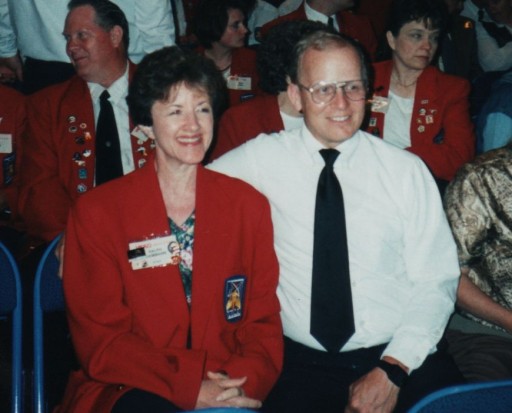
    Mr Dammann and his beautiful bride at the VICA Nationals closing ceremonies. I owe that man more than he can ever know.

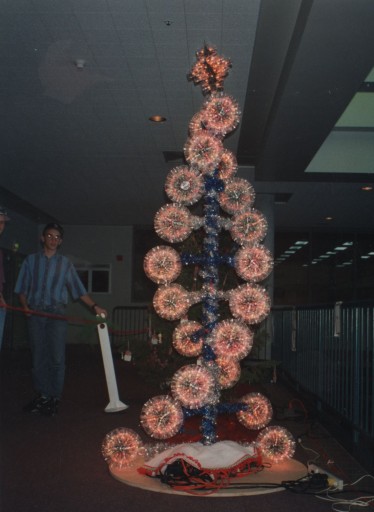
    As an example of the kind of things I ended up dong, my school had an annual Christmas tree decorating contest.  The wood-shop and electronics teachers decided they were tired of letting the home-economics classes have all the glory and recruited a few of us to “decorate” a tree that would stand out in a crowd.  We decided to build a “tree” out of a helical spiraling tower of lights and set them up on a sequencer to run in various patterns.  The wood-shop built the frame, a bunch of us built the light balls (Christmas lights stuck through the back of small plastic cups, and the cups glued together to form balls), and I designed and built the sequencer.

    s072206_0013
    Me standing next to the first “Christmas Tree” the shop-classes built. I built the sequencer that would flash the light-balls in a variety of patterns.

    We won the voting hands-down.  In fact, after two years of wiping out the competition, the rules were changed to require a real tree.  As a result, my brother and his cohorts were forced to integrate a small Charley Brown style tree into the display they built.  In the end, modified rules only made people more creative and the shop classes still won…

    As a result of Mr Dammann’s efforts, I became rather adept at working with electronics and was invited to participate in an annual state-wide electronics competition sponsored by the Vocational Industrial Clubs of America (VICA) my Junior year in High School.  With no idea what I was doing, I entered the competition and won the state championship.   I was off to the national competition in Kansas City.  I was pretty sure I wouldn’t win, but the prospect of flying on a plane for the first time and having the opportunity to experience a bunch of other new things made the trip quite a pleasure.

    While I didn’t place the first year, I won State the next and returned to Kansas City the summer after I graduated.   Our class also decided to enter a display competition with something as unconventional as our flashing Christmas tree, so a team of us got together to see what we could do.   We decided to put a custom-built clock up on a pedestal over a table that would act as the display surface.  We hung a pendulum with a magnet in the base of it under the clock, embedded magnets in the display surface to make the pendulum swing in a rather random motion, and I built a custom “exciter” that would put out a strong magnetic pulse when the pendulum swung over the center of the display to keep it going.

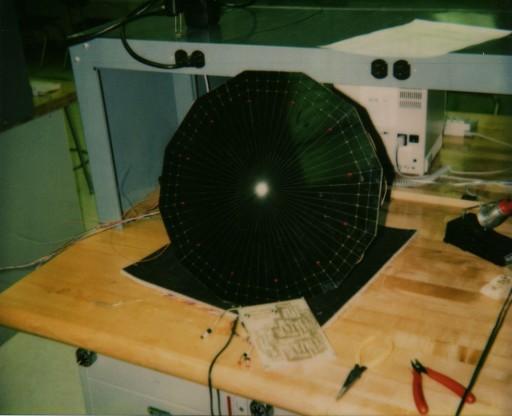
    The graphics shop printed the logos and other display materials, we recruited someone to sew the skirts together, the wood-shop built the clock cabinet and the display structure, and I took the lead developing the electronics to make it all work.  For the clock, Mr Dammann and I decided to build something unconventional by essentially integrating three light sequencers with a disciplined clock… one for the seconds, one for minutes, and one for hours.  The graphics shop printed a pattern on the surface of a sheet of plastic and I drilled out the holes, inserted the LEDs, and wired it all together with the custom circuit board that ran the thing.  Just for effect, we put a red light bulb in the clock cabinet just to add that special touch.

    s072506_0002
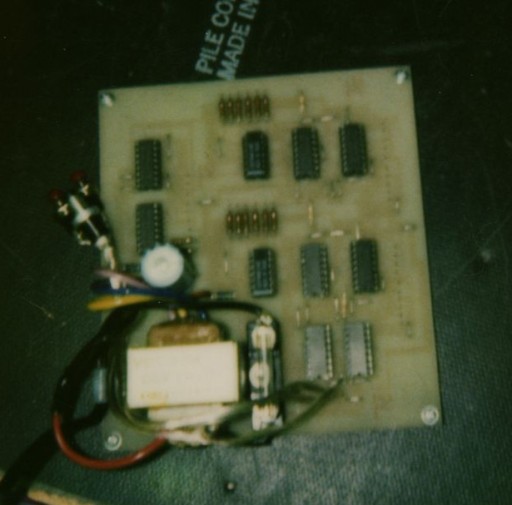
    The control board for the clock. It consists of a clock-generation section and three multiplexed counters that would recycle after twelve or sixty counts.
    s072506_0003
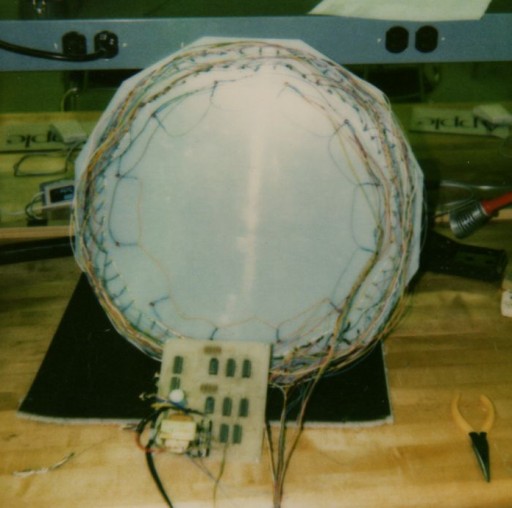
    The Completed electronics for the clock. The whole thing was designed from the ground up using basic cad tools to draw out both the schematic and the circuit board.
    s072506_0001
    There are 132 lights set into the face of the clock. The inner ring shows the hour, middle ring the minute, and outer ring ticks off the seconds.

    One of the funnier aspects of the clock was the reaction I got when we tried to pack it up and take it on the plane with us.  We were concerned it might get broken if we checked it in baggage or shipped it with the rest of the display, so we opted to bring it as a piece of carry-on luggage.  You should have seen the face of the security screener when he saw a box full of wires and circuit boards go through the x-ray machine.  They made me take the back off of it and show them there were no explosives inside it and show them how it worked before they would let me through.  That was before 9/11 when you could still bring pocket knives on a plane.  I doubt they’d let me take that thing on a plane today.

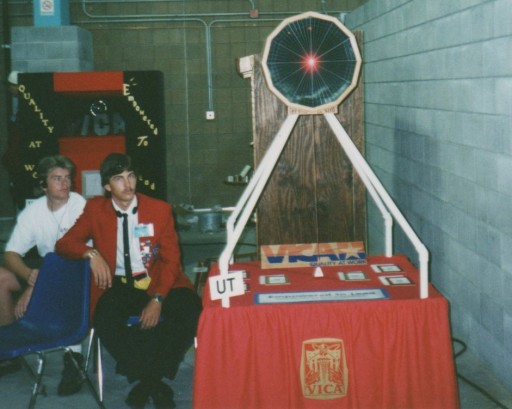
    s072206_0055
    Jason and Tyler (who’s last names I forget) watching over the display in the Kansas City convention center. I built the electronics, others built everything else.

    While we didn’t win anything for the display, the clock design was the coolest and most complex thing I’d done in the shop.  Years later, I reached out to Mr Dammann to see how he was doing and let him know how much I appreciated what he had done for me, only to find out that several years after he retired he had hunted down that clock and acquired it from the school.  He has it hanging in his house to this day.

    In addition to the display team and me, we had another team from our school that had won the state competition.  This team happened to include a bunch of girls, most of which I had dated at one point or another.  Being stupid teenage boys, a few of us thought it would be fun to harass them in an unconventional way.  One of the more popular projects to build in the electronics shop was what we call the “annoyatron” – a little box that was easily hidden and would emit a high-pitched scream periodically.  We decided it would be fun to modify one with a light-sensor so that it would only turn on when the lights went out and hide it in the girl’s hotel room.  I honestly don’t remember how we managed, but we were successful at placing it.  About two thirty the next morning, Mr Dammann knocked on our door to tell us he didn’t care who did it (I’m sure he knew) but that we needed to go get it and turn it off so the girls could get some sleep.  The girls got even the next day by filling our room with silly string and stuff like that.  They took our prank in the right spirit, and everyone had a good time in the end.

    I had more luck with my competition.  I felt I had done pretty well, but didn’t expect to place in the top three.  However, when they announced the winners, I came out second place.  I was ecstatic.  Aside from the accolades, I was awarded with a range of stuff donated by various companies that included a Snap-On tool kit, Kenwood oscilloscope, and a digital multimeter that would ultimately pay my way through college while I used them to fix televisions, radios, computers, monitors, and anything else that would pay.  I still have and regularly use those three items over 20 years after the fact.

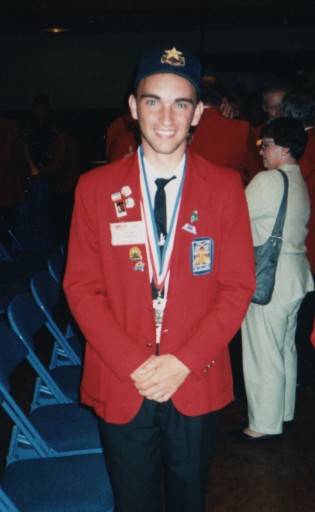
    s072206_0046
    Me, the night of the awards ceremony. I think I smiled almost continuously until after the plane landed that brought me home.
  • Jolly Green

    Jolly Green

    Middle of nowhere, not a soul is in sight,
    I'm alone far from help in a terrible fright,
    Marooned yesterday and all through the night.
    Weakened and failing, dealt a heavy hard blow,
    Then a thumping and rumbling rattling low, 
    Creeps through the quiet and steadily grows.
    
    Now the feet of a giant appear overhead,
    With a deafening roar beating down latent dread,
    Tells me help is at hand, and safety ahead.
    The jolly green giant called out to assist,
    Searching the morn' that frost's icy lips kissed,
    Pararescueman watching ensures nothing's missed. 
     
    He sees me and motions to show me he knows,
    Then out of the doorway he rapidly goes,
    Down a cable to meet me while rotor-wash blows.
    A rapid assessment - thinks I'm stable and then,
    He straps me in harness and upwards I spin,
    While twisting in air I am pulled safely in.  
    
    Just a minute, no more, and my rescuer's back,
    From a hover we drop to a zig-zagging track,
    Dodging through treetops to avoid an attack.
    Back to safety and comfort and a happier time,
    Relieved and or'whelmed I wipe tears from my eye,
    So grateful for giants that fly through the sky.

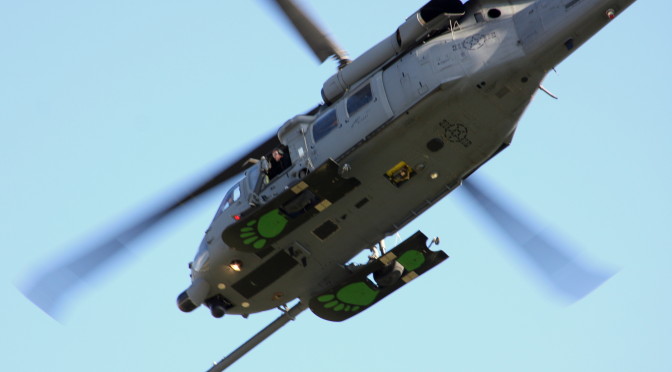
    In case there are any experts out there who want to critique this picture… it isn’t of a rescue operation. The helicopter is from the 210RQS from the Alaska Air National Guard. It is a rescue craft and crew, however in this case it was rigged up to carry a sling-load of batteries and other equipment to a remote instrumentation site in the Alaskan bush – hence no guns on the mount and the exposed cargo hook. Thankfully, I never ended up in a situation where the helicopter had to fight it’s way in.

  • Why Not Publish?

    I was on a flight home recently after an involuntary extension of a business trip, and happened to be seated next to an aspiring author who felt like striking up a conversation.  As we talked, he talked about how he had begun writing to deal with the loss of his mother.  That revelation led us down a series of wandering paths, along which it came out that I also write as a form of self prescribed therapy.  He asked if I had published anything, and seemed shocked when I told him no (other than scholarly/profesional journals) and that I wasn’t sure I ever would.  He seemed surprised and confused.  While he agreed that he wrote mostly for himself, keeping the result to ones self seemed inconceivable.  Why in the world wouldn’t  I try to earn money off of the result.  His reaction got me thinking, leading me to analyze why I feel the way I do.  The analysis is still incomplete, and probably will remain so, but I have come to some preliminary results that are adequate for my purposes.

    I suppose there is a fairly big part of me that dreads rejection.  What I write is meaningful for me, and I don’t want to be in a position where I am confronted with the reality that paints my work as a picture of futility, triteness, or inadequacy.  I am content with the knowledge that I have captured something of myself, and don’t need the approbation of others. However, once exposed and rejected, that withheld acceptance stings in a way that it would’t have had I not gone looking for it in the first place. In seeking for public praise, I risk losing the satisfaction and joy I would otherwise find.

    While I don’t like the prospect of rejection, that kind of pain is something I have dealt with successfully many times, and would willingly face again if I felt it was worth it.  So the question turns to one of determining the cost-benefit relationship and weighing the result.  To satisfy the engineer in me, I would normally want to evaluate every aspect and understand the failure modes, associated probabilities, costs, alternatives, and system impacts.  This desire to tear apart and analyze the situation is unhealthy in many cases since it often leads to paralysis.  However, my nature has been moderated by a life that generally forces me to work with something less than an 80% solution.  Given the limited time and energy I am willing to dedicate to this pursuit, I think I’ll settle for 30% in this case and hope reality looks something like what I come up with.

    The first question that comes to my mind is whether or not anyone who doesn’t have a personal interest in me would find my babblings and musings worth reading.  Without an interested market no product can be profitable.  This applies to publications just as much as it does to any other product. Unfortunately, I have no clear idea of market dynamics in this segment, and hesitate to even look hard for someone who might have a better read on the situation because doing so risks rejection and unfavorable or nonproductive feedback.  Furthermore, marketing myself makes me feel dirty and false while severely grating on me.  As an illustrative example, it makes me uncomfortable when my boss plays up my academic credentials in the small environment that is my professional circle.  I generally feel that if you need to know that information to take me seriously, you are to shallow for me to waste my time on.  However, this kind of self promotion is absolutely required in order to have any hope of success breaking into the publishing world.  That kind of self promotion really bothers me.

    The costs of self promotion are high, but high costs  can be justified by good odds of a high payout.  Unfortunately, I don’t believe the odds are particularly good that I could reap a reasonable payout.  Very few aspiring authors, even excellent ones, ever make much return on their investment.  Even if there were sufficient demand for the type of product I might produce, I have no reason to believe the material I could produce would be competitive.  What feedback I receive comes from rather biased evaluators and is limited in scope.  To my knowledge, nobody reads what I write with an eye to evaluating its commercial potential.  Without credible feedback indicating my assessment of the odds is demonstrably false, I have no reason to believe there is a market adequate to make it worth my time and energy.

    Next on the question list is whether or not seeking publication would still satisfy the needs that drive me to write in the first place.   I don’t write to please others. I write to please myself, and  I question whether I could maintain that perspective if I were to focus on publication.  I imagine it would be like golf…  I like the game, but would hate it if I had to do it for a living when the pressure of getting it “right” would disallow the hearty laugh that comes with a slice that takes the ball to the neighboring fairway.  I question whether pursuing writing would take the joy out of it all.  If I take the pleasure of of it I will have nothing worth writing, and in one fail swoop I would have robbed myself of both my dignity in becoming a shameless self promoter, and an element of happiness in ruining one of the few things I can find the time and energy to do strictly to please myself.

    Would I like to make money publishing poetry, essays, commentary, and stories?  Yes, but I doubt I have what it takes, either from a product standpoint, or from a personal investment in the cutthroat tactics and power plays required to push a good product to market.  I am generally happy with what and why I write, and taking steps to make it more than a form of self prescribed therapy would jeopardize that – without a high likelihood of a substantial return on investment.  So… After thinking it through, again, I come back to where I started.  I don’t plan to look for publication.  The three or so people who ever peruse this blog can enjoy it with the added pleasure of knowing they are part of a rather small and exclusive club of initiates.  And if you happen to get a chance to read the novel (if I ever decide to finish it) and other short stories I don’t post here, you are in an even smaller and more exclusive club unless something intervenes and changes my mind about publishing.

  • Storytelling: Spring Break

    Storytelling: Spring Break

    As with any of my stories based in reality, it is true and accurate only to the extent that my memory is correct.  This is an account of things as I remember them.

    Spring Break

    Many years ago I felt a strong desire to break free of school and work in order to spend some time tooling around Southern Utah.  I had time off, a small pickup truck, and enough money to pay for gas and any incidental expenses that happened to arise, so I made plans to take a bunch of back-roads through the red-rock country.   While I might have wanted to spend this time alone, I also had a sister who had just finalized a rather ugly divorce and was struggling to put her life back together.  After talking it over with both my sister and my parents, we (my sister and I) agreed to spend spring break together.  We threw a tent, sleeping bags, cooler full of food, camera, and a bunch of other gear in the truck and headed out for our first stop on the trip – Moab.

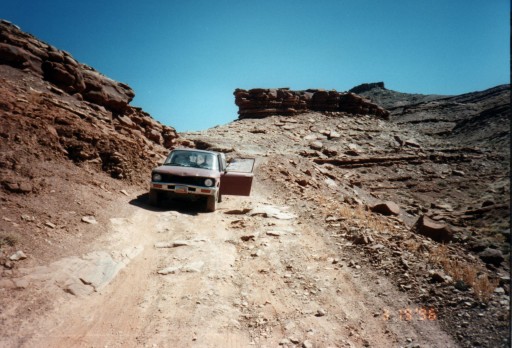
    The truck I owned at the time was a small, rickety, rusted-out, 4×4 Chevrolet Luv that was almost as old as I was, and was in much worse condition overall than I was.  In spite of being four-wheel-drive, the small street tires it had made it ill suited for substantial off-road driving.   It wasn’t particularly well suited for street driving either.  The doors were so rusted you could see daylight and passing asphalt through them, and they did nothing to keep the overly loud muffler and other road-noise out.  To crown it all off, when loaded down with more than just the driver, the truck had great difficulty maintaining anything above sixty-five miles an hour unless I was on a steep negative incline.  But… it was what I had, so we set out for adventure anyway.

    s072506_0024
    My torn-up Chevy Luv on a trail down to the river-level in Canyonlands National Park

    In spite of the truck’s limitations, we made good progress up to the point where we were about an hour outside Moab.  Through some unexplainable mechanism, the truck had managed to pick up speed to over 70mph on a 60mph road, and a  highway patrolman coming the other direction noticed.  He flashed his lights at me, so I pulled over to wait for him to make a U-turn and give me a ticket.  However, instead of writing a ticket and sending me on my way with the admonition to slow down, he became highly interested in me and my cargo.

    Among the first questions he asked was if I had any drugs or alcohol in the car.  I answered “No.”  Then he asked if I had marijuana.  I kind of stared blankly at him, which probably piqued his interest, then responded with something along the lines of “I thought that was an illegal drug…” He asked for the registration papers, and when he saw my mom’s name on them assumed it was my sister’s car.  When she replied no, he was instantly suspicious until we explained it was our mom’s.  I’m not sure he believed her, but he quit going down that road at that point.  Still doubting she was my sister, the officer instead decided to ask me what was in the film canister on the seat between the two of us.  It had never occurred to innocent me that someone would use a film canister (something that has become exceedingly rare these days) for something other than film.  Again, I hesitated in wonderment over why he would ask such a dumb question before responding blankly “film.”

    This line of questioning progressed in a similar fashion until it finally dawned on me the officer was looking for evidence of a pot stash since I was clearly a college age spring breaker headed to Moab to get high.  By the time I managed to convince the officer I wasn’t what he was looking for we had been on the side of the road for probably twenty minutes.  In the end, he seemingly forgot that I deserved a ticket, gave me a warning, and let me go.  I considered myself lucky that he didn’t decide to make me empty out all the crap I had packed under the shell in the bed of the truck.  Had he done that, I would have been there for hours playing a roadside version of Tetris to load it up again.  Getting off without a ticket (which I felt I deserved) was gravy.

    The final point on this interaction came a few minutes later when the CB Radio crackled with someone asking me what I thought about the cop who had me on the side of the road.  I looked down and realized I’d tuned it to channel 9, a channel reserved for emergencies, and one that you wouldn’t assume a guy like would be monitoring.  The only way someone would have known to call me on that channel was if they had seen the radio.  I’m convinced it was the highway patrolman trying to bait me into saying something bad about him.  Rather than complain about the incident, I instead replied that he was a good dude, and that the other person shouldn’t be broadcasting on that frequency.  We continued on our way without further incident, and spent the next day in Arches national park seeing Delicate Arch and several other spectacular formations.  However, the real fun was in Canyonlands the next day.

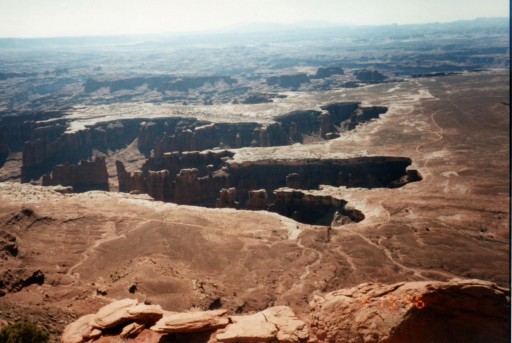
    Canyonlands is in reality two separate parks who’s joint-border is formed by the confluence of the Green and Colorado rivers.  To the north is “Island in the Sky” and the “Needles” to the south.   Another unusual aspect of Canyonlands is that the majority of the “roads” in the park require a 4×4 with good ground clearance.  From the Island in the Sky, the best scenery is found by taking the Schaefer canyon trail down a 1500 ft vertical cliff face to the White Rim, a ledge half-way between the Island in the Sky and the rivers.  A trail (the white rim road) ran from Schaefer canyon along the rim, following the Colorado river to the confluence and back up the Green river to another trail up to the Island in the Sky.   The entire trail is near 100 miles start to finish and extremely rough in places.

    s072206_0068
    Looking down at the White Rim from Island in the Sky. The white rim road is just visible snaking along down below.

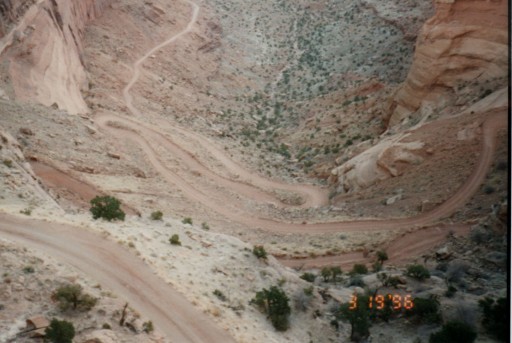
    Undeterred by the bad and steep road, I decided I wanted to head down the canyon to the white rim.  No sooner did I start down the canyon road than my sister decided she wasn’t up to it.  Being the obliging brother I am, I ignored her and pressed onward down switchback after switchback, having to back up to a wide spot a few times so a jeep coming up could pass.   Every turn and steep incline found my sister’s fingers digging deeper and deeper into the dashboard.   By the time we hit the bottom of the canyon my sister wouldn’t talk to me other than to insist that she would rather hike out than do that again.  Over the course of the day we saw amazing things, but none of it seemed worth it to my sister who found off-roading with me too frightening to continue much longer.   Finally, after an aborted attempt at a particularly difficult and steep trail down to the river level, I agreed to head back and get on more friendly terrain.

    As we were about to turn up the steep canyon road, we came across a man standing next to his mountain bike staring in dismay at the canyon road.  He was obviously in distress, so we asked if he could use a ride.  The look of relief in his face was palpable.  Even the prospect of fitting three across in my tiny truck wasn’t enough to cause a second thought.  We tossed his bike in with the rest of the crap in the back and squeezed into the cab together for the long ride up the canyon.

    s072206_0059
    Looking down Schafer Canyon. Many of the switch-backs are not visible, and it’s a lot farther down than it looks in the picture, especially when you consider the small green dots at the bottom are decent sized juniper trees.

    Along the way, this poor man explained that he had left the visitor’s center early the day prior expecting to complete the white rim loop in a single day.  He’d read a guidebook that claimed water could be pumped out of puddles along the trail, and that the distance was eminently doable in a day.  He had hit the trail without a tent, anything to make fire with, enough water for the day, or any clear idea for what he was getting into.  By the time darkness fell, he was halfway through the loop, out of water, out of food, and out of options.

    In the high-desert, temperatures drop rapidly when the sun goes down, and while daytime temperatures were in the mid-seventies, there had been frost on my truck that morning and the wind had howled all night long.  This poor man had ultimately resorted to taking shelter overnight in a pit-toilet at an unoccupied primitive campground.  Without enough room to lie down, he spent the night squatting over the hole and leaning against the wall.  Between the cold, his inadequate clothing and shelter, and the sheer discomfort of having to sleep while sitting up in a smelly outhouse, I doubt he slept more than a few minutes the entire night.  When day broke, he set out again, rationing his water and hoping to find help along the way.   When we met him along the trail he was dehydrated, exhausted, hungry, and unsure he had the strength to climb up that monster of a trail leading back to the visitor’s center.  After a drink, a granola bar, and some conversation, we dropped him off at the top of the trail.  He gave us a hearty thanks before heading off to his car and hotel room.

    The next day, my sister wanted nothing to do with rough roads, but I really wanted to explore an area in the needles section of the park that included a trail out to an overlook of the Colorado river.  My sister and I made a deal…  I would go into the ranger station and ask for intel on the trail, and if it wasn’t bad, we could head out to the overlook.  After a young (and rather pretty) ranger assured me that the trail was “smooth sailing and only a little rough towards the end” we took off to see what was out there.  She was right about the first part of the trail.  It was flat and coated with a shallow layer of sand that made for smooth sailing.  Unfortunately, the conditions changed radically almost instantly…  I was over-confident, and going too fast when I saw the drop-off coming.  My truck went airborne and we flew several feet before landing on the down-side of a 2-3 foot near vertical drop in the trail.

    Looking back at the obstacle, I didn’t see any way I was going to be able to crawl back up that rock-face.  But… since we were already past it, I decided to press onward and deal with this particular problem later.  After all… the trail was only supposed to get a “little rough” and maybe that drop was what she meant.  I was wrong about that point.  The next three miles were highly uneven slickrock sandstone where I rarely had more than three tires on the ground at any given moment, and frequently heard the scrape of the skid-plates under my transmission and oil pans against the rock.  My sister swore she would never forgive me.

    When we hit the overlook, there was a guy out there with a newer Jeep Wrangler crying over the dents in his oil pan.  He looked at me in wonder, openly questioning how I got my short, crappy truck out there.  I didn’t have a good answer, and after a few minutes admiring the view, we decided to tackle the trail back to civilization.  The ride back is somewhat fuzzy at this point, and to this day, all I can say about how we got over that drop-off is that it helps to have a vehicle you aren’t afraid of scraping up.   I’m not sure how I did it, but I’m pretty sure it took a few layers of steel off of the skid plates and a few years off of my sister.

    The rest of the trip was uneventful but amazingly fun as we visited several state parks and remote areas across southeast Utah.  In the end, it was a great time for both me and my sister, and I believe she did eventually forgive me for the stress and fear I put her through.  To this day, I want to repeat that experience with my family, but lack the 4×4 and the time.   Maybe in a few years…

  • Storytelling: Lightning Strikes and Skinny Dipping

    Storytelling: Lightning Strikes and Skinny Dipping

    As with any of my stories, this is true and accurate only to the extent that my memory is correct.  This is an account of things as I remember them.

    Lightning Strikes and Skinny Dipping

    From as far back as I can remember, I have loved opportunities to escape civilization and make my way into the wilderness.  Growing up in Utah, there were plenty of opportunities to do so, ranging from the High Uintah wilderness area a few hours east to some of the emptiest high desert on the continent to the west and south.  As a kid, my mother’s family made annual trips to both the mountains and to a set of sand dunes southwest of town.  These trips set a precedent that would forever shape my perceptions of what a vacation was supposed to be.  Instead of dreaming of Las Vegas, Disney World, or the Bahamas; any time I had the opportunity, I would load up what I needed and make a break for the desert, the mountains, or both.   Many of my better memories growing up revolve around camping out in the bush.  Whether it was with my family, Boy Scouts, or friends, I always felt at ease far away from the conveniences of modern life.

    One of the things that attract me to the wilderness is the very real sense of the power and majesty of nature.  One of the most visible aspects, and one I love to watch, is lightning.  Now, I don’t have a lot of first-hand experience with lightning other than watching it as a storm rolls through, but that on its own can be quite powerful.  One of the most incredible experiences I can remember was watching, hearing, smelling, then being enveloped by a thunderstorm that rolled across the west deserts of Utah to overtake and nearly drown our camp outside Delta.  If you’ve never experienced the feel and smell a desert thunderstorm soaking parched ground, there is no hope of explaining what it’s like.  I’ll never forget the rolling thunder and flashing bolts as we watched them approach from many miles away.  However, I do have a couple of rather close experiences with this particular expression of nature’s power — both of which occurred in the four-lakes basin of the High Uintah Wilderness Area.

    Over the course of several camping and backpacking trips through the Uintahs, I learned that the weather at altitude is highly unpredictable – especially in the summer.  Many times I’d been caught in a hailstorm when only minutes before the sky was clear and the air was warm.   Not wanting to be caught unprepared, I made it a point never to sleep under the stars, putting a tent between me and the rain if at all possible.

    On my first backpacking trip into the four lakes basin, things had been completely unremarkable other than the scenery.  We had arrived at the camp site happy to be at a point where we could stop for a few days rest, and we immediately began setting up camp.   I chose a spot in the shade of several large pines with a soft layer of needles covering the ground and set up my tent, feeling quite happy with my selection.  The remainder of the day was spent goofing off or fishing without incident.  I went to bed tired and happy.

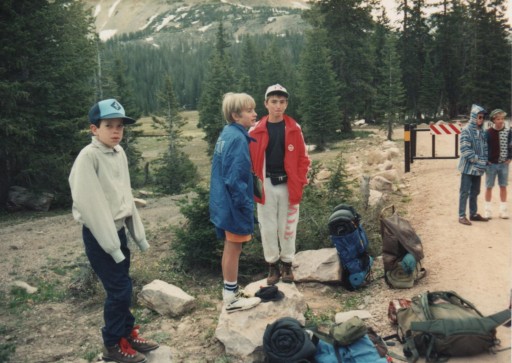
    kscan_0055
    The only picture I have of either trip into the four lakes basin.  This picture was taken as we were dropped at the trailhead on the first expedition. From left to right: Alan Lundgren, Mike Brady, me, someone I don’t remember, and Tom Mosier.

    Somewhere in the night, a powerful storm rolled in bringing hail and lightning with it.  I awoke to flashes of light, crashes of thunder, and the sound of hailstones bouncing off of my tent.  As I laid there watching and listening to the power of nature, there was a blinding flash accompanied instantly by a deafening crash of thunder.  My hair stood on end, and before I could react, I heard the sound of several things much larger than hailstones hit my tent and the ground around it.  I wondered what it was, but didn’t dare go out until the storm had passed.  The next morning, after watching the sunrise through the golden color of my tent fabric, I crawled out of my sleeping bag, unzipped the tent, and found a large piece of tree bark resting on the rain fly with several large chunks of green wood scattered all around.  Lightning had struck a tree only a few feet away and literally blew it apart.   Nature’s power is awesome, and I felt blessed that I hadn’t shared the fate of that all too nearby tree.

    The basin we were in was right on the main trail, and while remote, was rarely unoccupied.  The heavy traffic brought lots of fishermen competing for the limited stock in the lakes.  Consequently, fishing wasn’t particularly good, and as young men, the thought of depending on a couple fished out lakes for food wasn’t something we looked forward to.  After most of a  day trying to make due with the played out lakes, several of us took a hard look at the map and decided to hike over “cyclone” pass and along an unmarked trail to a remote lake to see if the fishing would be better where there had been less traffic.

    Cyclone “pass” wasn’t much of a pass.  Rather, it was more of a saddle between two high peaks, with even the lowest part of the saddle above the tree-line (roughly 10K feet).  Once over the pass, the trail on the map disappeared, but the lake would be easy to find by following the ridge-line north a few miles from the pass.   We took off with minimal gear and supreme confidence in our abilities.  We climbed over the pass, pausing only briefly to catch our breath and enjoy the spectacular views, then dove into the unmarked wilderness.  After several miles of  jumping between Volkswagen Beetle sized boulders we arrived at Thompson lake.  The fishing was awesome, and we limited out within a few hours.  The hike back to camp was uneventful, if tiring.  We had caught enough fish to feed us for the rest of our stay in that area, and the rest of the trip was beautiful and drama free.

    When our Scout troop returned to the four lakes basin the next year, there was a group of guys who wanted to head back over to Thompson lake and see if the fishing was as good as it had been the year before.   I don’t fully remember the reasons why, but I decided not to go with them.  If memory serves, I think I was feeling kind of sick and wanted to rest rather than tackle the steep climb up the pass and the mountain-goat version of a trail once I got to the other side.  In any event, I was one of a few people who stayed back at camp and watched as everyone took off to head up the pass.

    Several hours later, a black cloud rolled in with threats of a flash thunderstorm.  Almost as soon as this cloud arrived, enormous thunderclaps reverberated through the trees and across the basin.  I was glad to be under cover of a rain fly instead of out on the trail, and was sitting back enjoying the sound of the storm when a handful of guys came trotting out of the trees through the rain.  They had been on their way back to camp when the storm rolled in.  As a matter of fact, they were nearing the top of the pass when they first saw the darkening skies.  The ones we saw coming out of the trees had decided they weren’t comfortable standing exposed above the tree-line with a storm rolling in, and had taken off at the best speed they could make to get out of the open.

    A few, however, had decided that they weren’t in any danger, were too tired to run with their packs, and thought it would be neat to watch the storm from their vantage point at the top of the pass.  Apparently it hadn’t occurred to them that a graphite fishing pole sticking up out of a pack would make a pretty good lightning rod.   As they were standing up on the pass watching the storm flash and crash, lightning struck close enough to daze them and make all their hair stand on end.  These few, who had been too tired to jog down the hill earlier, sprinted all the way to camp.  By all accounts, the lightning struck within a few feet of Tommy Mosier.  He looked very rattled when he got back to camp, and I doubt he ever took another chance with being out in the open during an electrical storm.

    As with the previous trip, the remainder of the hike was fantastic as we hiked from lake to lake on a fifty mile trek.  However, a full week on the trail doesn’t make for the most fantastic of personal hygiene conditions.  By the time we made the last overnight stop at Granddaddy lake, we stank, and we knew it!  The thought of going back into town smelling and looking like we did didn’t appeal to us.  Since we were still several miles inside the wilderness and hadn’t seen anyone for several days, and since we had a full day to rest at the lake before we hiked out to the trail-head the following day, we decided to strip down, wash our clothes in a creek, and jump in the lake to wash off the worst of the stink and dirt.

    Something to understand about the lakes and streams in that area is that they are all snow-fed.  Even in late August there can still be pockets of snow and ice in shady areas.  As a result, the lakes are rarely, if ever, much above freezing.  Jumping into one of them is likely to cause an involuntary contraction of every muscle in your body followed by some form of audible exclamation.  Jumping in to get clean is a very rapid process…  wet, rub, rinse, then climb out and into the sun to dry out and warm up.

    We had stripped down, washed our clothes and hung them out to dry, and were just getting into the water to clean up when a large group of young women came trundling up the trail and into view.  Everyone in the water sunk down to their necks in an attempt to stay modest while we waited for them to pass.  Unfortunately for us, they didn’t just continue down the trail.  Apparently they had noticed us, and had slowed down to gawk at the spectacle.  By this point, I was getting horribly uncomfortable as various parts of me either turned blue or shrank into nothingness.   As near as I could tell, they wanted to see something they weren’t seeing with us hiding in the water, wouldn’t leave until they saw it, and I was tired of being cold and wet.  I stood up in all of my naked glory, smiled, and walked right through the line of girls who had stationed themselves between us and our camp, greeting them with something stupid like “hello ladies,” or “water’s fine, care to join us?” as I passed.   I’m certain they were more embarrassed than I, but I doubt they were more mortified than my scout master.