Blog

  • Meet Cocoa

    Meet Cocoa

    The coyotes seem to have given us a break recently.  Between permanently moving Thornton outside and doing a better job making sure the electric fence isn’t shorted out, we haven’t lost any animals to predators in a few months.  So what do we do to celebrate…  get more animals I guess.

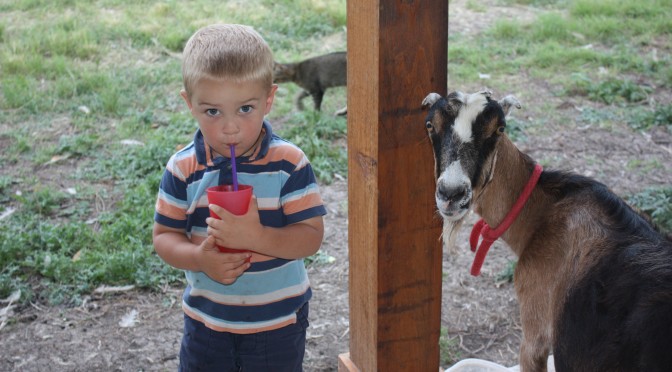
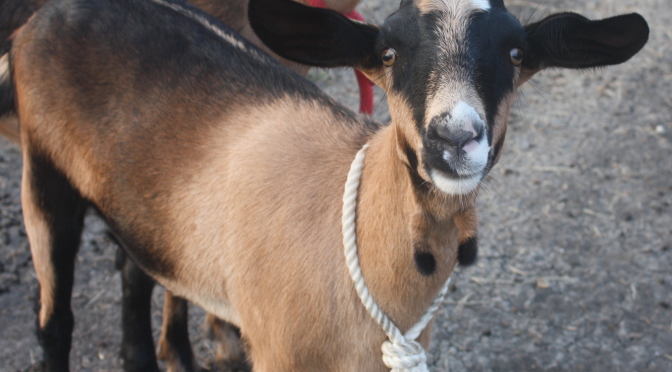
    Nippa the milk machine had a pair of very nice kids last March.  Rex, the boy, has found a home with Linda’s (the lady we got Nippa from) neighbour,  but Linda figured Nippa could use some company and sent Cocoa our way rather than continue to spend money to feed her.  Meet Cocoa.

    IMG_8141

    So, how does Nippa feel about having her daughter around to keep her company?  Let’s ask…  Are you happy Nippa?

    IMG_8240

    That’s a resounding YES!

    Both Nippa and Cocoa have been bred and will be kidding sometime around the first week in March.  Nippa has a track record of throwing two kids each year, so if Cocoa has two we could have up to six goats within a few months.  Not quite like rabbits, but still pretty awesome.  More milk and some cabrito assuming we end up with a male or two.

    On the flip-side, since Thornton has been banished outside to discourage coyotes and for tracking in unacceptable levels of mud and other dirt, he has become very lonely and somewhat depressed.  I think we’ll get him a friend next.  It’s almost disturbing how quickly animals multiply here (unless it’s a cat).

  • Northern Lights

    Northern Lights

    This was the most dramatic northern-lights display I saw in Alaska.  It happened on Valentines day 2012.  The kids and I spent almost an hour outside at 30+ below zero watching this because it was so beautiful.

  • More Old Pictures

    Can’t sleep tonight, so I’ll upload a few older pictures from the time-frame when we weren’t updating the blog.   These are from when Isaac and Sydney tested for Green-Belt in Tae Kwan Do.  The instructor frequently had them spar each other until Sydney learned to fight back instead of just try to run away from her little brother.

    Enjoy!

    IMG_6013 IMG_6010 IMG_6006 IMG_6001 IMG_5995

  • Making Mozzarella & Butter

    Making Mozzarella & Butter

    Nippa, the milk machine, generally produces almost exactly the amount of milk we tend to drink every day as a family.  However, when one or more of us aren’t here, the milk can begin to pile up in the fridge.  Recently I spent several days out of town for work, and Sydney had spent a week at summer church camp.  That translated into a couple gallons that were threatening to go bad if we didn’t do something useful with them. To add to the problem, Liz had bought a half-gallon of cream from the dairy down the street, but had only used about half of it making Ice Cream and Creamy Tomato Soup.

    Liz has been meaning to try making cheese for quite a while, and had even bought the rennet to do it with.  However, circumstances never aligned until this last Monday.  We decided to make cheese and butter for “Family Night.”   The kids each got a mason jar half-full of cream to shake while I used the opportunity to teach the science of cheese making (yes science… I’m quite the geek).  In the end, we ended up with a delicious ball of fresh mozzarella, ricotta, and braunkase (reduced carmelized whey).  All of it tasty and none of it from the store.  Nothing went to waste.

    Just as luck would have it, we had run out of butter that day, and the butter we made got us through until the next in-town shopping trip where we could re-stock on grass-fed organic butter (man… that makes me sound like an uppity food snob, but there are good reasons for it).

    IMG_8092IMG_8091IMG_8090

  • A Doghouse for Mr Thornton

    A Doghouse for Mr Thornton

    Liz has never really liked the idea of an “inside dog,” coyotes were wreaking havoc on our chickens, and we were planning on going on a family vacation for two weeks and leaving the Dog outside to “protect” the other animals and to make it much easier on the family who was going to be feeding and watering the animals.  The dog would need somewhere to get out of the weather.  Because the barn is behind the back pasture fence and I don’t like the idea of the dog hanging out in the chicken coop I decided the best option would be to knock together a doghouse out of scrap lumber in the (vain) hope that he would use it.

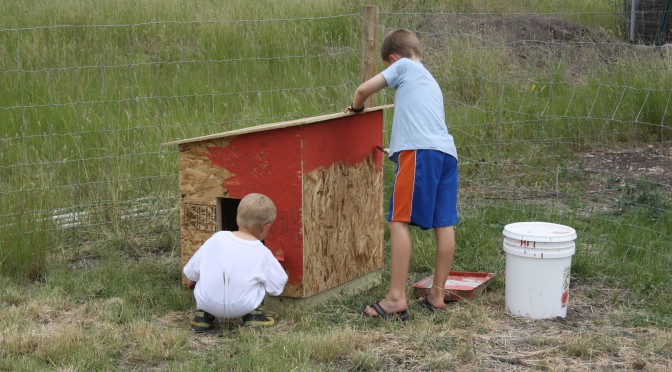
    As far as the dog goes, it was a wasted effort.  According to our friend who was feeding and watering him, Mr Thornton spent his time hiding in the shade under my truck, and I can’t see any evidence that he has been in there.  Since we got home, he’s insisted that he belongs inside with us, and I think we’ve given up on trying to convince him he lives outside.  On the up-side, the boys had fun painting it to match the barn and coop, and the one turkey the coyotes didn’t get while we were out of town has decided it makes a decent roost, and he  spends the night on top of if after the chickens he’s adopted as his flock go in for the night.

    As for Thornton protecting the other animals, ALL of the chickens survived the coyote raids.  Only the turkeys (who were in the back pasture where Thornton couldn’t go) were picked off.  Apparently a coyote had managed to get through the electric fence, grabbed a turkey to take back to the den, then dropped it on the wires when he got shocked by the fence.  The dead turkey shorted out the fence and opened up a hole that made it easier for the coyotes to get in and out over the next few days to pick off most of the rest of the birds.  You could see where Thornton had been scratching and digging at the fence and gate to get to the back pasture.  I suspect he was trying to go after the coyotes, because he doesn’t bother any of our animals.

    In the end, I don’t mind the lost turkeys.  I’m tired of scraping and spraying poop off the porch and listening to the constant noise.  The one bird that’s left is noisier than our rooster and leaves more messes on the porch than all 15 of the chickens combined.  Now that he’s the only one he spends his time with the chickens, and without a flock to keep him company I can’t keep him in the back field where I wouldn’t mind the mess and noise.  If this one makes it to Thanksgiving I’ll be surprised.

  • Whole-Wheat Sourdough Kefir Bread

    I love bread.  However, with the nutrition approach Liz has adopted you’re supposed to soak all grains overnight in an acidic liquid before consuming/cooking them to break down phytic acid.  The conventional (if you can call it that) method is to add a few tablespoons of cultured whey to act as a starter and get lacto-fermentation going to generate the acid.  However, I don’t like the flavor the whey adds.  To make it worse, most of my recipes for homemade bread don’t include an overnight soak/rise.

    Sourdough, on the other hand, essentially is an overnight soak because it can take all night to rise depending on your starter.  Unfortunately, I’ve not had great success getting sourdough to produce the results I wanted without cheating and adding commercial yeast, mostly because I tend to let the starter go too long between uses.

    However, I’ve found an alternative that seems to work very well for me.  In an attempt to break myself of the Diet Coke habit, I started brewing “water kefir,” aka “tibicos” – a fizzy pro-biotic drink brewed with a Symbiotic Culture of Bacteria and Yeast (SCOBY) kind of like kombuscha but using a different starter culture and sugar water instead of tea.  The end result of the brewing is a mildly acidic liquid rich in lacto-bacteria and yeasts like a sour-dough starter, but with more pleasant flavors and more than one use (I like to drink it straight, kinda like a carbonated unsweetened or lightly sweetened lemonade).  Because I use it as a regular drink, I haven’t had trouble with killing it from lack of use, and I pretty much always have a bottle or two in the fridge.

    Now for the recipe…  Start the recipe the day before you want the bread.  The rise-time for me always seems to take at least 8 hours, and most of the time it’s more like 18.

    • 4 C Water Kefir
    • 1 Tbs unrefined sea salt (should be gray or pink)
    • 3 eggs (pasture raised in your back yard if possible)
    • 1/2 C melted butter (from grass-fed cows if possible)
    • 1/2 C malted wheat flour, 1/4 C maple syrup or 1/4 C rapadura sugar (optional)
    • 9-12 C fresh-ground whole-wheat flour

    Start with cold Kefir and mix in the sugar and salt.  Melt the butter and whisk in the eggs until well mixed and add the eggs and butter to the Kefir.  Add about half the flour and stir until smooth, then add the remaining flour (more if needed) and knead to make a moderately stiff dough (I do it by hand because I got tired of repairing stripped out gears in my KitchenAid, but a machine works well if you don’t abuse it like I tend to).

    Once the dough is smooth and stretchy, shape it into 2 or 3 loaves and plop them into bread pans greased with lard, tallow, or butter (I don’t like any form of highly processed vegetable oil, and butter tastes better anyway).   Grease the top of the loaves with butter.  Cover loosely with plastic wrap leaving the cover loose enough to let the bread rise and let sit at room temperature overnight.  If by morning the dough isn’t rising, place the loaves somewhere warm (I use my dehydrator set to about 100F) until they have doubled (anywhere from 1-6 hours).  If they still haven’t risen, you have a choice to make.  You can either bake them anyway and eat fairly heavy but delicious bread (what I usually do) or wait for the yeasts to finally take off.  They will eventually, and with the acid in the Kefir, you don’t have to worry much about putrifying bacteria and the like.   Bake at 350 for about 30 minutes or until it sounds hollow when tapped on the bottom of the loaf.  Let it rest on a wire rack for 5-10 minutes, cut off a thick slice, smear thickly with butter, and enjoy!

    Notes:

    Water Kefir: look it up via your favorite search provider.   There are several places that describe it and how to obtain a culture and brew it.  I’ll eventually post something about how I make it, but no promises when.  Sometimes I add fruit juice or pulp to the kefir to flavor it, and that adds a unique and generally pleasant flavor to the bread.

    Unrefined Sea Salt:  I use Celtic Sea Salt because I understand that it retains all of the minerals found in the seawater used to make it and that it is an excellent source of trace minerals.  I suppose any kind of salt would work if that is what you have.

    Pasture-Raised Eggs: Eggs from pasture-raised chickens have dark yolks and firm whites.  I believe they contain higher levels of vitamins and minerals (particularly fat-soluble ones like A, D, and K2) than the eggs produced by factory-farm raised chickens, and know they taste better either way.  If you don’t have chickens in your back yard, I feel sorry for you.

    Butter (from grass-fed animals in particular): Butter is one of the best sources of vitamin K2 (as long as the animals making the milk are eating stuff containing chlorophyl), a substance that science is only just beginning to understand, but Winston Price without knowing what to call it tied it to strong teeth and excellent health including immunity from tooth decay and heart disease.  Furthermore, I don’t buy the saturated fat and cholesterol scare tactics employed by modern medical practitioners.  Their low-fat, low-cholesterol, low-taste diet seems to have gotten us worse off than our ancestors were on a high-fat nutrient rich naturally grown diet.  See for example www.westonaprice.org. The research is quite interesting.  Avoid margarine and other processed vegetable oils like the plague.

    Malted Wheat Flour: I make my own by sprouting wheat berries until the baby-plant (not the furry rootlets, but the thing that will be grass if you let it grow much more) is about as long as the grain, throwing them in my dehydrator for a while at temps below 115F until they are crispy and sweet, then grinding them into flour.  it adds a sweet, nutty flavor, and provides sugars for the yeast to digest.
     

  • When is Enough Enough?

    When is Enough Enough?

    I thought things were getting pretty bad a while ago when our collection of animals grew from ONE dog and three children to a gaggle of chickens, the dog, and a series of feral cats (never more than two at a time).  One thing I’m learning though is that if you are willing to accept responsibility for an animal, someone will be willing to give one to you.   Thanks to the wiles of the coyotes we were down to one cat and had cut our chicken flock substantially, so of course we needed to fill the void with something…  Enter the goat, a bunch of turkeys and a kitten.

    In our desire to “simplify” our diet (principally as a reaction to a life-changing diagnosis) we had shifted to drinking raw milk and moved away from highly processed foods or foods with ingredients that are made in a laboratory or manufacturing facility.   Raw milk is delicious but expensive.  Naturally raised meat is worse.  The chickens were round one in a broader effort to have more control over what we eat, but only round one.  While the  best grass-fed raw-milk dairy in Texas is closer than the closest gas station, I sometimes feel like we were single-handedly paying for the farmer’s race car.   Unfortunately, we were tapped out in the home/yard/pasture project portion of the budget, so even if we wanted to, we couldn’t afford a goat or dairy cow.

    In spite of our best efforts not to give interest-free loans to the government, when we did our taxes this year we found we would have several thousand dollars we hadn’t planned on.  We decided to use it to build a small barn to shelter things that turn grass into delicious food and string electric fence around about a quarter of our lot (electric fence is cheaper and quicker to install than any other type).  About the same time, a friend was having trouble figuring out what to do with the milk from three lactating goats to the tune of about two gallons a day.  She offered to let us take a few of the goats once our fence was up.  Double good…  she doesn’t have to milk as much, figure out what to do with all the milk she can’t drink, or feed goats she doesn’t get benefit from; and I get to cut down our milk budget by almost a car payment.  Meet “Nipa” – on extended loan from down the street.  She ain’t pretty to look at, but is quite the “sweet spirit.”IMG_8056The goat is about as entertaining as the chickens.  I’m almost convinced she thinks she’s a dog.  Any time the dog comes over, the goat wants to be right there getting a pat on the head.  She spends a lot of the day on top of a large pile of dirt that was left behind when our builder dug the leach-fields for the septic system.  I actually enjoy milking her in the mornings, and Liz  has decided that she doesn’t mind goat milk as long as the milk is clean and free of the “goaty” aftertaste that was the result of our friend not brushing down the goat, thoroughly cleaning the udders, and stripping the first few squirts for the dog or cat (whoever is closer).As if the goat weren’t enough, we decided to try “free-range” turkey for Thanksgiving.   Chickens were easy enough and kinda fun, so we ordered the minimum number of  poults (baby turkeys) you could order from the hatchery.  Several weeks later and we have nine disgusting birds that look a lot like vultures and poop all over the place (one of the original ten got smothered by the others the first night I moved them out of the brooder).  They’d better taste good.  They do eat a lot of bugs and spiders though.

    turkeysFinally, we got ANOTHER cat.  We were down to one (the one featured in a previous post) when a friend offered up a few kittens.  Liz brought one home and Michael immediately adopted it as his.   This has been the only thing that seems to work for keeping him out of the chicken coop.  Any time he’s outside he’s got that cat in his arms telling himself that the kitty is “sooo cute.”  He routinely dunks the cat in a bucket of water we leave out for the animals, then rolls it around in the dirt.  When he’s not playing Chinese water torture with it, he’s hanging it by it’s legs or tail.  The weirdest part of the whole thing is that the cat doesn’t seem to mind.Michael_and_Estella

  • Liz the Coyote Killer

    It never fails… the best fun always happens when I’m not around.  I happened to be out of town this last week for work.  Were Liz and I to trade places, I’m pretty sure I’d go crazy with her on the road from time to time and me left at home to manage all the affairs.  This week though, she gave me even more evidence of her outstanding ability and my unworthiness in comparison.

    As I was boarding my plane early Friday AM to come home I noticed a voice-mail that must have come in while my phone was going through the airport security protocols or I was rushing madly to make my gate after the planned one and one-half hour drive to the airport turned into three hours courtesy of regional flooding and closed roads.  After barely making my flight (I boarded right before they closed the doors), I listened to the voice-mail.  It turns out Syd had woken early and decided to go out on the back porch and watch the sunrise.  In addition to seeing a beautiful sunrise, she saw half a dozen “crazy” coyotes “jumping” around in the back lot.  Liz was calling to ask what she should do and if it was okay to shoot one.

    By the time I called her back, she’d gotten her gun, gone out back, and popped off a round.  The whole pack scattered, but not before killing and eating two of our chickens.  Liz wasn’t convinced she’d hit anything, but a little later Isaac went out back and saw them in the next field over.  One of them could only walk a few steps before collapsing.   I hope the stupid thing dies a slow death.  Over-all, that’s pretty impressive.  Rather than mess with a long-gun she wasn’t particularly familiar with, she grabbed her handgun.  Given where the coyotes were and where the fence was, she couldn’t have been closer than about 30 feet.  A coyote is a pretty small target, and 30 feet is pretty far for a 3 inch barrel.

    Unfortunately, it doesn’t look like the pack learned their lesson.  They came back last evening while we were out at Sydney’s performance and killed four more chickens.  I can’t afford to loose any more.  The stupid little birds take forever to start laying eggs, and at the going rate I’ll be out of layers within a week.  In the interest of fresh eggs, I’ll be waiting for them with a big scary black rifle.  This could be an entertaining night…

  • A new definition for Boy

    Liz came home the other day with a new definition.  I doubt it would show up in Webster’s or any other authoritative dictionary, but anyone who has ever had boys will almost certainly recognize it.

    BOY: A noise with dirt on it!

    Enjoy!

  • Gloves are Good and Wow, That’s Red

    Gloves are Good and Wow, That’s Red

    One of the blessings of this life is that every day presents some form of opportunity to learn.  This week, among other things, I got a somewhat painful lesson about the wisdom of wearing gloves when trying to wrangle sheep, and a reminder that you shouldn’t wear your good sunglasses when painting a barn.

    We have a good friend a few miles from here who is single and somewhat elderly.  When her husband died of cancer a little over a year ago, she was left to run the 10-acre homestead on her own.  She’s quite capable, but when it comes to wrestling the Dorper sheep she’s collected, she needs a little help.  Since I like to eat lamb, and since working trades is one of the standard ways to get stuff done out here in the boondocks, I help her out wherever I can, and she reciprocates.  This year, she’ll set me up with a nice lamb to slaughter for Christmas dinner.

    Thursday, I took the day off work to work around the yard, and our friend asked if I could come help her immunize her flock and castrate two young males.  I’d never done that before, and the opportunity to learn a new skill sounded kinda fun (evidence that I’m firmly out of my right mind, but I’m happy in that state).  Everything went well for the first few.  We simply poured some grain in a trough set back into a pen, let several wander into the pen, closed it, and went to work.  Unfortunately, after the first round, they got the hint about what we were up to and decided to run for it.

    Since they weren’t going to go down easy, it became a game of trying to corner and wrestle them to the ground long enough to get the job done.  It turns out I’m pretty good at it, because I was able to work through the herd quickly enough without much help, much to the surprise of our friend.  That’s when I got the lesson.  We had one sheep left, and she was the most skittish of the bunch (she’d just watched us castrate and immunize her two little boys).   Because she was so cagey, I figured I’d slowly work her into a corner before making a grab for a leg to flip her over and pin her down.

    I managed to corner her, or so I’d thought.  She found a small gap about six inches wide between a fence and a tree with knobby bark.  I knew it was there, but I didn’t believe a sheep that fat could fit though a hole that small.  I grabbed hold just as she made a break for the gap, and she dragged me with her, scraping the back of my hand along the bark as she went.  Heavy gloves (you know, the kind I wear all the time when I’m working in the yard) would have been a godsend.

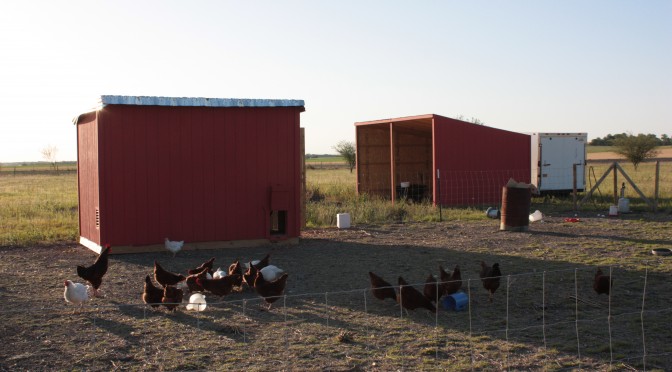
    IMG_7845Aside from messing with sheep, I spent the rest of the day finally  painting the chicken coop and barn.  Liz said she wanted a red barn.  Wow, did she ever get one…  You can’t miss it.  I’ve been scraping little red flecks of paint off of my sunglasses for two days now.  If I haven’t learned by now to not wear nice things when working outside or in the garage, I doubt there’s much hope for me.

    IMG_7843