Each day that dawns begins anew,
Brings light to what was dark.
Dries morning dew and opens eyes,
To see a morning lark.

Yet daylight too must yield its way,
Retreat as evening comes.
Give place to swift encroaching dark,
Though tasks lie still undone.

We cannot stop this constant churn,
Though fear or doubt cry out.
The rolling tides of forcing change,
Are deaf to human shouts.
Blog
-

Sunset
-
To Know, or Not To Know?
On what seem to be fairly regular occasions I find myself in a position where I wonder if Hamlet was wrong about his very famous question that surfaced while he reviewed his awful situation and contemplated terrible options for dealing with it. I occasionally have reason to wonder whether the real question is not “to be, or not to be,” but rather “to know, or not to know.” The existence and personal acknowledgement of this question is somewhat disturbing to me given that I have spent the vast majority of my life actively seeking for both knowledge and wisdom. At my core, I have built a life based on obtaining and applying knowledge. Willful ignorance is weakness and ugliness. If you know me at all, you know that I love to learn… learn anything… learn everything (if that were possible). How is it then that I could even contemplate willful or “blissful” ignorance.
I have always understood that knowledge comes at a price. Anything worth having requires giving up something in exchange, and knowledge is no exception. Aside from the work it requires to learn, knowledge comes with other responsibilities – in particular, the responsibility to use it appropriately. Once obtained, knowledge requires we wield it as a weapon in defense of truth and right, a lever to lift the afflicted, a light to chase out darkness, and a safety line to prevent personal catastrophe and aid in rescuing the lost. It is a powerful tool, and like any other tool, requires energy and discretion on our part in order to use it effectively.
Throughout my life, my quest for knowledge has been a central focus. You might say I’ve attempted to become something akin to the mental equivalent of a high-performance athlete, constantly working to build strength and capacity. As with an athlete’s physical capacity, building mental capacity requires exercise of existing capacity to the point where that capacity fails, prompting a system response to rebuild stronger. That process universally entails discomfort, if not outright pain. However, it is a pain that the experienced practitioner recognizes, understands, and actually enjoys because it is a sign of progress. The benefit is visceral and real in the tangible and foreseeable future.
As an example from my earlier life, I began running regularly while in graduate school to relieve stress and keep my wits about me. When I began, running anything over a mile was painful. I didn’t enjoy it. In reality, I hated it. However, I recognized a need to master my body and clear my mind, so I continued through the pain. It wasn’t long before I began to see the benefit that came with challenging my body as my capacity adapted to the new challenges. Within a year, the guy who routinely struggled to pass a one-and-a-half mile fitness run for the military was running half-marathons and ultimately a full-up marathon for fun in spite of the fact that both the build-up and the actual race resulted in considerable pain. I saw the benefit, so the cost in time and discomfort was worthwhile.
This experience with physical pain directly correlates with my experiences gaining knowledge. From a very early age, I have found the process of learning exciting. I have always been able to apply bits and pieces of knowledge in ways that I find rewarding, to the point where the experience many would describe as “the pain of learning” is an exciting journey. Just like when, at the peak of my training for the marathon, I found the physical discomfort of training comforting and pleasurable, I very early in life began to love the effort it requires to learn. While not my foundation, this concept is at the core of who I am. One might claim it is the load-bearing walls that support the rest of the structure. Questioning it is like driving a bulldozer through the center of a building and expecting it to remain standing.
Unfortunately, as I’ve “gained experience” with life the unhappy realities of our mortal condition have presented me with somewhat regular opportunities to obtain knowledge and face realities that inflict pain without any clear payoff to offset the price. Usually that kind of knowledge has to do with understanding the unfortunate realities that impinge upon me such as the evil nature of some men, motivations and intentions of public figures, and the willful ignorance of others. For this kind of unhappy understanding, at least, I have found a path to accept it philosophically. However, lately I’ve found a niche where I’m not sure knowledge, or rather information, isn’t outright hurtful.
A few years ago Liz got rather sick. For a long time, the doctors were unsure what the nature of the illness was. They struggled to develop a course of treatment that would pull her back from the brink. It was a very dark time for me. As they worked their way through the various possibilities I would occupy myself with pouring over the medical and other literature to understand the nature of the disease(s), treatment options, prognosis, etc… At first it felt like a therapy, providing me with something on which to expend the nervous energy that threatened to build up to a point where it would consume me. Learning was my default method for tackling a problem, and I applied it with vigor here.
However, as the easily identifiable and treatable conditions were eliminated one-by-one, what began as therapy took on more of an aspect of slow torture. As the list of possibilities shortened, the consequences and potential outcomes became disturbingly frightening. To make matters worse, Liz needed reassurance and I needed strength. I was forced to suppress the pain and anguish boiling under the surface. The effort to keep control of my fears left me with nothing in reserve. Not only did I suffer, but those around me suffered as conditions that wouldn’t normally have bothered me triggered harsh or inappropriate responses. What had begun as therapy began to fuel the disease. I eventually came to doubt the wisdom of arming myself with information.
This anecdote is one of a handful of similar circumstances that have led me at times to question the utility of knowledge in all cases. I can’t help but wonder sometimes if it wouldn’t have been better to be the trusting and blissfully ignorant idiot, unaware of the awfulness of the road ahead. There are times when knowing you are facing a tough road can prepare you for the journey, making the experience less painful or even enjoyable. But I’ve also found times where knowing the path doesn’t equate to being able to alter it, slow the progress, or even prepare for the impact that is barreling at you. Sometimes I wonder if I would be happier in certain circumstances were I unintelligible to the crisis until it suddenly and unexpectedly swept over me.
At present, I am staring at another situation where dredging up information has instigated anticipation of a potentially terrible path while leaving me completely unable to change course or prepare for the journey in a way that would be any more effective than simply waiting in ignorance. In this case, should the information prove relevant, all I have done is rob myself of a period of relative peace I could have enjoyed. Luck may favor the prepared, and knowledge may be the glory of God; but isn’t there a small shred of truth in the sentiment “ignorance is bliss?”
-
Siege Weapons Part 2
Mangonel: a type of catapult. It’s name comes from a Greek-Latin word for war machine.
The mangonel was a siege weapon used to launch rocks, dung, bales of hay (set on fire), dead bodies, wooden spikes, and hostages (very few hostages survived) over or at a walled fortress. Hostages were launched from mangonels to scare the people inside the wall. The dead bodies and dung were launched to spread diseases to the people in the fortress or castle.
Mangonels work by a mechanism called torsion. Torsion is when you take ropes and twist them and stick the throwing arm in the twisted ropes. When you pull the throwing arm down and lock it in place the ropes spring the throwing arm forward. It took one person in full armor to pull the throwing arm down and hold it down in place while another person put the lock in, which is on a rope or string, so when somebody pulled the string the throwing arm was released. The projectile was then launched forward over the castle wall. Some people were too light and when they pulled the throwing arm down enough they went flying into the castle wall. Sounds like a dangerous job…
In the Siege of Dover in 1216 among many siege weapons used, the mangonel and trebuchet were the favorite catapults of the French army. The French sieged Dover so they could get control of the ports and docks in England so they could send a ship inland toward the capital city and attack. But the French never got past Dover (only the objects launched by the mangonels got “passed over”).
Today mangonels are mainly made for hitting people with water balloons and tennis balls. And in some cases, marshmallows. Most people make them because they are interested in siege weapons, physics, and people who like medieval history.

Mangonel shot used in the Siege of Bedford Castle in 1224 -
Multi-polar
When in Rome, do as the Romans– St. AmbroseI was pondering some on the nature of the “quote” above and decided to look up it’s history. Much to my surprise, it is attributed St. Ambrose, a devout Christian. Given the way this sentiment is used in modern society, I was thunderstruck at the idea it had originated from one of the most influential Christian thinkers of the early Church. On the surface, it would appear that St. Ambrose is advocating for a form of moral relativism and giving license to abandon morals and standards in order to “fit in.” However, after reflecting some and looking for the context around which the thought was based, I understand how it could be applied to Christian morals and have found a modicum of comfort in it.
It was something in the nature of my professional, interpersonal, and private relationships that initially got me pondering on this topic. You see… it seems to me I have something of a split personality. When at work, the personality and behaviors I utilize are markedly different from those I use with my family or social acquaintances. The public face of Dad when he gets home from work looks very different from that of the LtCol who just left work. Both of these faces look different from the face of the Priesthood leader, and all of the faces combined look different from the face that lies hidden in the recesses of myself.
I have, of necessity, developed something of a segmented personality and persona that has dropped deep roots into the crevices of my brain. What I must be to function in the varied environments I live and work in changes with the surrounding environment to some degree, and the long years of practiced mental segregation have resulted in rather solid dividing lines between the various contexts. Because of the nature of my work, much of what I say or do at there must stay there. Aside from requirements to protect certain information from disclosure, the techniques and traits used to get “it” done are wholly inappropriate and inadequate for social or familial situations. As a result, I have a “work brain” and “work personality” that activates almost automatically when I walk through the doors to my office. Similarly, I have a “home brain” and “home personality” that kick into gear when I am around family, and a “social brain” and “social personality” I can drag out of hiding when I need to be sociable at a party or other “fun” gathering.
The lnikages between these various personalities have tended to get weaker and weaker as I get more and more exercised at using them for their intended purposes. In fact, one complication of this kind of compartmented reasoning and reacting is that I tend to forget what I was doing and what is required of me almost instantly when I switch from one context to another. When I am at work home is not in my thoughts much, and events, anniversaries, requirements, shopping lists, or any other home-related things I should be remembering are archived in the “home” section of myself and lie dormant until I leave work and shift gears. The process works both ways. As a result, I am a rather forgetful person on the whole.
This split-personality characteristic has always bothered me. It has often made me feel like a fraud to some degree, and caused me to attempt to consolidate the public faces of myself from time to time. Each time I’ve made the attempt it has been aborted after exhaustion kicked in or consequences stemming from misapplied techniques became uncomfortable. As a result, I’ve resigned myself to the unhappy reality that having a context-sensitive personality is an unfortunate but necessary requirement for me. While I strive to ground all of my behaviors on a common foundation, the aspects of me that different people are exposed to look entirely different depending on where and when the interactions occur.
Given that there are several different public versions of “me,” none of which fully reflect the totality of me, that they have evolved to satisfy the requirements of my environment, and that they may seem inconsistent with each other, it’s no wonder that I have found grappling with this reality to be a little uncomfortable. This is where the context around St Ambrose’s message becomes important. He was addressing the Church about differences in non-doctrinal liturgical practices between geographic regions, not about adopting amoral or immoral practices simply because they were common in the local area. I believe his message was that in cases where you aren’t compromising your integrity, honor, or moral standards it is okay to adopt the custom of your environment to smooth the way.
I still doubt it is ideal, and can’t completely shake the thought that I ought to be “who I am” no matter where I am or what I am doing. However, as the distinct and mutually incompatible segments of my personality have been developed they have become a part of “me” to the extent that if given the opportunity to simply adopt one or a combination of multiple of them, I’m not sure which I would choose. Am I the cynical, hard-nosed, over-confident, business-oriented professional? Am I the quiet reserved and awkward geek? Am I the academic? Am I the socialite with a wide network of friends? Am I the hillbilly redneck who would rather spend time under the hood of a car or on a tractor than anywhere else? Am I the artist and poet? … The answers to each of these questions, unfortunately, is “Yes,” and I am sure there are more caricatures should I dare to plumb the depths of myself. I don’t think I am capable of dropping any of them (except maybe the business professional) without damaging a part of me that has become important in some form or fashion.
So, while I don’t necessarily care for my current state of mind (or personality, or being, or whatever…), I guess I have come to terms with the fact that it is who I am, and that it will be a part of me for the foreseeable future.
-
Siege Weapons Part 1
The ancient Assyrians were one of the first civilizations to use the battering ram, although it’s more commonly known as a medieval weapon. Battering rams were made to knock down walls and gates; some even had real sheep heads on them. Others had spikes on them to pull down wooden gates. They are still being used today in smaller sizes to knock down doors.

-

In the Wind
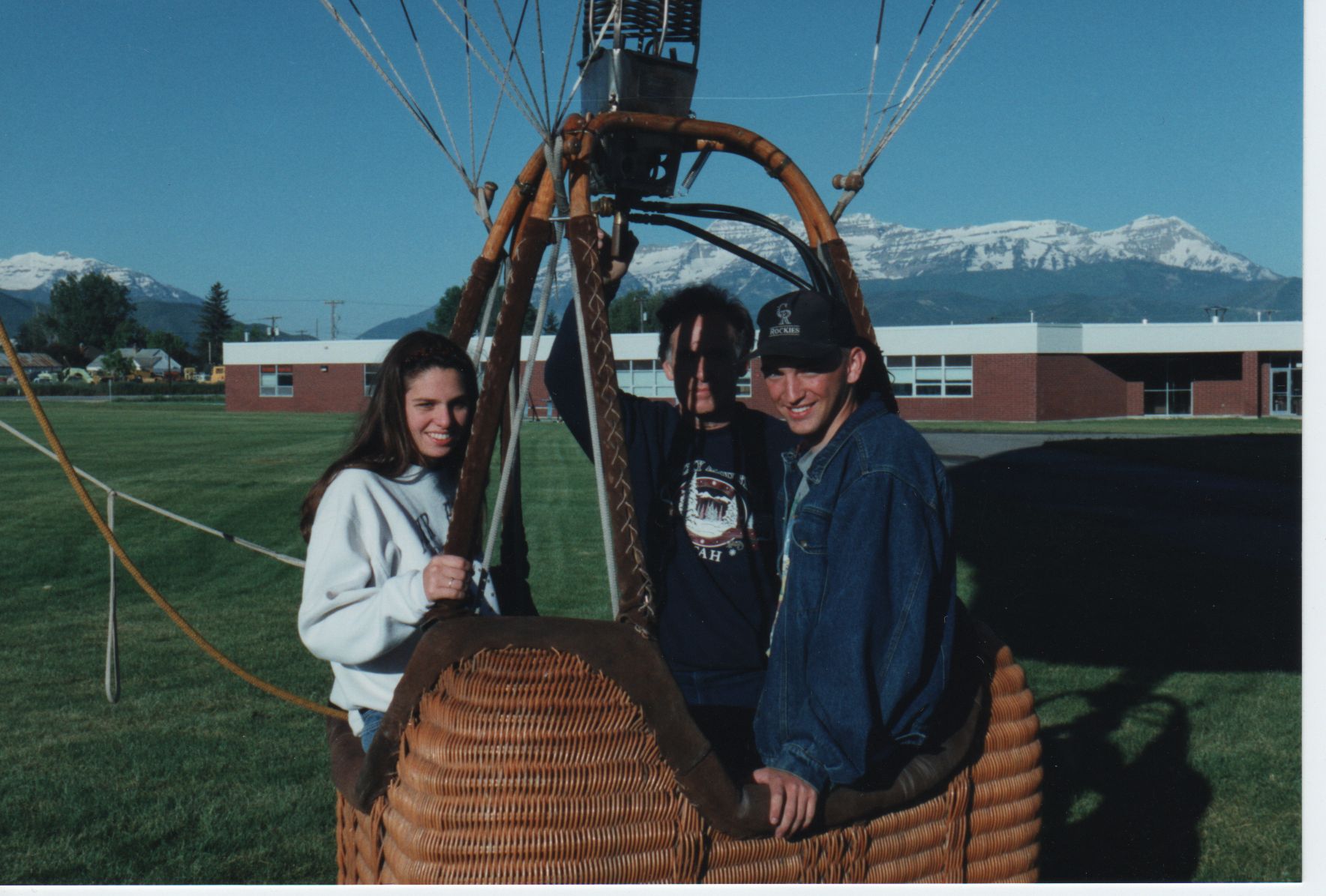
Now this was a great trial to those that did stand fast in the faith; nevertheless, they were steadfast and immovable in keeping the commandments of God, and they bore with patience the persecution which was heaped upon them.– Alma 1:25About twenty years ago I spent several weekends driving chase truck for my neighbor who owned and operated a hot air balloon. The deal was that if I drove long enough he would take me up on a ride. My friend Sean and I decided a balloon ride would make an awesome homecoming group date and both of us signed up. After the prescribed number of weekends, we both got dates and headed for the mountain town that was a favorite of local balloonists. I remember my date being afraid of how it would feel to be that high in the air hanging in the wind while I was anticipating feeling the wind in my face.
At this point in my life I had been in small and large planes and on almost any form of wheeled transportation you can think of. I was used to the feel of being buffeted by the wind and pavement. In fact, the feel of wind in my face was what drove me to spend as much time as I did on motorcycles. Without pausing to consider it, I unconsciously expected the balloon ride to be something along the same lines.
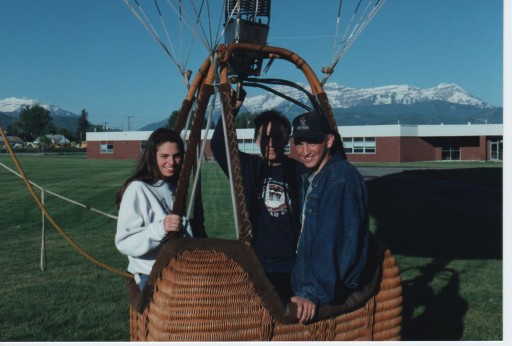 Once we got airborne I quickly realized how wrong I was, and had I stopped to think about it, it would have been obvious the ride was going to be completely tranquil. As soon as the balloon lifted off the ground the light breeze we had been enjoying stopped. We had the feeling of being completely motionless, and without looking at the ground it was impossible to get a sense of the direction we were traveling or even appreciate the fact we were moving in the first place.
Once the balloon had slipped is moorings it was completely and totally at the mercy of the wind. Wherever the wind blew, we went without really feeling like we were moving. The only recourse the pilot had for changing course was to change altitude looking for a wind that was blowing in the right direction. As the ride progressed we enjoyed the beautiful scenery and excellent company – drifting with the wind over the beautiful mountain valley. However, all good things must come to an end, and we eventually began to run low on fuel. As the pilot looked for a field to land in our options began to become somewhat limited due to the winds near the surface. In the end, we had to settle for a manure covered cow pasture and hope the owners wouldn’t be too upset if we disturbed their cows (we did disturb them, but that’s a story for another day).
I hadn’t thought much about that day for years until I recently read an Ensign article as part of a Sunday school lesson that talked about our need for a spiritual anchor. The teacher talked about how we will drift with the current if we don’t set an anchor. I don’t have a lot of nautical experience, but it resonated with this experience in the balloon. It seems to me that when we slip our moorings or cut away our spiritual anchors we are at the mercy of the undercurrents in society and whims of the morally bankrupt. We begin to drift without any means to direct our path to a deliberate end-point.
As with the ride in the balloon, there are references we can use to detect our motion away from the moorings we left behind, but unlike the balloon, the reference points require us to do a little more than casually look over the edge of the basket at the ground. And worse yet, our ability to utilize the reference points weakens as we get further and further from our point of departure, requiring more effort to distinguish our movement the further we get from the truth. The reference points for life may vary somewhat from person to person, but they always have common characteristics, the most important of which is that they must be grounded in the reality of eternal truths.
Without the benefit of being based on eternal principles, the winds, waves, storms, tremblings, and other abrasive realities erode any foundation built by man and result in an unstable and shifting reference. As anyone versed in celestial navigation can tell you, without a fixed and immovable reference we can be sure of neither our course nor our current position. Without a grasp on where you are and where you are headed, it doesn’t matter if you simply cease to fight against the currents and glide along effortlessly wherever they may take you, even if in the end it lands you in a pile of cow manure.
Just like the balloon ride, finding our way to a defined destination requires a few things. First, it requires the realization that you have drifted away from your goal. By identifying the fixed reference point(s) grounded in truth, we can see where we are and what direction we are going. However, just identifying position and heading is inadequate. Making it back to safe harbor requires changing direction which means deliberately leaving the currents that have carried us away in the first place. We must seek out currents and fair winds that move us in the right direction. For some of us, that may mean abandoning friends and behaviors that have contributed to the currents, for others it may mean letting go of grudges, pride, or other similar factors. The bottom line is a requirement to remove ourselves from whatever influence(s) carried us away in the first place and put ourselves in a position where the influences will guide us back to a safe landing on solid ground.
Even leaving the current that carries us away isn’t enough. Once we have left the moorings, it takes work to return. In the case of the balloon it was a chase truck assigned to follow, recover, and return us to the start-point. Unlike the balloon ride, we can’t rely on others to take us back to where we started without us putting in the effort. It requires work on our part which can include repentance, forgiveness, study, prayer and reflection. However, there is a support crew ready and waiting to help us along the way. Family, friends, neighbors, priesthood leaders, teachers, and more are there to help and guide us along the way. Even more importantly, the Savior has told us that his arm is always extended towards us to lift us up and carry us when needed if we will bend to His will.
Once we return to the safe harbor and solid moorings, we then must work to make sure we don’t get caught up in the air currents that will carry us away again. First, we need to keep our eye continually on the fixed references of eternal truths so we can detect drift early on before it has carried us far afield. Second, we should get instantly suspicious any time things feel calm. When we were in the balloon basket prior to liftoff, we felt the wind blowing against us. It only became particularly calm when we lifted off and began drifting. If we don’t feel like we are going against the flow, we are being dragged by it, which is a position none of us should be comfortable in.
-
Camping
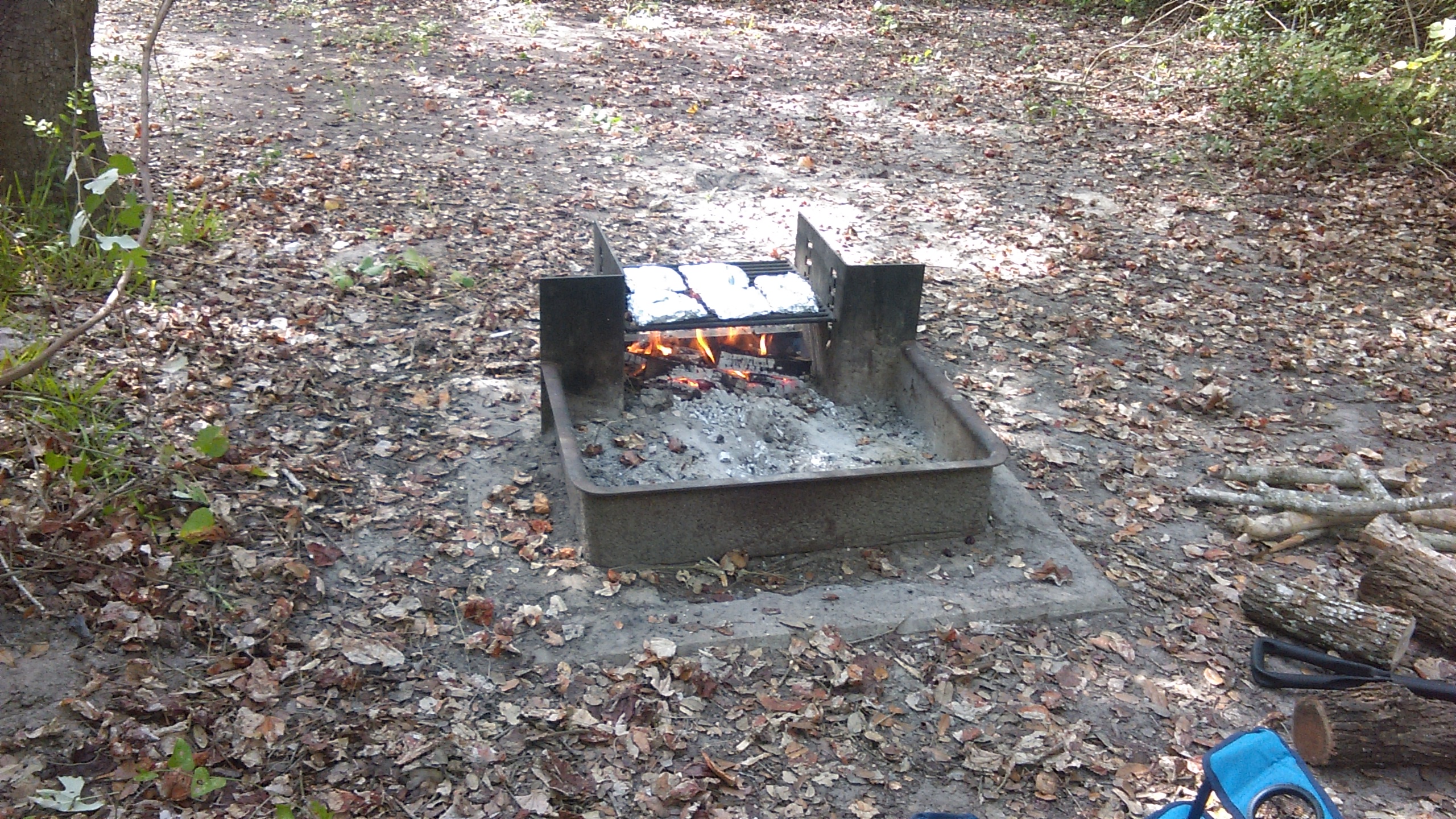
This weekend we packed up the family for a short trip to the coast to test out the recently acquired pop-up trailer. Not a lot to say other than whoever thought tin-foil dinners were a good idea in the sweltering heat of a South-Texas summer needs to have their head checked. It’s bad enough cooking over a fire when it’s cool outside, but doing it at 95+ degrees in the coastal humidity sucks! The worst part of the whole deal is that I don’t really have anyone to blame but myself. I was the one that put together that part of the menu. Even cooking with the smallest fire I could make was enough to make me wonder why anyone would settle this part of the country before air conditioning.
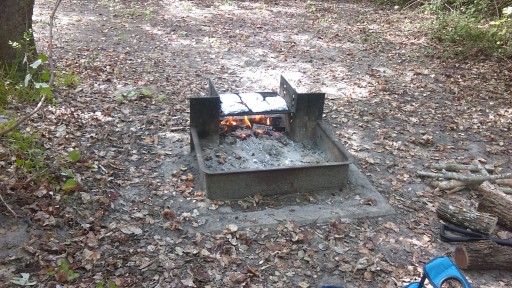
Isaac went right to hitting trees with sticks, messing around with his new fixed-blade knife, and generally enjoying being dirty. arabic casino He also decided that the mustang grapes growing all over were fairly tasty and fun to play with.
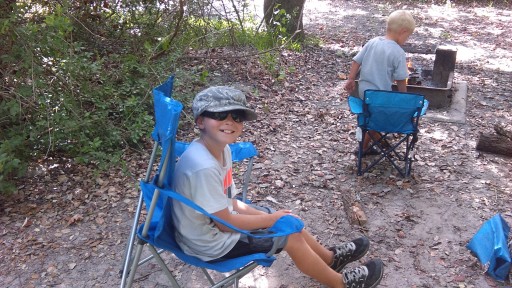
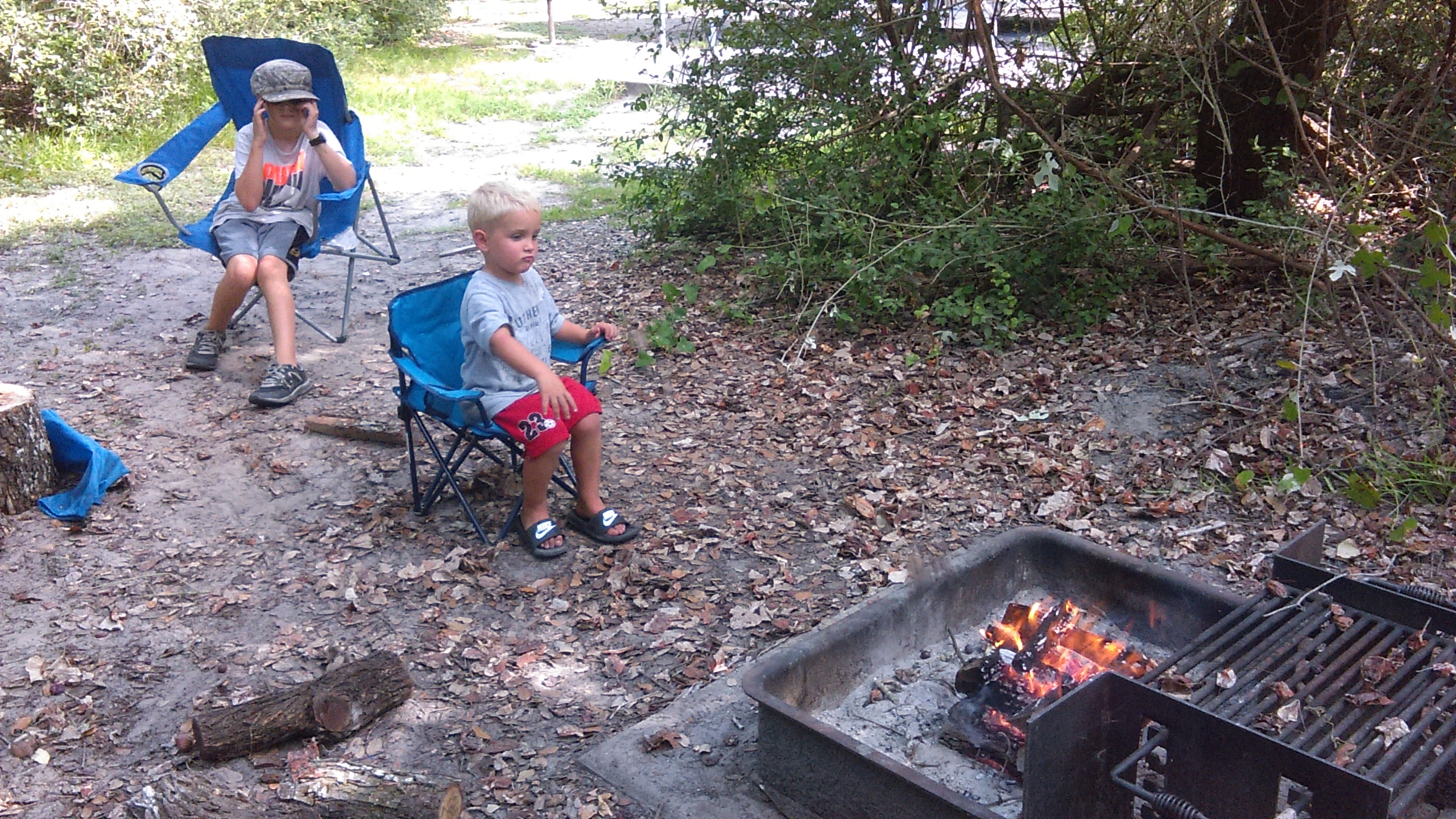
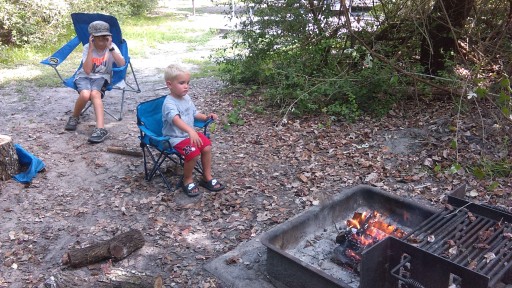
The heat didn’t stop Michael from making the most of an opportunity to throw stuff into the fire. He must be a true boy at heart. I’m not quite sure how it happened, but I think this picture captured the only time during the whole trip where we were able to convince him to wear something on his feet.
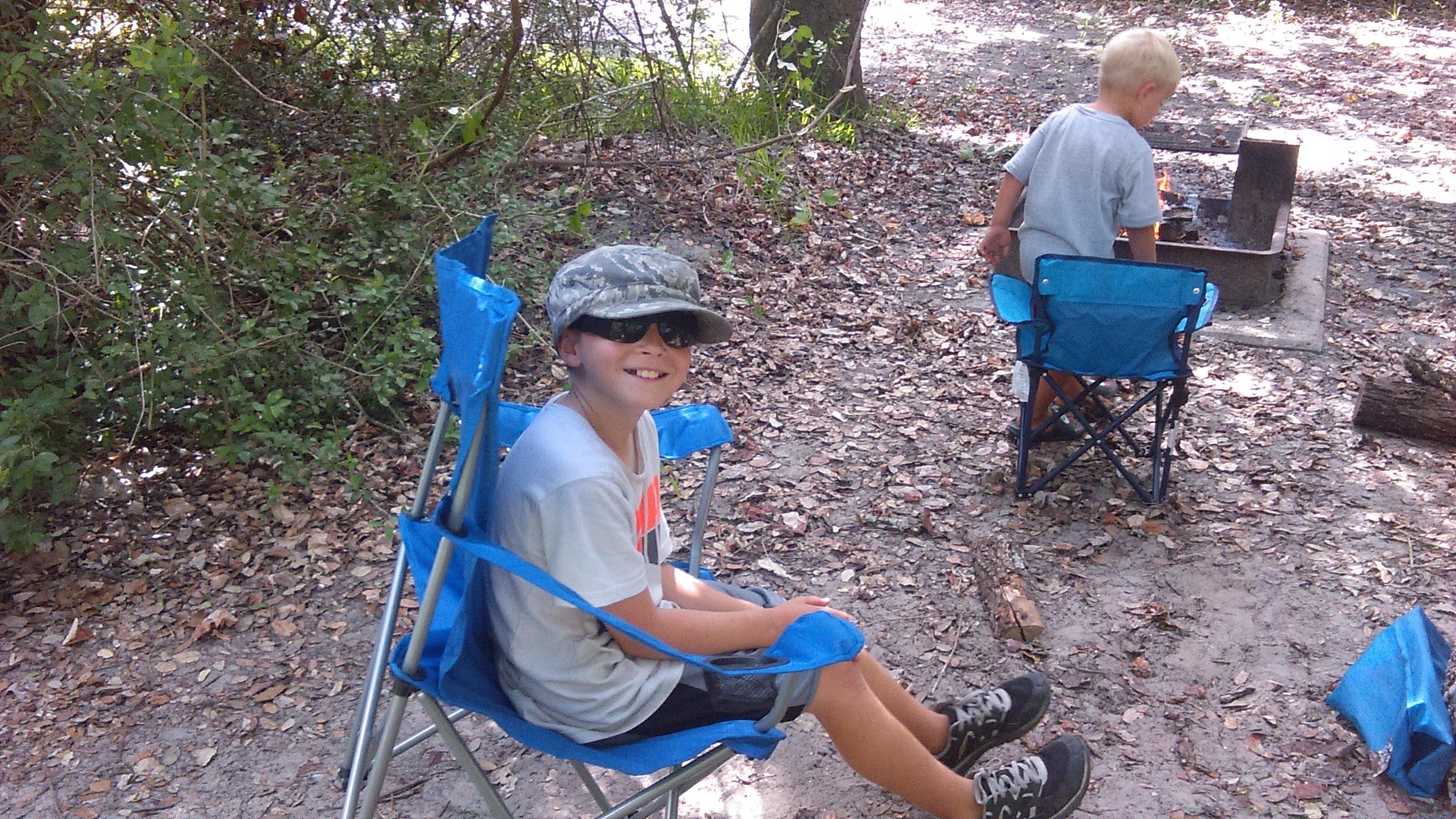
Sydney made the most of things by dressing up in camouflage from head-to-toe. I guess she figured she could hide from Michael and Isaac better that way. طريقة لعب بوكر Unfortunately for her, there weren’t any cute boys in the neighboring campsites. Apparently we chose to camp in the geriatric ward. لعبة بوكر حقيقية Our kids were about the only ones around.
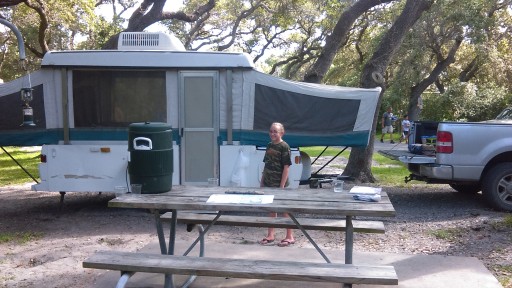
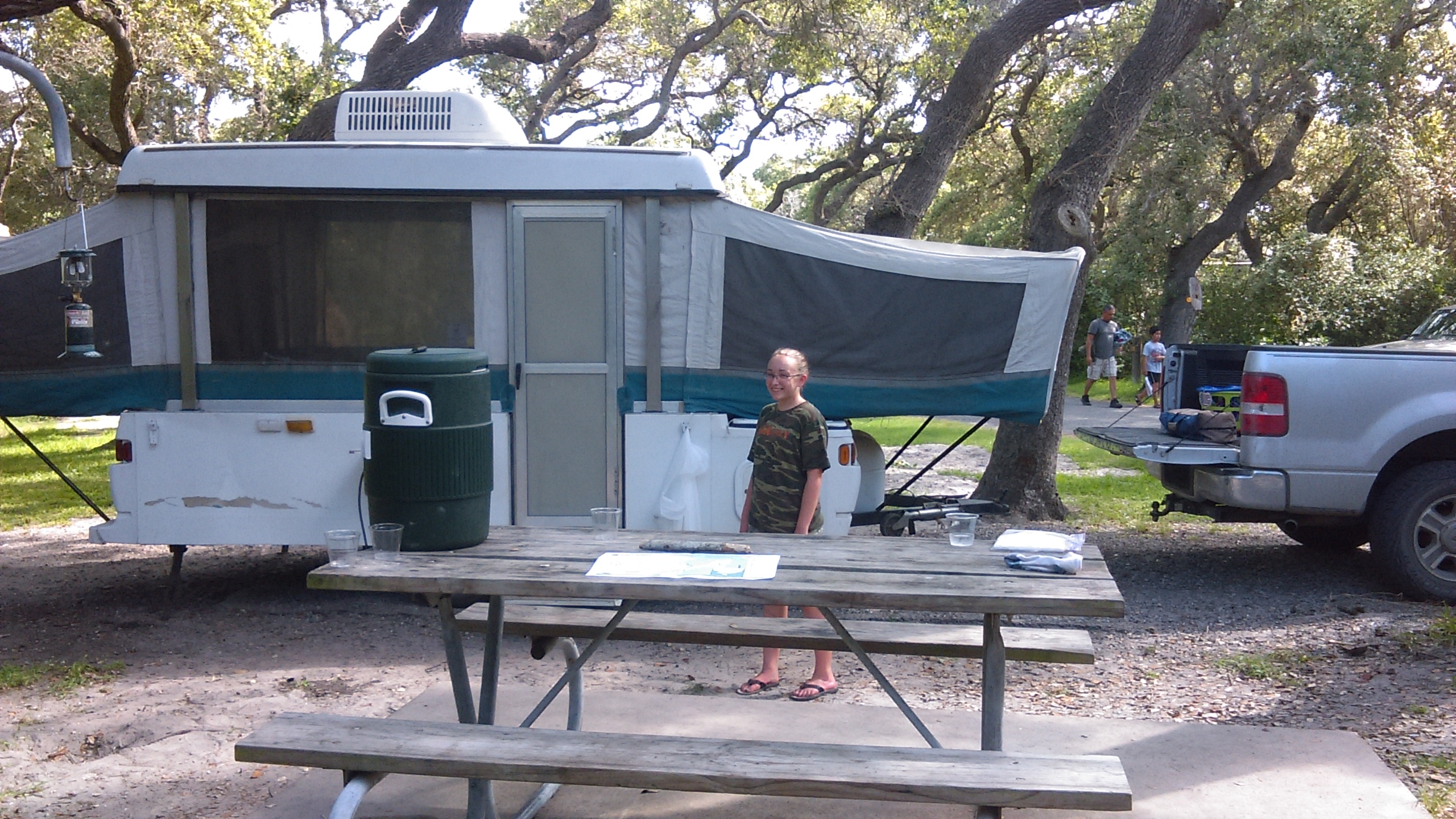
If you look closely, you can see my favorite part of the trailer… the air conditioner on top. It’s tough to keep up when it’s near 100 and humid, but the air conditioner managed to take the edge off and give us somewhere to seek relief from the oppressive heat.
Two days at the beach and we were sunburned enough to satisfy our vitamin D requirements for a while, but you won’t see pictures. I forgot to bring the waterproof camera, and I have a poor track-record with cell phones and salt water. You’ll just have to imagine Sydney, Isaac, and Michael playing in the bathwater-warm surf for hours on end while Liz and I enjoy doing nothing under a sun canopy. I think we’ll have to go back again when it’s not so awful hot. Maybe next time I’ll remember the waterproof camera.
-
Free Trailer
Last summer, Liz and I traveled back to the home country to spend time with our extended families. Among the things we did there was take a weekend trip camping in an offshoot of the Rocky Mountains with my brothers and their popup/tent trailers. Liz and I thought it might be fun and affordable enough for us to get one, and started looking around for a used one in our price-range. As luck would have it, not long after we returned home from vacation a friend told us they had one we could take for free.
Free is my favorite price. Unfortunately, free is almost never free. Besides, I don’t like feeling like I’m taking advantage of someone, so I offered to get an old (1947) tractor of theirs back up and running in exchange. I re-wired the electrical to switch it from 6v to 12v, added all the other stuff necessary to create a charging system including fabricating an alternator mount, replaced a rusted-through exhaust manifold, and fixed a leaking radiator. Quite a lot of work, but in the end, it was mostly labor (and kinda fun at that), so I still felt like I had come out ahead.
Fast-forward almost a year, and Liz decides we need to go on a couple of shorter trips this summer. One to the beach for a weekend, and one to somewhere up north about a day’s drive. Both require either paying for hotel rooms, KOA Kabins, or fixing the trailer and taking it with us. Being averse to spending lots of money on lodging when I have a partial solution waiting for me to deal with it, I finally got around to working on the trailer. As a side note, I have a hard deadline about 2 weeks from the time of this writing. When I committed to finishing the trailer, I expected about a day’s work in total.
I knew there was some water damage in the front cargo compartment, and the short door/step was coming apart. I figured on a half-day to repair that along with a half day to clean out the dust, dirt, and wasp-nests that had accumulated over the course of the last couple of years would do it. Because the whole thing smelled of dirt, and to get a better idea for what I was really getting into, I started by attempting to open the canopy and clean the inside. Problem… the crank that raises the roof was missing. The previous owners didn’t know where it was either. Good thing I have a pile of scrap, a grinder, and a cheap welder. Two hours and a failed prototype later and I had fabricated a reasonable replica that functioned perfectly. So much for just a half-day of work.
After opening the canopy, it became clear mice had decided to nest in there over one of the winters it was sitting and chewed several holes in the canopy and window screens. Opening the canopy further revealed stitching on one of the seams that had dry-rotted and come apart. My leather sewing kit would come in handy for that, even though hand-stitching several feet of heavy canvas didn’t sound like fun. Patching and stitching the canopy chewed up a trip to the outdoor megastore and about six hours. On to the door.
The door proved to be a much more difficult repair than I had figured. The manufacturer had opted to forgo screws and bolts in favor of aluminum pop-rivets in an effort to cut both weight and cost. I had to drill out and re-do over 50 of the little buggers just to get the door apart, not to mention the work involved in fixing the latch, straightening out the bent frame, reinforcing a couple areas, and getting it all back together. What was supposed to take an hour took more like ten.
That done, I moved on to the interior. A full day (12+hours) of scrubbing, sweeping, wiping, pressure-washing, canvas patching, and other general cleaning did wonders, but also revealed lots of additional things that needed attention. Every cabinet door and drawer was falling apart, so I pulled out some glue and my trusty brad-nailer. With their help and about three hours I had fixed the cabinetry. There was also some critical bracing that was missing in the benches/beds that a trip to the scrap wood pile in the garage and some rough carpentry took care of. The water pump in the sink was falling out of the hole because the particle board around the screws had disintegrated, but with a deadline looming, and no immediate need for that particular function, I opted to leave it for another time.
Now that all the “easy” stuff was done, it was time to tackle the water damage in the front cargo area. Originally, I thought I’d be able to get away with reinforcing the floor with some cheap OSB and replacing two panels on the sides, but after looking closer and pulling up the linoleum, it became clear I would have to completely disassemble, demolish, and re-build everything forward of where the forward bed pulled out. By the time I was done pulling off the plastic and aluminum body panels and tearing up rotten OSB and particle board, there was nothing left but the frame. The demolition alone took over three hours, another three hours to go to the hardware store and back, and another eight or so hours to re-build the cargo box and get the body panels back in place.
If you’re keeping track, that adds up to 44 hours so far, and I still have to hand-sew patches over about five or six holes in the screens, make sure the tires are road worthy, stitch up a couple holes in the upholstery, make sure the road-lights all work, and get it licensed. When it’s all said and done, I’m probably looking at something like another 8-10 hours for a grand-total of about 52 hours. Considering what I make when I’m being paid for my work, this free trailer is pretty expensive. Good thing I have more time than unallocated money (and I don’t even have much time). Assuming I can spend Monday on it, I should have it done in time for the first outing in a couple of weeks.
One bright-spot… the air conditioner works, and everywhere we have planned to stop has power at the campsites. Yes… I have fallen far from my backwoods days camping with only what you could carry, but this is Texas in July. I’ll accept the ribbing, and enjoy being able to sleep in something slightly cooler than a hot oven.
-
Through the looking glass
What’s wrong with DC? How is it that the array of government and our duly elected representatives can be so disconnected from the reality of the majority of American lives? After spending another several days in the national capitol region, I am reminded of at least one of the reasons. DC is nothing like the rest of America. It is a frighteningly distorted fairytale land, and I am convinced that anyone who spends much time there will eventually lose touch with the realities facing most of America.
The fact of the matter is that people are influenced by their environment in ways they are largely unconscious of. I have lived in enough places and worked in enough different environments that I have seen the impact local culture and environment have had on my personality, outlook, expectations, and perceptions. I have been perhaps fortunate that those experiences have been diverse and have constantly challenged biases and prejudices in ways that have forced me to adopt a more critical view of the messaging (overt and otherwise) that has been working to shape my opinion. What I see in DC is a self insulating and perpetuating micro-climate that is distinct from what life is like in the vast majority of America and inexorably shapes the perceptions of those who live there.
I recently saw a report claiming that Democrats in the District make up 75% of the population, unaffiliated 16%, and republicans 6%. Regardless of your political affiliation, you have to admit that DC is far from representative of the broader population. About the only places where political affiliations are this polarized are deep inner cities where the population has become addicted to government largess and a few extreme rural areas where a small pocket of right-wing conservatives are the only humans within an entire voting district. This severe polarization, however, is not even a significant part of why DC should have figured prominently in Lewis Carrol’s tales. Every time I have the misfortune of traveling there, I add experiences and anecdotes to my mental library chronicling the fantasy land that is DC.
My hotel receipt from my recent trip is a decent place to start. The room cost me $239.00/night at a discount rate from a nation-wide hotel chain. I can rent the same category of room almost anywhere else in the united states (other screwed-up megalopolises like LA and NY excepted) for around $120.00/night, and many places for around $90.00. There are no extra amenities to justify the extra cost, and in fact, the hotel was in need of a refresh compared to a similar property in the same chain I stayed at in Omaha recently (incidentally for $110/night). For the extra $119.00/night, I got the privilege of walking half a mile to a metro station in a humid 90 degrees, city lights shining through my less than blackout curtains, traffic, noise, limited cable channels, and slow Internet service.
This enhanced cost of living is not just for the transients. A friend purchased a home on the outskirts of the NCR almost ten years ago for over $600,000. For that price he got a three hour commute to a modest home on a postage-stamp of land tightly controlled by the HOA. Eight years later, I built my dream-home on 5+ acres for well under half that amount. In their mind, I am the crazy one.
This disparity seems lost on most who live in the NCR much above the poverty line. Those with a family seem to think it normal to spend ten thousand or more dollars on a mortgage or lease each month while parking their Mercedes, Jaguar, BMW, or Cadillac SUV in a rented stall that costs them nearly as much as my mortgage. The thought of not spending hundreds of dollars a month on each of the five or so extra-curricular activities for each of their 1.5 kids (if they have any) is heresy. And as for the thought of putting them in public school, well… that is for “other people’s kids.”
For those too young to start a family (under 40, or maybe 50), a home and kids is unthinkable. Extraordinarily expensive and crowded apartment high-rises are interspersed between large office buildings housing major defense contractors, consulting firms and think-tanks. Things as simple as a functioning kitchen are tough to find, and functionally unnecessary because most food is prepared in a restaurant, usually with some fancy name and/or pretentious decor. Life for this crowd revolves around work and play in search of “self actualization.”
Consider another take on the demographics. I see in the District a relatively small set of very distinct and disconnected populations, only a few of which are statistically significant outside of the national capitol region (NCR)… First, and most visibly, there are the government employees. These people depend on the government for their paycheck which is quite large and well protected when taken in context. This group has a vested interest in perpetuating and expanding the roles and responsibilities of the government and in expanding the benefits accrued to those who “serve.” In the NCR, these employees fall into two primary categories… The young and ambitious, and the old and powerful. The young and ambitious want to be old and powerful, so they spend their days coddling and reinforcing opinions of the old and powerful. The old and powerful spend their days doing “brain work” by loudly proclaiming the opinions that have been given them by one or more of the other power-broker classes (the young and ambitious or the rich and connected). They all live lifestyles that would be unrecognizable to almost anyone from the “flyover states.”
The daily uniform for men in this class consists of expensive suits or designer shirts and ties. Clothing that appears functional is a clear indicator that one is either a tourist or one of the various categories of servile underclasses. A man-purse is a mandatory accessory for the young variety as is a hairdo and general demeanor that is sufficiently androgynous to avoid offending people of any sexual persuasion. Women among the young and ambitious are generally skinny, pretty, wear skirts above the knee (often well above the knee), tight tops that expose substantial cleavage or otherwise draw attention to their frequently augmented breasts and are generally in their 20s or 30s. The old and powerful women are rarely seen, but are hardened, wear pant suits, and are either chauffeured in or occasionally drive expensive luxury cars. Middle-aged women seen in public are often tourists or under-class.
The most powerful class in DC though is not the collection of government employees. It is the rich and connected, many of whom are at the disposal of large corporations dependent on government largess, and the remainder largely paid by the rich and powerful to use their connections to develop and propagate legal justifications or politically correct explanations that obfuscate the true nature of government actions. Many of the latter are graduated from the old and powerful or pulled from the most ambitious and successful of the young who collected contacts and networks before switching to selling that information to the highest bidder.
The rich and connected are in a unique position. They have at their disposal and routinely exploit information that can be used for or against those who are in positions of power. They reward desired behavior with insights that, strangely enough, almost universally add to the personal wealth of the powerful or their close connections. They use their access to media to manipulate messages and agendas. Behavior that is disruptive is punished through leaks, disinformation campaigns, “spin,” ostracism, or other thuggish tactics. Even the perception of the potential for punishment, coupled with the rewards of compliance, is more than adequate in almost all cases to silence real debate and discussion. As a result of long years of participation, many of the old and powerful have also worked their way into the rich and influential category. This is the pinnacle of DC success, and the real reason behind many of the decisions made.
Unfortunately, simply shutting down discussion and debate is not an option because there must appear to be two sides to each debate. Representatives need to have materials for reelection campaigns. To satisfy this need, spurious topics with important sounding and politically hot undercurrents are brought to the forefront to occupy the media and distract constituents while the old and powerful collude with the rich and influential behind the scenes to line their pockets and solidify or deepen their personal influence and wealth.
A short walk down any of the major streets will highlight another oddity. Unlike other major cities that are built around one or more industries that have a requirement to produce something to survive, DC is founded squarely on the one and only organization that doesn’t need to produce tangible results, please shareholders in any real sense, and can “solve” its problems by giving itself more power, money, and influence. Because of this, corporations in the city do not produce tangible products for end consumers. Every major company with the resources to dedicate has an office in the NCR with the express intent of influencing governmental decisions in their favor so they can “bring home the bacon.” Street after street is filled with offices for corporations like Lockheed, Boeing, Textron, Bell Labs, Raytheon, CACI, SAIC, and on, and on, and on. Nowhere else in the world will you find such a concentration of ‘nonproductive’ employees.
This would make no business sense if the bureaucracy functioned in a fair and impartial manner. However, big corporations don’t get and stay big by doing things that didn’t make business sense. There is a form of unvoiced and notionally legal quid-pro-quo that keeps these offices gainfully employed. Money translates into access, and access shapes policy which drives spending – constituents be damned.
If I sound somewhat cynical of our government, I am. The miracle of it is that it works at all. Throughout history, representative governments have collapsed when they became seriously corrupt and focused on purchasing votes through government programs. Given the current state of things, I’m surprised we haven’t already gone over the edge. Perhaps there is just enough of truth and honesty in our public servants (or at least fear of an informed public) to keep things from completely going off of the rails. Then again, maybe we’re on the track and headed for the cliff with a full head of steam but just haven’t felt the rails fall out from under us yet.
-
The Modern Moral Compass
While our country remains untainted with the principles and manners which are now producing desolation in so many parts of the world; while she continues sincere, and incapable of insidious and impious policy, we shall have the strongest reason to rejoice in the local destination assigned us by Providence. But should the people of America once become capable of that deep simulation towards one another, and towards foreign nations, which assumes the language of justice and moderation while it is practising iniquity and extravagance, and displays in the most captivating manner the charming pictures of candor, frankness, and sincerity, while it is rioting in rapine and insolence, this country will be the most miserable habitation in the world; because we have no government armed with power capable of contending with human passions unbridled by morality and religion. Avarice, ambition, revenge, or gallantry, would break the strongest cords of our Constitution as a whale goes through a net. Our Constitution was made only for a moral and religious people. It is wholly inadequate to the government of any other.– John Adams, Address to the Officers of the Massachusetts MilitiaWhen John Adams gave this speech to the officers of the Massachusetts militia, the French revolution had already produced the “reign of terror” and victimized the French people for almost nine years. The atheistic fraternal principles upon which the revolution was based were a point of concern for then President Adams, and he had predicted its ultimate failure. In his view, a functioning democracy required a people bound by religiously founded principles and guided by an undeviating moral compass. I believe he understood that any government “by the people” would ultimately unravel if “the people” were unworthy of it. I doubt he could have foreseen our day, but I also doubt he would be surprised at what we have done to our government given the decrepit moral condition of society.
Some of the incessant hyperbolic and hyperventilating news coverage has given me pause to ponder the general state of our nation. Recently, a deranged bigot shot up a historically black church and ruthlessly murdered nine people attending a prayer meeting. As a result, we are supposed to believe this horrible action is an inevitable and exclusive outcome of historic anti-black racism and that banning flags, erasing history, and publicly castigating anyone who happens to disagree is the cure. We must spend hours and hours discussing at length the white-man’s shame and find every creepy looking picture of the perpetrator ever taken so it can be plastered on everyone’s screens in an effort to demonize him. Nobody seems interested in dealing with the fact that the mentally ill have always been with us, and that violence of this sort is rare, not new, and only preventable by deeply infringing on multiple fundamental liberties. As long as we are unwilling to arbitrarily and forcibly institutionalize anyone who shows signs of mental instability (never mind the very contentious discussion about what constitutes instability and who gets to decide), we must accept the risk that these types of events represent. Yet we don’t talk about the real issues, and we are unwilling to cope with the inevitability of risk.
With similar breathlessness, media outlets spread hate, hysteria, distrust, discontent, and sometimes outright disinformation when someone dies at the hands of law enforcement if the incident happens to support the narrative of powerful people. Meanwhile, we are unwilling to discuss the realities and risks that contribute to the distrust and dangerous tension that exists between police and their constituents. We aren’t allowed to ask why it is that police have shifted away from “community” policing, are armed better than most third-world armies, and escalate to lethal force when they feel threatened. We cannot question the conditions and undercurrents of society that have engendered a feeling of mutual dislike between police and the public they serve. We certainly can’t have an open and honest debate about why a police officer might feel more likely to be threatened by a young black male than any other demographic due to the foregone conclusion that this stems from Jim-Crow era racism. Any attempt to deviate from this party line is instantly dismissed and often results in a reprimand, marginalization, and/or mandatory white privilege training. Informed, frank, and open-minded discussion or debate has been completely replaced by volleys of shouting and thirty-second slogans hurled from one side of the debate to the other.
While talking heads with little real interest other than self-aggrandizement foment unrest and further violence, another string of victims (mostly minorities) and perpetrators (also mostly minorities) is constantly being produced without substantial news coverage. The mass outrage that should be appropriate given the large numbers of lives being destroyed by this politically inconvenient violence is silent or suppressed. This violence is ignored, not because of racism, but because it doesn’t support the narrative. Apparently it’s racist to want to talk about some of the most common perpetrators, victims and most importantly the causes of violence against and by minorities. Even more fundamentally than that, we as a people don’t seem interested in the root causes of violence writ-large – the combination of policy, history, economics, collusion, greed, real racism or other forms of prejudice, and cultural corruption that is corroding the very foundations of our society.
A look at the “privileged” classes doesn’t bring much more hope. My personal experience is ripe with young men of any race with little ambition, useless education, and a deep-rooted sense of entitlement. Rather than put on a pair of over-alls and pick up a shovel or crawl under a car, they squeeze themselves into clothing designed to make women look stupid and make men look like effeminate she-males. They spend their energy and time lost in virtual worlds incapable of providing any real rewards, and cringe at the thought of responsibility that comes with being a contributing adult member of society. Sex for them is simply a pass-time that provides selfish pleasures most often experienced through pornography, and real intimacy is forfeit to on-line or casual relationships. Marriage and family are arrangements of convenience, assuming they happen to find it convenient long enough to enter into that all-to-temporary social and tax-advantaged arrangement. Children, when even in the picture, are often an afterthought, selfish desire, accident, or inconvenient obligation. I see a generation largely adrift and sitting precariously under the sword of Damocles while they stoke a fire hot enough to singe the string that keeps it suspended.
As if watching an entire generation implode weren’t bad enough, we are asked and expected as a society to celebrate when a fading celebrity who is uncomfortable with the body God gave him undergoes extensive surgery to look like something he is not. What’s more, an apparently large and highly visible swath of society does celebrate. Pictures of this “transformation” are plastered all over public spaces and (s)he is heralded for inherent “bravery” while collecting large paychecks for sharing the journey with an eagerly voyeuristic public. We collectively seem to have accepted the narrative that gender is not a biological trait, but that it also must not be viewed as a choice – the vast majority oblivious to the internal inconsistency of this view. Parents and medical professionals now consider and initiate hormone therapy to delay or disrupt normal sexual development so the child can “decide” if it wants to be female or male.
We celebrate publicly when the Supreme Court overturns millennia of cultural wisdom and tradition to redefine the fundamental unit of society. The very fact that we feel a need for the state to sanction and subsidize relationships that are incapable of propagating society doesn’t seem odd. Instead, those who “cling” to traditional beliefs are castigated as “intolerant” and bigoted as opposed to the “enlightened” members of society who seem quite intolerant of dissenting opinions on the subject.
These examples are simply a small taste of the variety of stories, anecdotes, and current events that call into question the long-term viability of our culture as it currently stands. We are in a time and place where we are being taught and seem to believe that family relationships are optional and are for the fulfillment of individual “needs,” that children are a burden, that mothers who raise their own children instead of “contributing to society” by working outside the home are selfish, that self worth comes from external sources, that exercising judgment is the same as being judgmental, that terminating a viable pregnancy (killing an unborn child to use politically incorrect speech) is a desirable alternative to the inconvenience and responsibility of an unplanned pregnancy, that success and failure are the product and result of other people’s influence on our lives, that there is no primal role for personal responsibility and individual effort, that rapid and unrestrained personal gratification is the height of achievement, that life has little value, that work is an inconvenient necessity rather than a blessing, that humans are evil beings who are destroying the global environment, and that right and wrong are flexible concepts. If they believe in God, many have fashioned a God in their own mind who is the deified equivalent of a parent who refuses to tell their children no, introduces them to the joys of being high on methamphetamine, and takes their son to see a prostitute for his sixteenth birthday.
Our moral compass seems to have been degaussed, or worse yet, had its polarity reversed. The terms John Adams used to describe a dysfunctional and dangerous society “which assumes the language of justice and moderation while it is practising iniquity and extravagance, and displays in the most captivating manner the charming pictures of candor, frankness, and sincerity, while it is rioting in rapine and insolence,”
are fully applicable today. We, as a society that was originally based on classical liberal ideals and traditions cannot enjoy the benefits of a government built around those ideals if we abandon the very foundation on which that government was built. We will only get the government we deserve, and at present we don’t deserve much that is virtuous or praiseworthy.Because of our vanity and greed we have put ourselves in a position where we no longer have the right to complain about the onerous burdens placed on us by the societal masters. We have proven incapable of governing ourselves, and as such should not be surprised when a subset of ambitious and corrupt individuals take that task on themselves. Unfortunately, or perhaps fortunately, few seem to see through the tissue-paper thin veneer of self governance and liberty to understand the true nature of the ties that bind us. Our ignorance, insolence, and self-absorption have allowed avaricious men to gradually wrap thin flaxen cords around us for so long that we are now bound fast and subject to their whims and pleasures without realizing how it happened. In some cases we fail completely to understand that we are even bound.
Our government, once at least outwardly based on the concepts of individual liberty and god-given rights, is gone. It has become a nanny-state oligarchy where “citizens” are artfully manipulated and exploited by the powerful to extract wealth and power while a few elite (and not necessarily those who sit formally in judgment) decide which “rights” are fundamental and which are inconvenient.
Benjamin Franklin’s assessment of the outcome of the constitutional convention seems prescient when viewed through the lens of current events. When asked “What have we got, a republic or a monarchy?” Dr. Franklin reportedly replied “A republic if you can keep it.” It doesn’t appear we have been able to keep it.There does seem to be one silver lining to this cloudy picture though. Darwin at his best described adaptation of species through essentially a die-off of the unfit and preferential (or selective) breeding reinforcing positive genetic characteristics. Perhaps since the loafers and deadbeats don’t seem to be interested in peopling the earth, maybe they’ll breed themselves out of relevancy and a few more sane, rational, independent, and thoughtful people will fill the void with children brought up outside the nonsense of the main-stream. Who knows, maybe in a generation or two they’ll be able to look back on our time with the same disdain with which we ponder the inquisition or other shameful periods in history.