Blick ins spiegel – was siehst du da?
weis ganz nichts.
es sieht allgemein aus
und recht bekannt
aber kann nicht sagen das ich ihn kenne
was will er?
was ist er?
wer ist er?
ich glaubte, ich konnte es raus puzzeln
ich glaubte falsch.
General-interest stuff about our family
Blick ins spiegel – was siehst du da?
weis ganz nichts.
es sieht allgemein aus
und recht bekannt
aber kann nicht sagen das ich ihn kenne
was will er?
was ist er?
wer ist er?
ich glaubte, ich konnte es raus puzzeln
ich glaubte falsch.
I wish I knew how it came to be
That various bits and parts of me
Creak and grind incessantly
as if I were full ninety-three
I’ve spent most of the last few months working with a customer to define a project. They came to us knowing that the scope and requirements weren’t well defined, and asking for our expert opinion to help them simultaneously develop the experiment they wanted to carry out and the hardware to conduct it on. And, do all of this on a very short time-frame. We signed up to the challenge, believing they believed in us and that we would be successful in overcoming the current shortfalls.
As the last several months have dragged painfully on, we have made almost no progress; all while spending over 7 digits on engineering and other support. At every turn, the customer has asked us our engineering judgement and expert opinion, only to belittle our world-class experts and demand detailed analysis and exquisite proof to support our positions that are simply based on the expert judgement they requested. This, all while they were insisting that we needed to go fast… really fast.
In their hurry to go really fast, they have sabotaged any potential for progress by requiring that they be intimately involved in all processes. Their involvement has generally led to nothing but discontent and confusion. We have spent hours listening to lectures that did nothing to bring us closer to resolution. We’ve done this repeatedly, and at length. The end result is that we are months and months into the project with only marginal progress in defining what the project is.
Yesterday, the customer sent an angry email demanding to be included in all of the sub-group meetings we were having. We aren’t having sub-group meetings because we haven’t been able to get the customer to agree to what any given sub-group needs to be doing. All of those personnel are off supporting other projects with better defined objectives. The project lead responded by telling the customer that we couldn’t do sub-group meetings until we had agreed-to objectives for the sub-groups to meet, and that prior attempts to integrate their team hadn’t been helpful. In short, he told the unvarnished truth.
Today, our big-boss was contacted by their big-boss who demanded that the project lead be fired. The deputy to their big boss (and worst instigator of uncertainty and inefficiency) had been offended at the project lead’s email. Add this to the fact that we just lost our very capable lead Systems Engineer because he couldn’t take the BS any more, and we’re in a bad place. The two people with the most capability, who were most invested in the outcome, and who had the most potential for bringing it to a successful close are gone. When I’m the last one standing with any real idea for what the customer expects, we’re in deep shit. All because of a fragile ego who believes the only way to get performance is to micromanage high performers, and believes all contractors are worthless pieces of crap who don’t know enough to fight their way out of a paper bag.
I can’t help but wonder how long it will be before I end up without a job because one of my less filtered thoughts makes it out into the public. I doubt it’ll make it more than 2-digits worth of days.
A little while ago, I came across a picture on the internet that showed a garage where the door had been opened to reveal a wall of snow completely filling the opening, and a snow blower sitting in the garage. On the wall of snow there were three letters in spray paint — FML. Shorthand for the rather crude phrase, “Fu*k My Life.” At the time I chuckled. All of us have that thought from time to time, I expect. Most people don’t actually believe it.
Unfortunately, much of the time I think that thought and mean it. At the moment, I’ve just been through a one hour long complete meltdown because we threw away a couple of cardboard boxes. The performance included screaming at the top of his lungs, throwing stuff, banging heads on the wall, treating everyone like shit, and yelling at me and Liz. It was as if we were performing open heart surgery without anesthetic; like we had skinned his pet dog alive in front of him.
The only advantage to today’s meltdown was that it only kind of spilled over onto one of my other kids. Usually it results in high drama across the board. My family acts like they hate each other. Whether that’s true or not, they sure can’t stand being together for more than a few seconds. My family is a wreck. Looking at the way things are, how they are supposed to be, and how they are likely to be; I’m ready to say it with all seriousness. Again. Today. And most days.
It’s been a while since I’ve written anything outside of my day job. Life has been too busy and challenging to spend much time on anything other than getting from point A to point B. I expect I’ll write more on that later, when the terms of my probation/conditional release/whatever are actually expired and I am free to fully speak my mind. In the meantime, I’m saving a few thoughts for later.
As I write this, the world is deeply immersed in the mass-panic that is COVID-19. In the last week or so, politicians too scared to accept the risk of being caught doing nothing in the face of a crisis have done what politicians do, and reacted strongly. Unfortunately, that is almost never the best course of action to take. The strong reactions have included things like shutting down economic activity on a scale not seen in at least two generations. They have included measures to distance people from their neighbors who would otherwise be the natural people to identify and attempt to help those truly in need. They have included measures that have only deepened the irrational panic and despair that have gripped the general population. The people who have been elected to protect the interests of the general public have made decisions that unquestionably have done grave and (probably) lasting damage.
This behavior is not unique to politicians. It is a product of groupthink, fear, and intolerance. Headlines scream of apocalyptic outcomes, so people get fearful. In a panic to feel a modicum of control in this uncontrollable situation, they do stupid things like buy a year’s supply of toilet paper and trying to check out of the grocery store without using their hands. They worsen the panic as those on the fence see the herd moving that direction and feel like they must be wrong if they are being left behind. Those few free-thinkers who happen to have the fortitude to stand aside from the herd and walk a different path are forcibly rounded up and cajoled into compliance — not necessarily by physical force (yet), but by social constructs we’ve built and exercised through application of the “cancel culture” across a broad array of contentious and emotional issues.
We, as a society, don’t tolerate critical thinking. We don’t listen and evaluate in rational thought. We don’t tolerate those among us who do. We do, however, reward and reinforce those who overreact to sensational things — because they’re doing “something.” Because they say things like “if we only save one life, it’ll be worth it.” Because we don’t want to feel powerless. Because thinking and listening require us to admit we don’t know something and be willing to change our minds.
Death is inevitable. Saving one life at the expense of another isn’t a justifiable action unless the parties involved have consented to it. I doubt the brick mason who will lose everything in the coming months as the economy crumbles, drop into despair, and end his life would have willingly made that trade to extend the life of an elderly person with underlying health concerns who is already far along that path to the grave. While this is an uncomfortable thought, it is the truth. Saving one life comes with costs. And nobody (at least not those in control of the message) is considering those costs.
Families make those kinds of decisions all the time. As parents, grandparents, children, siblings, and spouses grapple with illness, they must evaluate the tradeoff between expensive treatments and the possible benefits and likelihood of success. Sometimes they decide to mortgage everything and proceed, other times they opt for hospice and to make the most out of the time left to them. We are capable of those kind of decisions. The policy makers dictating our current response are not. Nothing of what has been done has been done with anything close to sufficient logic, rational thought, or informed consent.
If I were wrong about all of this, there would be much more discussion about the relative impact of the various counter-virus measures put in place compared with the number and type of people who are predominantly affected by it. We would have an honest discussion about the fact that doing a trillion dollars of damage to our economy to prevent a million deaths would come out to $1,000,000 per death. We would further talk about the fact that there is almost no scenario where we end up with a million deaths, and that we have almost certainly already done a trillion dollars worth of damage to the economy. We would also talk about the fact that that $1,000,000 per death is taken from people who likely would not be directly affected or have an interest in the outcome. Unlike the cancer sufferer who is making a decision based on personal resources and desires, this decision has been made by those with the least to lose. They have decided to take money involuntarily from each of us, in the hopes of reducing the toll by some undefinable and arbitrary amount.
To make matters worse, the current discussion isn’t at all grounded in a sense of community and what the Germans call “Mitleid” (together suffering, roughly). If it were, we would also talk about how we accept tens of thousands of deaths annually from the flu and other related seasonal maladies without more than the occasional 30-second blip on the news encouraging people to get vaccinated. We would talk about the number of deaths due to preventable things like alcohol and drug abuse and the amounts we spend (or don’t spend) to stem that tide. We would talk about intergenerational poverty and the impact it has on families. We would talk about the failures of the prison system that leaves countless people unable to obtain the necessities of life in a legal manner. We would talk about a great many things with urgency. We don’t. We don’t talk. We occasionally yell at each other, but that isn’t talk; not really. Talking involves listening to understand and communicate.
This particular scenario is unique in that it is sensational, and is happening at a time when communication is near universal, ubiquitous, instantaneous, and rewards only the sensational at the expense of critical thought and dry and uncomfortable facts. When the sensation dies down, and we come to the realization that this virus is going to be an inconvenient reality in our lives for the indefinite future, we will relegate it to the unfortunately long list of inconveniences of modern life that we choose not to give any heed — but not before screwing up the lives and futures of hundreds of millions of people.
Driving drunk is dangerous. Writing or saying anything while angry sometimes rises to that same level.
I’ve spent the last three years trying to decide if it was worth it to be on Facebook or other social media platforms. There have been times it let me know about major life events for friends and family I wouldn’t have known about otherwise. It has allowed me to keep in touch with folks who would have otherwise been lost in the chaos that has been the last 20 years. However, it has also been the cause of waste and unhappiness.
A while ago, I wrote about a decision to cut way back on it (https://www.diligent5.org/?p=2069). As expected, I quickly fell victim to the features designed to keep people engaged. After further thought, I decided to fix that problem permenantly… I have deleted my account.
Will I miss seeing things from friends and family? Yes. But if you aren’t close enough to know how to reach me without facebook, I suppose life will go on independently for the both of us just fine. The bad far outweighs the good in my opinion. I’m sorry you fell victim to the purge.
Plans tend to be a fairly regular topic on this blog. They have been a major part of my life. However, I am once again left to wonder why I bother.
Previously, I wrote about an opportunity I had to apply to be the EE department head at the Air Force Academy, and how that would interfere with the plans I had made to go back to the life I had left behind in Texas. That opportunity didn’t pan out, and I was grateful for that. I interpreted it a reason to hope that my original plans would work out. I hoped that this surprise “opportunity” to deviate from my plans would be the last. I was wrong. I was wrong in a big way.
When I left the house on my way back to Albuquerque after spending two exhausting weeks fixing it after severe weather came through and damaged it, I had a crushing impression that I would never live there again. I was devastated — physically after the work, and emotionally after the loss. I hoped that impression was the work of a disturbed mind, and that it would pass and that we would be able to return as planned. That was over three years ago.
A few weeks ago, Liz and I made an unexpected decision. We decided to sell the house in Texas and return to Utah. In many ways, this makes no sense. I have a firm job offer there. I have a house there. I have friends there. Why would I leave it all behind. The reasons are varied, and difficult to articulate. It’s enough to say that we aren’t going back. My plans, yet again, have been overcome by events, and I’m staring at uncertainty.
To be fair, I’ll find work. I’ll find a house. I’ll find new friends. We’ve done this many times before (except for finding work), and I know we can do it, but I’m so tired of starting over. Why is it that the best way for me to make sure something doesn’t happen is to plan on it happening. Perhaps I should plan on a major financial collapse and civil war… maybe that way we’ll be prosperous and safe for the indeterminate future.
Update: the house is sold, and (even stranger) it looks like we will actually be going back to Texas – at least for a few months. After that, who knows… We plan on settling down in Utah, but how we get from here to there is unclear at the moment.
Almost 10 years ago I was in Florida with orders to move to Alaska the following summer. Excited at the prospect, I decided that one thing I wanted to do up there was hunt bear and moose, so naturally I went to the gun store looking for a rifle capable of taking that kind of game.
At the time, I wasn’t all that well versed in guns. I had lots of experience shooting with my family and with the military, but I had never spent the time to become particularly familiar with the ins and outs of hunting rifles. The only bolt-action gun I’d ever owned was over 100 years old and more of a museum piece than anything else. I had some vague ideas about different brands and models having good reputations but beyond that, I was clueless. I did know, however, that I wanted something bigger than a standard 308. I also knew that wood stocks could result in variability due to changes in temperature and humidity, and given that I intended to use it for hunting in Alaska, I wanted something impervious to weather — a composite stock was on my wish list.
Looking through the store’s inventory, I came across what I thought was a good deal that would fit my needs perfectly. It was a lightly used Winchester Model 70 chambered in 300 Winchester Short Magnum. I recognized the Model 70 as one of the guns I’d heard good things about, that was promising. To sweeten the deal, the rifle was on a “composite” stock and came with a scope. The whole package was around $450 out the door. I packaged it up in a cheap zipper case, bought a box of rather expensive bullets, and headed to the range to check out my new toy.
After the first shot I knew I was in trouble. It wasn’t even on the paper, and it kicked like a mule. One of the local range rats came over, and let me borrow his laser bore-sighter to get the thing on paper at least. Five rounds later, and I realized I had a bigger problem. At 50 yards, the grouping was over five inches (would be over 10 inches at 100 yards). Up to this point, I’d never found a rifle that couldn’t out-shoot me, so I asked someone else who was on the range to fire a grouping to make sure I wasn’t just being extra recoil sensitive. Their results looked like mine. It looked like I had actually found a rifle that was less capable than me.
After talking it over with a few folks at the range, their first recommendation was to point out that the scope and rings were very cheap and probably weren’t holding up against the heavy recoil. I grumbled, packed up, left the range, and ordered $400 worth of a scope and rings/mounts. My cheap gun had doubled in price before I had 10 rounds through it. With the new scope mounted and bore-sighted, I went back to the range expecting to see a 2-3 inch maximum grouping at 100 yards given that I routinely pulled off groupings almost that tight with open sights on the M16.
I was very disappointed. The groupings had tightened up by a factor of two, but were still about five inches at 100 yards. Had this been the $400 gun I’d started with, I would have probably been satisfied (at least for the time being), but now I was almost $900 into it, and it was performing like a $400 gun. Something had to be done. I did some homework to see what I could do. The barrel and muzzle crown looked good, but the “composite” stock was really just cheap plastic. Based on info I had available, it seemed likely that the stock was warping under the recoil and resulting in an unstable platform for the action and barrel.
I got online and ordered a good-quality carbon composite stock with the manufacturer’s assurance it would fit my rifle. It arrived and I realized that the barrel contour for the WSM chambering was much fatter near the action than a typical chambering, and that the stock would require extensive work to make it fit. To make things worse, I would need a new trigger guard and floor plate. After some searching I found a viable but unfinished (raw steel) trigger guard and figured I could just blue it. As for the stock, 80-grit sandpaper and lots of sanding would relieve the barrel contour. I’d be in business soon enough. Add these parts to the cost, and the rifle was now in the $1400 range.
By the time I had the stock fitted (mostly) and the trigger guard blued and mounted, it was time to move, so the rifle got packed up and moved north with all the rest of my stuff. Testing it out would have to wait. We drove north and I found other things to be busy with at work and home. The rifle sat and collected dust.
Moose season opened up, and I had found friends who would let me tag along with their hunting party since I had no idea what I was doing and needed help. To make sure I could at least hit a moose, I took the rifle to the range to see how much improvement I had made. $40 worth of ammunition later (about 10 rounds), and I had a four inch group at 100 yards. Slightly better, but not nearly what I had hoped. However, it was good enough for the moose I hoped to shoot, and I didn’t have time to do any more troubleshooting.
Several trips to the range over the next two years confirmed that I could only really expect about a four inch group, no matter what factory ammo I tried. Frustrated, I put the gun away and moved to Texas. There isn’t much call for a 300 WSM in Texas. The deer are the size of large dogs, and Pigs are better handled with something that’s quick, close, and has a heavy bullet like an AK-47 or a 300 BLK. Over the next four years I never once shot my 300 WSM.
Fast forward to the last year or so. New Mexico has some of the best Elk hunting in the world, and there are other species like Oryx that are notoriously tough animals that call for a long-range high-energy round. I had planned to put in for both Oryx and Elk, so I pulled the 300 WSM out of exile and decided to figure out how to make it shoot better. By this time, I had learned a lot more about guns and shooting for accuracy, and I took a more deliberate approach to figuring out what was going wrong.
Looking at the work I had done to fit the stock to the rifle, I realized that I hadn’t properly cut the barrel channel, and the stock was pressing on the barrel in several places. Most guns do best when the barrel is “free floated” — i.e. the stock doesn’t touch the barrel at all. The pressure on the barrel was changing depending on how I held the stock, how tight the screws were that held the action to the stock, what way the wind was blowing, etc… Change pressure on the barrel, and change where it points. I needed to work on the stock again.
Another thing I noticed was that the bluing on the trigger guard was rusting badly. I would need to do something about that if I wanted this gun to last and be worth half what I had put into it so far. Thankfully, I had recently had an excuse to experiment with CeraKote, and had some left over that matched the rest of the gun. I disassembled, sand-blasted, coated, and baked the guard. Thankfully, it turned out.
Since I was going to be working on the stock anyway, I decided to try my hand at glass-bedding. I relieved the barrel channel and went through all the prep-work to do a bedding job when I realized that the aluminum bedding block that was part of my fancy stock had been cut wrong. It’s supposed to provide rigid support between the action and the stock, but it was cut too short where the rear screw attached the trigger guard to the action. I ended up cutting and hand-filing a piece of aluminum to the right dimensions to fill the gap, then embedding it in the bedding compound to give a final rigid pillar for the rear screw. Other than that, the bedding job went better than I hoped, but I’m sure someone out there will find fault with it.
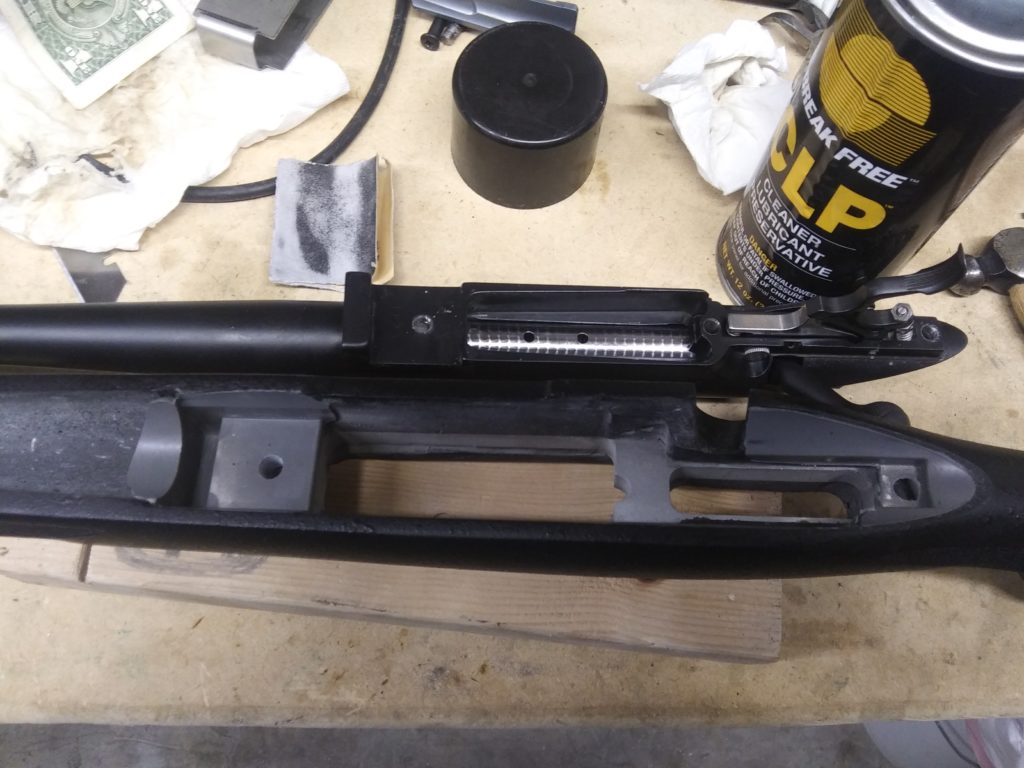
In the process of prepping for the bedding job, I got looking at the trigger. After borrowing a pull gauge from a friend, I confirmed something I had been suspicious of for a while. Even adjusted as far down as possible, the pull was heavy (often over 4lbs), gritty, and worst of all, inconsistent. Since I had the trigger apart for the bedding job, I decided to use some 1000-grit wet-dry sandpaper wrapped in a utility-knife blade (to provide a straight edge and prevent rounding) to polish the sear surfaces. That brought the pull weight down to a consistent and crisp 1.5lbs, which I adjusted back up to 2lbs for my own sanity.
In the time since Alaska, I had reacquired reloading equipment, and decided to take another variable out of the mix. I decided to buy the dies and bullets to develop a custom load for the rifle. Not only should that make things more accurate, but it also cuts the cost of shooting this thing substantially. Factory loads can run from $2 each to $6 each, but I can load them for about $0.75. I loaded up a series of loads, took my newly upgraded rifle to the range, and expected results.
I wasn’t completely disappointed. The first grouping came in at about one inch. Unfortunately, as I continued shooting, the groups opened up. Thinking through what I was doing, and paying close attention to fundamentals, I realized I was flinching pretty badly. With the ultralight stock and a hot load, the recoil is terrible. I’ve never been recoil sensitive before, but I am with this thing.
At this point, I’m probably about $1600 of direct costs into the gun, countless hours of messing with it, and another $500 or so in ammo, and I can’t shoot it accurately. A sane person would have sold it and bought a 308 or 6.5 creedmoor. Me… Time to throw more money at it I guess.
I like the 300WSM, just not the recoil. I can have a muzzle break installed and cut down on the recoil and help with the flinching. There goes another $200-ish. My $400 gun is anything but.
As I’ve looked at the various options, everyone has their subjective measurements for how much the reduction is, but those kind of stats bother me. I want to know how much it actually helps (it’s the geek in me). At this point, I’m mentally committed to putting a break on it, but I still want to know how much good it does. That’s where my nerd skills come in.
In my collection of project junk, I happened to have a 3-axis accelerometer and several microcontrollers that I can use for things like running sensors and recording data. I spent a weekend developing and optimizing a rig that will detect the recoil and measure the acceleration over the 100ms or so that it takes. Knowing the acceleration and the mass of the gun, I can compute the force applied to my shoulder and the overall impulse. Collect some data before the muzzle brake, collect some after, and I can quantify the improvement I get for my $200 — something I’ve not seen on any of the gunsmith’s web-pages yet.
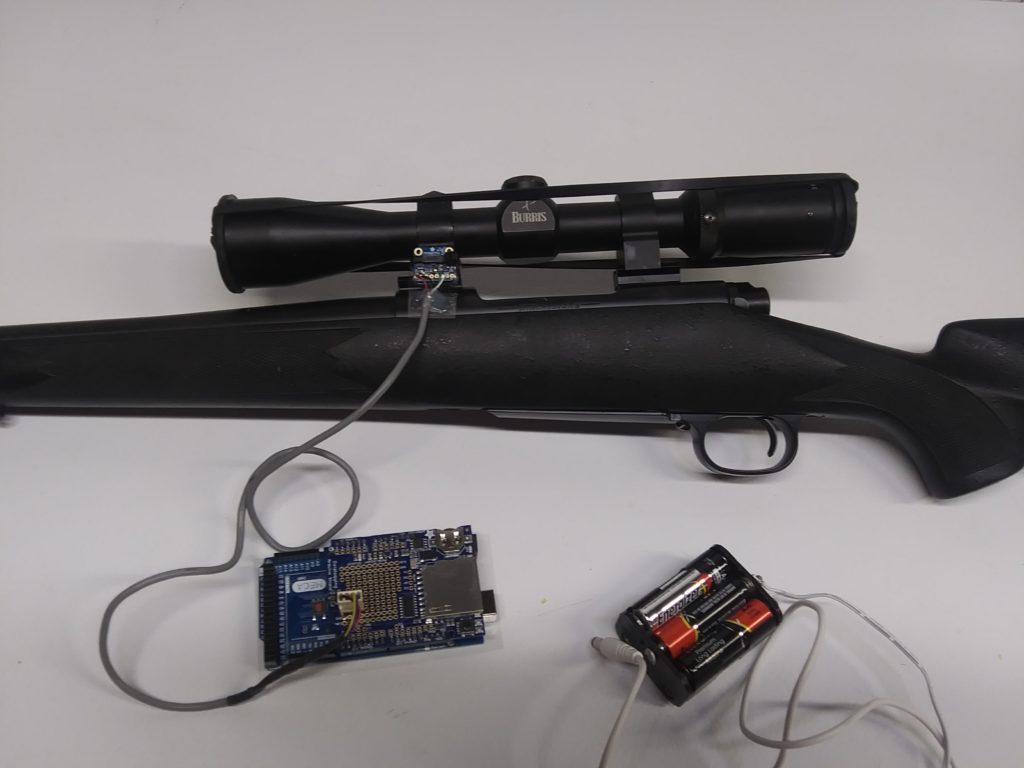
Based on published data from others who have done similar things, I expected the +-8g range on the sensor would be plenty, so I took this setup to the range to establish a non-muzzle brake baseline. About 25 rounds later (with a mix of tight groups and flyers) I came home to analyze the data.


I found two things in the data:
1. I flinch just under half the time, and it’s terribly obvious in the data when I do.
2. The 8g range is not enough. I need a sensor that can handle harder accelerations.
What next… Well, I have a new sensor on order. As soon as that gets here, I go to the range again. As soon as I get good baseline data and can cough up $200, on goes the muzzle brake, I’ll collect more data, can quantitatively compare the recoil, and (hopefully) finally have a gun that shoots like I want it to.
Kind of a long saga. I would have been so much better off financially had I spent $1000 on a better gun to start with, but then I wouldn’t have had so many challenging and interesting projects. Besides, there is something easier about spending a few hundred dollars at at time, even if it costs more over the long-run.
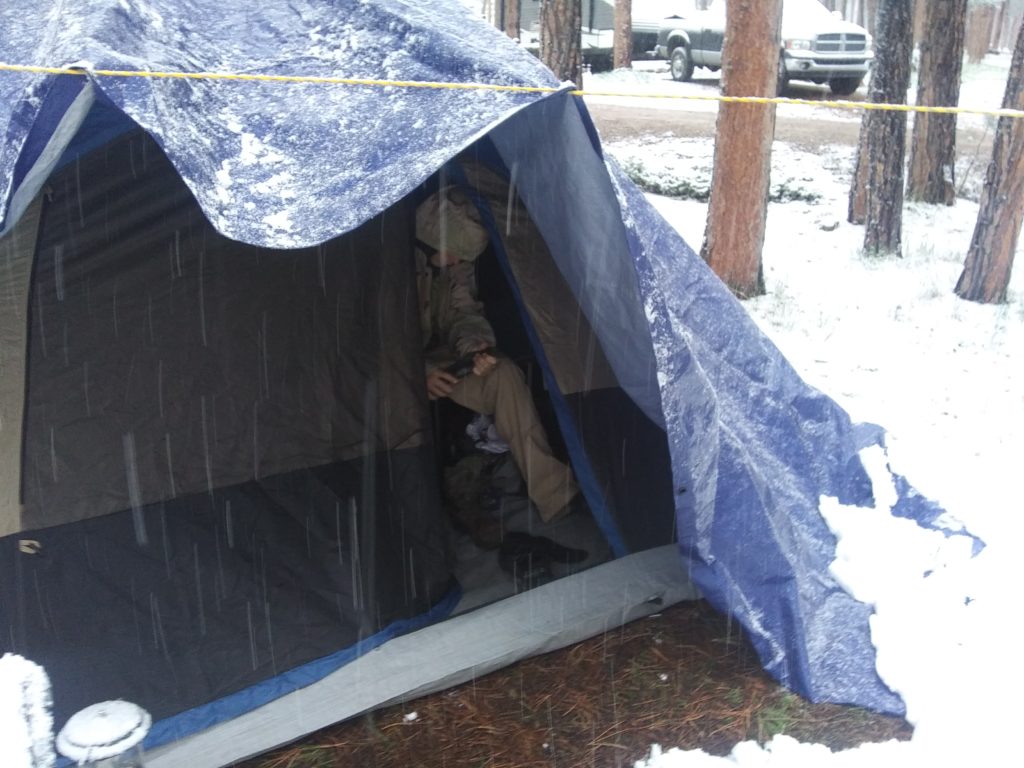
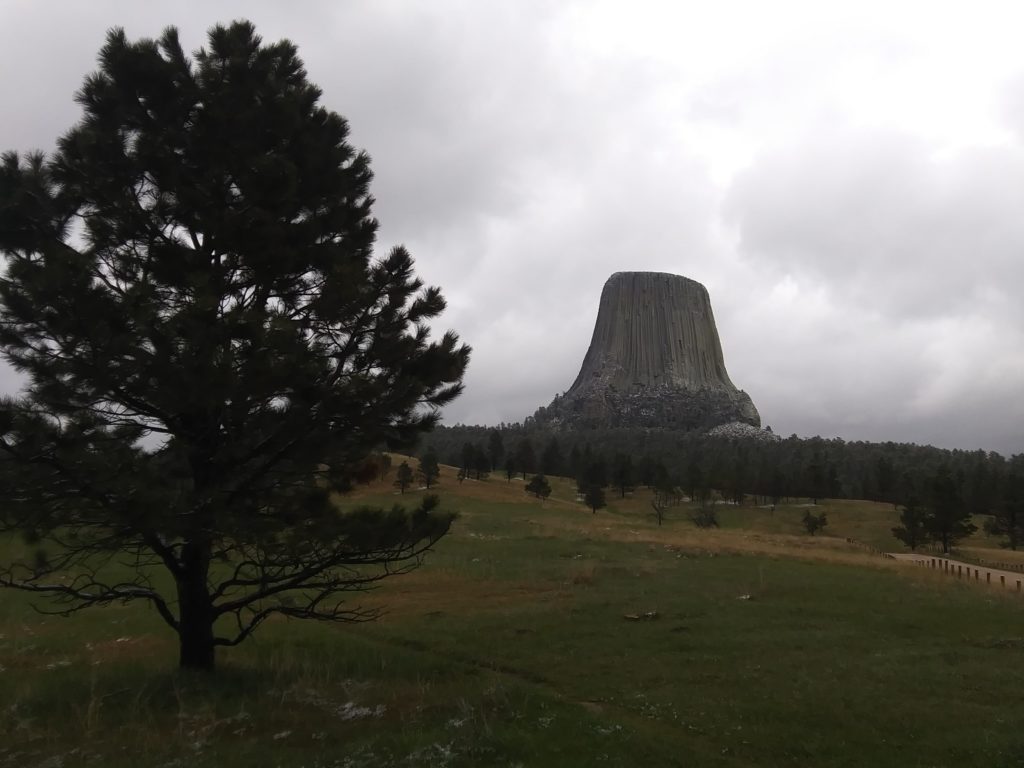
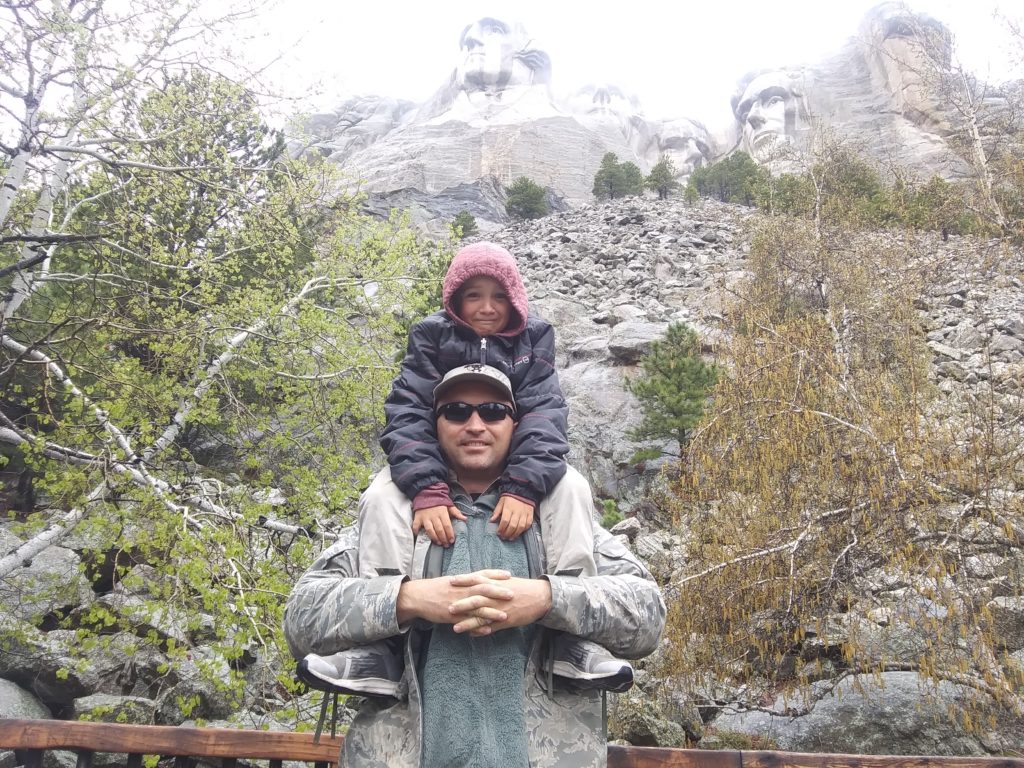
Circumstances conspired to the point that recently I discovered a need to drive to central Wyoming, then find a way to keep myself occupied for a few days before heading home. As you look at these pictures, keep in mind that they were taken in June — i.e. summer. Without much explanation, some pictures for your enjoyment.